‘It made me feel erased.’ NC victims outraged after assailants leave prison early
For 50 years, L.S. had tamped down the trauma of the morning she was walking through Duke University’s East Campus and a stranger threw her to the ground and threatened to kill her as he choked and raped her.
Months later, the then nursing student testified at her attacker’s 1972 trial, where a defense attorney asked why she hadn’t screamed louder or fought harder as 19-year-old David Felton had tightened his grip on her neck.
It all came flooding back this year after L.S. learned the Durham County District Attorney’s Office in November had vacated Felton’s 1972 rape conviction. L.S. found out after she received a letter from a nonprofit investigating Felton’s claim of innocence.
The letter said Felton had sought assistance regarding his conviction of assault with intent to commit rape.
“I thought, ‘well wait a minute, that’s not right,’ ” said L.S., who has moved out of the Durham area but had the same address and phone number for 35 years. (The News & Observer doesn’t generally name victims of sex crimes, but is using L.S.’s maiden name initials with her permission.)
With help from a state victim services employee and the executive director of the nonprofit North Carolina Center on Actual Innocence that had sent the letter, L.S. went on a fact-finding mission. She ended up filing a grievance against Assistant District Attorney Michael Wallace with the North Carolina State Bar.
Her concerns included Wallace not contacting or consulting her before the charge was vacated and not informing her when Felton was released.
L.S. also wrote in the grievance that Wallace tried to take advantage of her lack of knowledge by saying that the law forced the change instead of clearly explaining the role the prosecutor’s discretion plays in the process.
“I thought ‘How would that happen without my knowledge, or without any input from me, at all?’ ” she said.
“It made me feel erased,” she said. “It made me feel dismissed.”
The N&O found people in at least two other cases who said they weren’t notified before the DA’s Office consented to reducing convicted assailants’ sentences, letting them leave prison early.
▪ In February 2004, Vincent Holloway pleaded guilty to kidnapping, rape, sexual assault and robbery with a dangerous weapon.
Holloway was 17 when he forced an N.C. Central University student into her car at knifepoint in 2003, raped her in a muddy yard, and took her car, purse and ATM number, The N&O reported.
A reporter recently informed the former student that Holloway’s maximum sentence was reduced from 25 years to 10 years in December, and that he had been let out of prison on post-release supervision at the end of the month.
“It feels like I was raped by the Durham DA’s Office all over again,” the woman said.
Investigators told the woman that Holloway, whom she didn’t know, had watched and targeted her before the rape, she said.
“They released a man like that back onto the street not even letting me know,” she said.
▪ In 2013, Damari Harper pleaded guilty to second-degree murder and assault with a deadly weapons with intent to kill after he killed Zacchaeus Ormond, 20, and shot a woman in the hand in 2012 as they were walking home from a store.
Harper, who was 22, was sentenced to consecutive sentences that totaled up to 25 years.
Ormond’s siblings learned that Harper’s sentence had been reduced to a maximum of 10 years after they saw Harper’s family celebrating the reduction in Facebook posts.
Ormand’s mother, Julia Hope, said she was never contacted, even though a DA’s Office employee had promised to keep her informed.
“It hurts,” Hope said. “I don’t understand.”
After The N&O shared these stories, Durham County District Attorney Satana Deberry apologized and said her office is looking into how the lapses occurred.
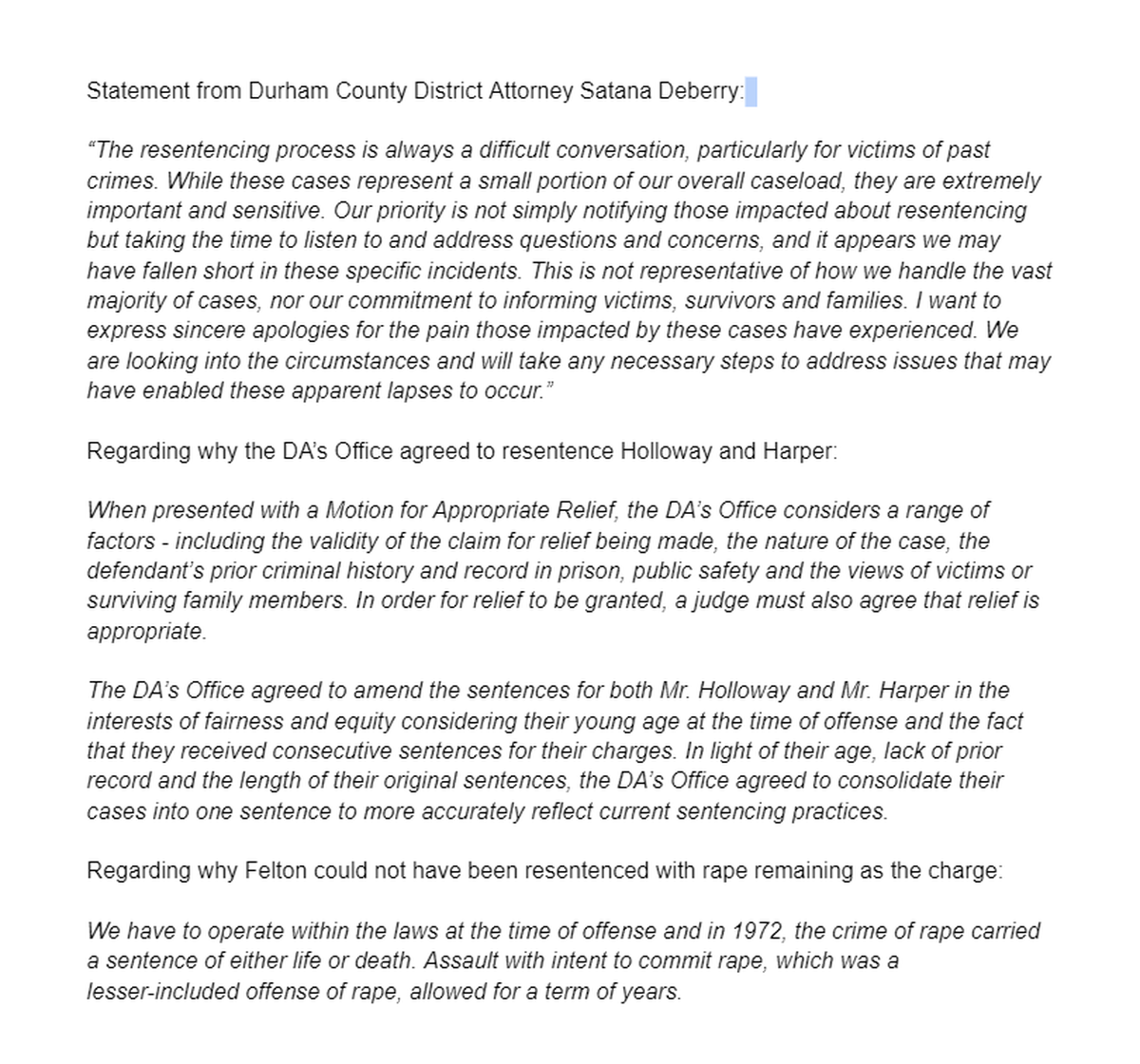
“This is not representative of how we handle the vast majority of cases, nor our commitment to informing victims, survivors and families,” Deberry said in a statement. “I want to express sincere apologies for the pain those impacted by these cases have experienced.”
The District Attorney’s Office responded to the N&O’s request to interview Wallace with two statements from Deberry, who is up for re-election in the May 17 primary.
The statements didn’t answer all the questions, including what steps the office takes to find victims, whether they track when victims can’t be reached and how often that occurs.
DA spokesperson Sarah Willets wrote in a text that the DA’s Office did try to contact Ormond’s family.
Attacker ‘is just out’ of prison
After L.S. received the letter from the Center on Actual Innocence she contacted the North Carolina Statewide Automated Victim Assistance and Notification system. A state employee found Felton had been released in November and wasn’t required to register as a sex offender.
“He is just out,” L.S. said.
The more she learned, the more the trauma L.S. had suppressed started spilling out. She stopped sleeping. Her heart wouldn’t stop racing.
It also made her worry for others.
“They could be in the same situation, and they didn’t even know it,” she said.
Difficult conversations about prior crime
The District Attorney’s Office doesn’t track the outcomes of motions for appropriate relief, the legal mechanism by which the three men’s convictions and sentences were changed.
After L.S. contacted The N&O, a reporter started reaching out to victims in cases in which a sentence change had been identified through tips and court data.
The first two victims who were contacted confirmed the DA’s office had not notified them before or after the change in their case and the assailant’s release from prison.
Conversations about resentencing are always difficult, Deberry said in her statement.
“Our priority is not simply notifying those impacted about resentencing but taking the time to listen to and address questions and concerns, and it appears we may have fallen short in these specific incidents,” she said.
Are victims ‘third-class citizens’?
Kit Gruelle, a North Carolina domestic abuse and sexual assault survivors advocate, said contacting victims enables them to protect themselves if they feel unsafe, and avoid being re-traumatized by seeing their assailant on social media or running into them in person .
The Durham cases are examples of some prosecutors treating victims as “third-class citizens,” said Gruelle, the program director for Second Bloom of Chatham, a nonprofit advocate organization.
“They are [treated as] insignificant to the process, and the process happened to their body,” Gruelle said. “I don’t know how anybody could come up with a valid excuse that we don’t need to include the victim in this arrangement that we are coming up with.”
Motions for appropriate relief
Motions for appropriate relief are typically made to correct errors in the judicial process such as proof that a key witness lied or that a defendant had ineffective counsel. The law allows a judge grant such motions if the prosecutor and defendant agree in what some call a consent motion, according to a UNC School of Government blog post on the motion.
In Durham, motions for appropriate relief have increased and been streamlined since Deberry unseated one-term DA Roger Echols in 2019.
Under Echols, defense attorneys outlined why a conviction should be vacated or a sentence shortened. Echols would leave it to the judge to decide whether there should be a hearing. Orange County follows a similar protocol.
Under Deberry, and with the three cases in which the victims weren’t contacted, some motions for appropriate relief moved forward after the assailants’ attorneys spoke with the District Attorney’s Office. In such cases, the motions and consent orders were granted in open court without a hearing.
State law allows that, but Echols said it’s better to explain an “extraordinary” change to a jury verdict or plea in a written motion, especially when the motions don’t always make the court calendars and the victims are not being notified.
When weighing motions, the Durham County DA’s Office considers factors like the validity of the claim, the defendant’s criminal history and prison record, public safety, and the views of victims and surviving family members, Deberry said in her statement.
“In order for relief to be granted, a judge must also agree that relief is appropriate,” she noted.
Durham Senior Resident Superior Court Judge Orlando Hudson has handled most if not all the consent motions for appropriate relief. Hudson didn’t return phone messages left by The N&O for this story.

Nia Wilson, a community organizer who asked Deberry to run for DA about four years ago, said there may be more that the DA’s Office needs to do for victims, but that doesn’t take away from the work she has done in trying to make a historically racist system more just.
Deberry ran on creating equity, and she is actually doing it, said Wilson, executive director of SpiritHouse, a nonprofit that promotes restorative justice and autonomy for Black communities. Her platform included focusing on violent crime, diverting low-level cases and ending school-based criminal referrals for juveniles.
“Some people aren’t going to agree with that because they just see criminals, and they don’t see people,” Wilson said.
Reason felony sentences changed
Harper and Holloway received consecutive sentences, meaning one sentence to follow another, for their convictions, Deberry’s statement said.
“In light of their age, lack of prior record and the length of their original sentences, the DA’s Office agreed to consolidate their cases into one sentence to more accurately reflect current sentencing practices,” Deberry’s statement said.
Harper didn’t have any previous felony convictions. While in prison he had five infractions. The most recent was substance possession in November 2021. Earlier this month he was convicted of two felonies and sentenced to probation for charges related to conspiracy to possess a controlled counterfeit substance in prison.
Holloway had been convicted of five misdemeanors, including larceny and breaking into vehicles the year before the 2003 rape. He had more than 120 prison infractions.
The woman Holloway raped said she remembers the judge saying he was sentencing him to a stacked sentence because he wanted him to serve the maximum term. She doesn’t understand what changed, especially considering all his infractions in prison.
In her statement, Deberry said that when Felton was sentenced for rape in 1972, state laws prescribed he be sentenced to life, which would require the state parole board to approve his release, or the death penalty.
The conviction was an obstacle to setting a specific number of years when he could get out, Deberry’s statement said, but the new charge after the motion for appropriate relief allowed them to establish a term of years.
Felton served about 50 years in prison, over twice what he would receive under current laws, Deberry’s statement said.
“Resentencing ensures fairness for individuals serving prison sentences that can be decades longer than a sentence they could receive for the same crime today,” the statement said.
Felton had unsuccessfully sought a motion for appropriate relief more than a dozen times before one was approved in the consent process in November.
Felton’s attorney Jason Yoder said he represented Felton for free because of the egregious injustice in his prison term.
North Carolina victims’ rights
Current and former prosecutors said it’s unclear how North Carolina victims rights laws, adopted in 1996 and expanded in 2019, apply to older cases and post-trial motions for appropriate relief. But it’s clear the intent of the law is for prosecutors to give victims reasonable notice and an opportunity to be heard in court and to confer with the prosecutor, they said.
Victims are also supposed to be notified by the state when their assailant is released from prison. The notification procedure depends “on the flow of information” from other institutions, said Department of Public Safety spokesperson Brad Deen. There are a number of reasons the department wouldn’t be included in the flow of information, he said.
Orange-Chatham District Attorney Jim Woodall said his office works hard to find all victims before a change in a case, especially in serious crimes.
“If you take all the victim’s rights legislation … the clear intent is to give victims notice of what is going on and seek their input,” he said.
Woodall uses an in-office investigator to find victims, he said, as well as another employee skilled at finding people.
“There are ways now, especially with computers and the internet, to locate most people,” he said. “It does take a little bit of effort.”
1972 rape on Duke’s East Campus
L.S. was 18 when she was a Duke University nursing student working the night shift at a nursing home near campus.
As she walked through East Campus on the summer morning, she passed a man who said hello and then attacked her, she said.
“The choking, as I remember it, that started right away,” she said.
He told her he had nothing to lose because he had just tried to rape another woman who would tell on him, according to L.S. and court documents. As Felton’s gripped L.S.’s neck, she thought she was going to die, she said.
Two security guards patrolling the campus discovered Felton, who was on probation for assault, on top of L.S.
Court documents indicate that before Felton attacked L.S. he had broken into another woman’s house and tried to rape her. It appears the more serious charges in that case were dismissed after Felton’s rape conviction.
Concerns about transparency
L.S. eventually connected with Assistant District Attorney Wallace and discussed the case over a video conference.
Wallace told L.S. that he had tried to contact her. She asked how the parole board and the Center on Actual Innocence was able to find her at the address she had lived at for 35 years, but he was not. He told her he didn’t have access to the same resources, she said.
Wallace told her that the change to Felton’s sentence was based “on statutory changes in 1994 of the rape sentencing guidelines,” L.S. wrote in her grievance.
L.S. walked away from the conversation believing those changes had forced the DA’s Office to vacate the rape conviction. But as she talked to others she learned that the law wasn’t retroactive and that that she should have been easily found using standard legal search engines, she wrote in the grievance.
She also asked why Felton didn’t have to register as a sex offender.
Wallace responded in an email that North Carolina Sheriff’s Association information indicates Felton should be placed on the registry, and Wallace planned to reach out to the judge and defense attorney.
Two days later he sent her an email saying Felton’s case was “officially closed,” according to the emails which L.S. shared with The News & Observer.
“We no longer have jurisdiction over him,” he wrote. “After having spent 50 years in prison, the end result, while it does not satisfy all of your concerns, it is a fair and just conclusion within our legal system.”
L.S. followed up with four emails asking why the charge had to be vacated and more about the sentencing laws on Jan. 31, Feb. 1, Feb. 4 and Feb. 16.
Wallace responded on Feb. 18 and said North Carolina law gives prosecutors wide latitude in charging decisions.
“I hope you can understand, which I am sure it may difficult, but the reduction in the sentence for life to 50 years closed this case,” he wrote. “I wish I could give you a better explanation but there is nothing I can do now that the case has been closed.”
NC State Bar grievance
L.S. filed a grievance against Wallace with the North Carolina State Bar.
Grievances aren’t made public unless the committee decides to send it to the Disciplinary Hearing Commission. The process can take weeks or months, the website states.
Wallace hasn’t been notified by the State Bar about the complaint, Deberry wrote in a statement. The State Bar acknowledged receipt of the complaint at the end of February, but hasn’t indicated the case is closed, L.S. said.
L.S. understands somewhat why they changed his sentence, but said the way the DA’s Office has handled it has been hurtful.
“I am a victim and a survivor. I was attacked. I was raped. I was choked,” she wrote in her grievance. “None of that has changed.”
This story was originally published May 4, 2022 at 12:00 AM with the headline "‘It made me feel erased.’ NC victims outraged after assailants leave prison early."