
190 people were shot in Durham in 2019. How the police chief says violence has changed
At 8:30 a.m. one day in early December, a half-hour before district court opened, more than 130 defendants were scheduled for courtroom 4D.
They included two rival gang members, part of the same gang but different sects: One was suspected of killing the other’s brother, though he had not been charged in the death.
Nothing happened in the courtroom beyond an exchange of words. But as tension spilled into the streets, a gun battle broke out, sending people running for cover.
It was the second shooting outside the courthouse in 2019.
The next day, someone opened fire in the Oxford Manor public housing neighborhood and then days later outside a tobacco shop on South Roxboro Street.
All three shootings involved people who were on the Dec. 3 court docket. And they repeated a pattern in Durham of a small group of people committing crimes over and over, Police Chief C.J. Davis said in a recent interview with The News & Observer and The Herald-Sun.
“I think it is representative of the emboldened kind of attitude that some people have, or wanting to demonstrate that they don’t care where they are, they are going to have their fight,” Davis said.
“That is where my request for additional visibility comes into play,” she said, referring to her budget request for more officers last spring. “It is not all about calls for service. It is about understanding that we can be a crime-rich environment when we don’t implement proactive things to stop that.”
Initially, Davis proposed adding 72 officers to the roughly 550-officer force over three years, saying she wanted to reduce overtime and reduce shifts from 12 to 10 hours.
City Manager Tom Bonfield brought a request for 18 officers to the City Council, which it rejected 4-3, with Mayor Pro Tem Jillian Johnson and council members Charlie Reese, Javiera Caballero and Vernetta Alston voting no. Council members Mark-Anthony Middleton and DeDreana Freeman supported the chief’s request. Mayor Steve Schewel offered a compromise of nine officers, which the council also rejected 4-3.
The debate continued during last fall’s City Council election campaign — won by Johnson, Reece and Caballero, who ran on a shared platform. The incumbents said they supporting violence prevention programs and other community efforts “separate and apart from law enforcement” would be more effective than adding officers. None returned phone calls for this story.
But courthouse shootings and budget battles are not the only issues fueling the debate over the city’s response to violent crime.
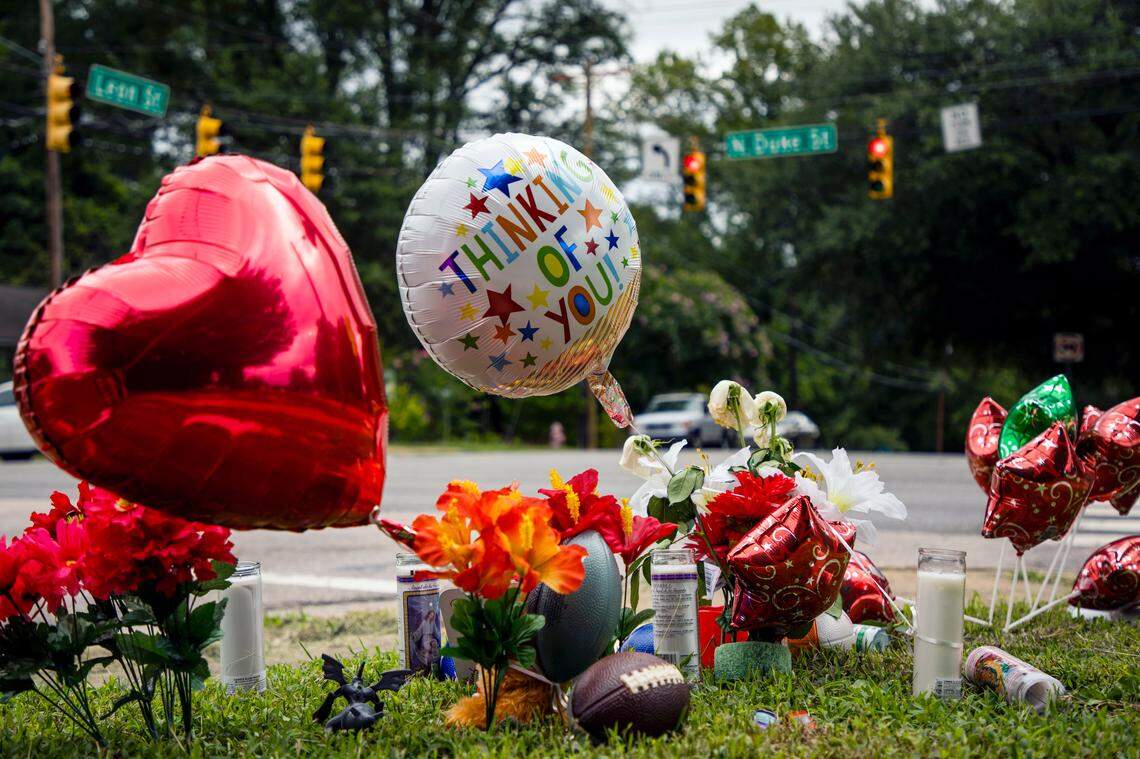
For many the death of Z’Yon Person underscored what is at stake if Durham cannot control violent crime. The 9-year-old was fatally shot in the head Aug. 18 after someone in a passing car fired into his aunt’s SUV as she drove him, his sister and three cousins to get snow cones in northern Durham. Another boy in the car was shot in the arm.
While shootings intensified the election-year debate, they didn’t appear to result in significant immediate changes in how police fight violent crime. Davis temporarily moved officers to the gang unit, and the Sheriff’s Office pledged to work more closely with the city.
Hundreds of shootings, dozens of killings
The N&O has reported Durham’s annual homicides for years, but in 2017 started to look more closely at the total number of reported shootings in the city and their impact.
In 2019 there were 652 shooting incidents reported to police; 190 people were injured, including 32 who died.
All told, from gunfire and other causes, a total of 42 people were killed in Durham last year, 37 of those cases criminal homicides.
None of those numbers were records. In 2017 Durham had 729 reported shootings; in 2018 it had 619. Homicides peaked in 2016 at 42.
Longer term, Durham’s violent-crime rate actually dropped 25% from 2000 to 2013 — as City Council members who rejected more police pointed out — before rising again in 2014 through 2017. The changes mirrored national trends.
Police are concerned about all shootings, which are considered aggravated assaults, Davis said. “Anytime you look at aggravated assaults,” she said, “you are thinking in your head that could have been a homicide.”
All told, 638 people were shot in Durham since 2017 in 2,000 reported shooting incidents, according to police. The number includes those killed.
But even shootings in which no one is physically injured harm neighborhoods, haunting children with bullet holes in bedroom walls and windows.
“They don’t just impact the individuals that are shooting at each other,” Davis said. “ They impact everybody in the surrounding areas.”
Southern High senior: Growing up fast
Growing up in a violent city forces teens to grow up faster, said Jamae Blank, one of a group of Southern High football players who started holding “Guns Down, Lives Up” rallies at their school last year.
“We can’t go outside and shoot hoops like we used to, or ride the bike around the neighborhood like we used to because crime is everywhere,” the 18-year-old senior said.
Of 11 seniors on the team who spoke with an N&O reporter, nine said they knew someone who had been shot and or killed. Some knew more than one.
Blank’s mother asks him to text fer when he gets to each destination.
“It’s not really fear. It’s just caution,” he said. “Bullets don’t have a name. So you can literally be driving down the street and get shot for no reason.”
.jpg "IMG_1749 (1).jpg")
330 gang members arrested 620 times
The city’s gang dynamic has changed. Fights used to break out over turf, Davis said, but today violence is driven by personal disputes between individuals who might be in the same gang.
“It doesn’t have to be that you are in my neighborhood and I am going to get you here,” the chief said. “You could be at the mall and I see you and I got a problem with you, and we have it out right there.”
Gang members are also sharing information, including court dates, over social media, sheriff’s officials said. Social media posts, videos and comments fuel the fire.
As of Dec. 10, the city has 2,060 validated gang members, said Jason Schiess, a Durham Police Department analyst.
As of the end of November, 330 of them had been arrested 620 times since Jan. 1. They faced 1,229 total charges, including 425 felonies and 760 misdemeanors.
In response to recent shootings, Davis added two officers to the gang unit. It now has 13 positions, including three that are unfilled.
Arrests in 1 out of 10 shootings
Philip J. Cook, a professor in Duke University’s Sanford School of Public Policy, led a study on Durham shootings in 2015 and found while police made arrests in half the homicides, they made arrests in only 10% of the nonfatal shootings
Cook, who was awarded the 2020 Stockholm Prize in Criminology for research on gun violence and effects on society, argued for putting more resources into investigating those cases at the December meeting of Durham’s Gang Reduction Steering Committee.
Arresting shooters interrupts the cycle of violence by taking them off the street, deters future crimes, and improves community relations, Cook argued. Residents also see police taking action against those wreaking havoc in their neighborhood, he said.
Research in Boston showed both shootings and homicides started out with a roughly 10% arrest rate after two days, Cook said. While homicide arrests continued, non-fatal shooting arrests stopped as officers moved onto the next incident.
Beyond increasing investigators for nonfatal shootings, Cook also sees opportunities to enhance police efficiency through training, selection of investigators, case management and technical assistance.
Community engagement
When Davis was hired in 2016, people told her that she had her work cut out for her.
But Davis said she had a different perspective.
“Durham is not that big, and the (number of) individuals committing crime is not that many,” she said. “It’s just a matter of getting the resources to get our arms wrapped around it and to put a maintenance plan in place.”
“If people think they can come to Durham and commit these kind of crimes, and it is wide open, it will continue to happen,” she said.
In addition to having more people to do investigations, Davis wants more officers visible in the community to deter and respond to crime when it occurs.
After the Dec. 3, courthouse shooting, the Police Department’s Community Engagement Unit played a key part in responding to the next afternoon’s shooting in which gunfire struck three apartments at Oxford Manor public housing community on Wiggins Street.
In 2017, the unit started patrolling and organizing food drives and youth trips there and in the McDougald Terrace public housing neighborhood. By building relationships, officers are getting more information on those committing the most dangerous crimes in the city, Davis said.
In this case, a community engagement officer heard the shooting and responded quickly. Officers tried to stop a stolen vehicle, whose driver fled until the car hit a rock in a yard on Woodgreen Drive.
Four people in the car fled, but three were found hiding in a shed and backyard two streets away, according to court documents.
Officers recovered three handguns in the foot chase, including one reported stolen in Raleigh in October and a second reported stolen in Durham in May.
Two adults and one juvenile were charged.
In this case, police made arrests quickly. People don’t understand that investigating some aggravated assaults can takes weeks, Davis said.
“It’s really just connecting all the dots,” she said. “And when you have so many aggravated assaults, it is hard to put a person on each one of those cases.”
Davis is still working on her 2020-21 budget request, but said she is always going to advocate using her expertise and best practices.
She is also going to ask for answers from the City Council.
“When crimes occur, we are trying to be proactive,” she said. “If us not applying the strategic initiatives that I have for this department, if that is not the answer, then I need to know what the answer is because the citizens deserve to know what the answer is.”
“I am waiting for that. I haven’t seen it yet.”
This story was originally published January 13, 2020 at 5:58 AM with the headline "190 people were shot in Durham in 2019. How the police chief says violence has changed."
