Can Chapel Hill answer worries about ‘Missing Middle’ housing with revised plan?
The story was updated April 8, 2023, to note that NEXT Chapel Hill Carrboro also has a nonprofit public advocacy group.
Chapel Hill’s Town Council could discuss in more detail Monday a plan to increase the variety of housing that could be built in existing single-family and multifamily neighborhoods.
The plan has changed from the version that earlier this year sparked a public outcry and thousands of emails to the mayor and council against changing single-family zoning rules and allowing apartments in existing neighborhoods.
Town planning staff will present the revised plan at a council work session Monday.
The council does not vote at work sessions, which are an opportunity for members to talk, and will not take public comments Monday. The meeting will be taped for viewing later on the town’s website, Mayor Pam Hemminger said in a news release Thursday.
The initial changes would have allowed several types of housing in a variety of neighborhoods, including those zoned for single-family homes.
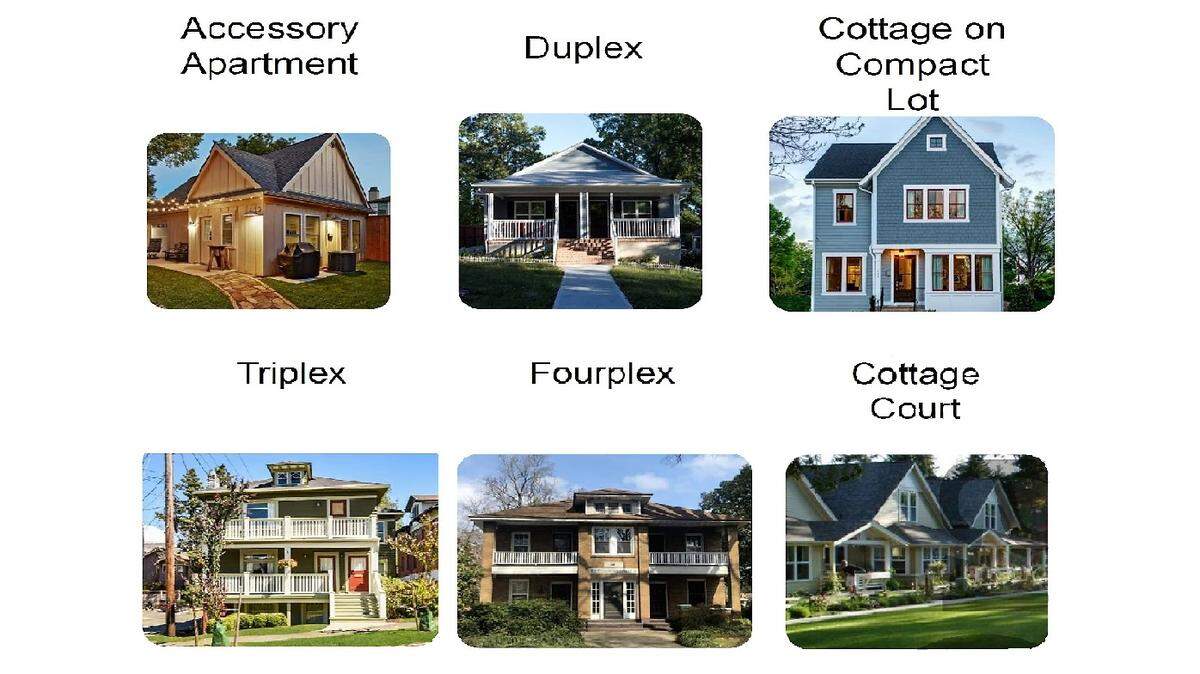
The revised plan would only allow duplexes, accessory apartments and cottages on smaller, more compact lots in single-family neighborhoods. All other types — triplexes, fourplexes, cottage courts and townhouses — would be limited to areas that already allow multifamily housing. Details include:
▪ Accessory apartments: Would be allowed in residential districts, plus land zoned for cultural, religious or institutional facilities. Examples include garage apartments, as well as a second, smaller home on the same property.
▪ Duplexes: Would be allowed in residential districts served by public utilities
▪ Triplexes and fourplexes (quads): Would require staff approval in districts that already allow multifamily buildings with three to seven units.
▪ Townhomes: Allowed in multifamily zoning districts
▪ Cottages on compact lots: Allowed in most residential districts, except for rural neighborhoods
▪ Cottage courts: Would require Planning Commission approval for cottage court projects — multiple small homes clustered on a lot — in multifamily districts
▪ Multifamily districts: Zoning districts that already allow apartments and other multifamily housing types would be updated to clarify that 5 to 10 units would be allowed with staff approval or over 10 units with a conditional zoning permit from the council
Builders also would have to meet specific limits for each housing type based on lot size, floor area, stormwater, parking, tree canopy and, in some cases, compatibility with homes within 150 feet of the lot.
HOAs, conservation district rules
The proposed policy would not change land-use rules in areas covered by one of the town’s Neighborhood Conservation Districts or that have a homeowner’s association, which are subject to state law and have more expansive powers over the character and appearance of a neighborhood.
Heated conversations, opposing groups
The town’s Housing Choices for a Complete Community initiative started in 2021. The town hired The Keesmaat Group, a Canadian consulting team, to lead the process, starting with talks among community members and stakeholders, such as UNC.
The resulting plan to create more “missing middle housing” has supporters but also has stirred fears that developers would replace single-family homes with apartments, student renters and potential nuisance issues, like more noise and parking, plus higher property taxes.
The conversation online and in meetings has become personal and hostile at times, driven in part by competing grassroots groups, the Chapel Hill Alliance for a Livable Town, or CHALT, and Triangle Blog Blog, a news and opinion website that formed a nonprofit this year.
CHALT members manage the Chapel Hill Leadership PAC, which successfully backed Hemminger and multiple council members elected since 2015, and an online newspaper, The Local Reporter. They have opposed changes in the town’s zoning to allow more housing types in neighborhoods.
TBB writers, who have pushed for the zoning changes, include members of NEXT Chapel Hill Carrboro, a nonprofit formed in opposition to CHALT and to support more dense, walkable and bikeable development. NEXT has a nonprofit public advocacy arm, the NEXT Chapel Hill-Carrboro Action Fund.
Housing advocates, housing boards and nonprofit groups have formed another group pushing for more housing to serve lower-income workers and families.
Missing middle, affordable housing
Missing middle housing doesn’t necessarily create affordable housing, experts say.
The cost of a home or rent may still be expensive in desirable neighborhoods, but building a duplex or multiple condos on a lot instead of one home means more people pay the land costs, and smaller homes can be built more affordably.
Having more homes to meet the demand could drive down pressure on home prices in the long run, reducing the cost of older or smaller housing stock.
Town staff said about 70% of the town is zoned for single-family homes, leading to inefficient land use and higher housing costs. They noted that about 46,330 people commute into town for work, and only about 30% of Chapel Hill residents work in town.
Recently collected racial equity data showed about 58% of the town’s renters and 19% of the homeowners — many lower-income and Black — are cost burdened, paying more than 30% of their income for housing.
The town needs about 3,280 housing units to serve those earning less than 60% of the area median income — $40,100 a year for an individual or $51,600 for a family of three, they said. UNC student households only make up about a third of the need.
U.S. Census estimates showed the town only added, in total, a couple of hundred housing units between 2010 and 2021. Several thousand more — mostly apartments — are being built, are approved or are in the development pipeline.
A 2021 report recommended the town increase its housing production by 35% over the next 20 years, adding about 485 homes a year, only 10% of which should serve UNC students.
What’s next
Monday’s meeting at the Chapel Hill Library may attract a crowd, Hemminger said, and the fire marshal is trying to accommodate as many people as possible. The meeting will be taped for later viewing online.
The council will schedule more public hearings in the future. Comments and questions also can be emailed to mayorandcouncil@townofchapelhill.org or planning@townofchapelhill.org.
A new survey will be posted following the meeting at townofchapelhill.org/housingchoices.
Find more information about Monday’s meeting and an agenda online.
This story was originally published April 7, 2023 at 10:07 AM with the headline "Can Chapel Hill answer worries about ‘Missing Middle’ housing with revised plan?."