
‘What happened to the $167M?’ Durham wants Light Rail transparency before Commuter Rail.
City, county and regional transportation leaders gave the Durham City Council an update on the planned Triangle Commuter Rail project Thursday.
But as planning moves forward to connect the region’s largest cities with Research Triangle Park, the mayor and council members first want to know what happened to the millions of dollars invested in the failed Durham-Orange Light Rail Transit Project.
“What happened to the $167 million in light rail?” asked Mayor Elaine O’Neal, who compared the failed project to the nation’s broken promise of “40 acres and a mule” to Black people at the end of the Civil War.
“Transportation for African Americans is a particularly thorny issue, “ she said.
“Throughout our history, our plight has been the slaves and [their] descendants to this day have never ever realized the promises of stability in housing and transportation,” O’Neal explained. “And we continue to see that evolve even now as we watch a number of brown and Black people being displaced in the housing arena and now with transportation.
“And what has generally happened is when those shifts occur, Black people have usually been the labor force and others have benefited,” she said.
In 2011, Durham and Orange counties began collecting half-cent sales taxes to help pay for the planned 17-mile light rail line between Durham and Chapel Hill.
But the effort failed, in part, because Duke had concerns about construction and light rail cars running outside its hospitals.
Former Durham Mayor Steve Schewel called the failure to launch the Durham-Orange Light Rail Transit Project a “tremendous disappointment.”
on Thursday council members echoed O’Neal, who in addition to seeking a full accounting of money spent, wants to make sure people who rely on mass transit like buses are involved in future planning.
“I am getting so many questions about what happened to light rail, and now we’re talking about commuter rail ... we have to make this make sense to our constituents,” said council member Leonardo Williams.
“I really, really, really am looking forward to commuter[rail] coming to the area, but I want us to be wholesome in the information that we are sharing,” he said.
Up to $2 billion to build
In 2020, the Durham County commissioners authorized a memorandum of understanding to begin defining the roles, responsibilities and cost sharing for commuter rail.
The project involves GoTriangle, the Durham Chapel Hill-Carrboro Metropolitan Planning Organization (MPO), Capital Area MPO, Wake County, Johnston County, N.C. Department of Transportation and the N.C. Railroad Co.
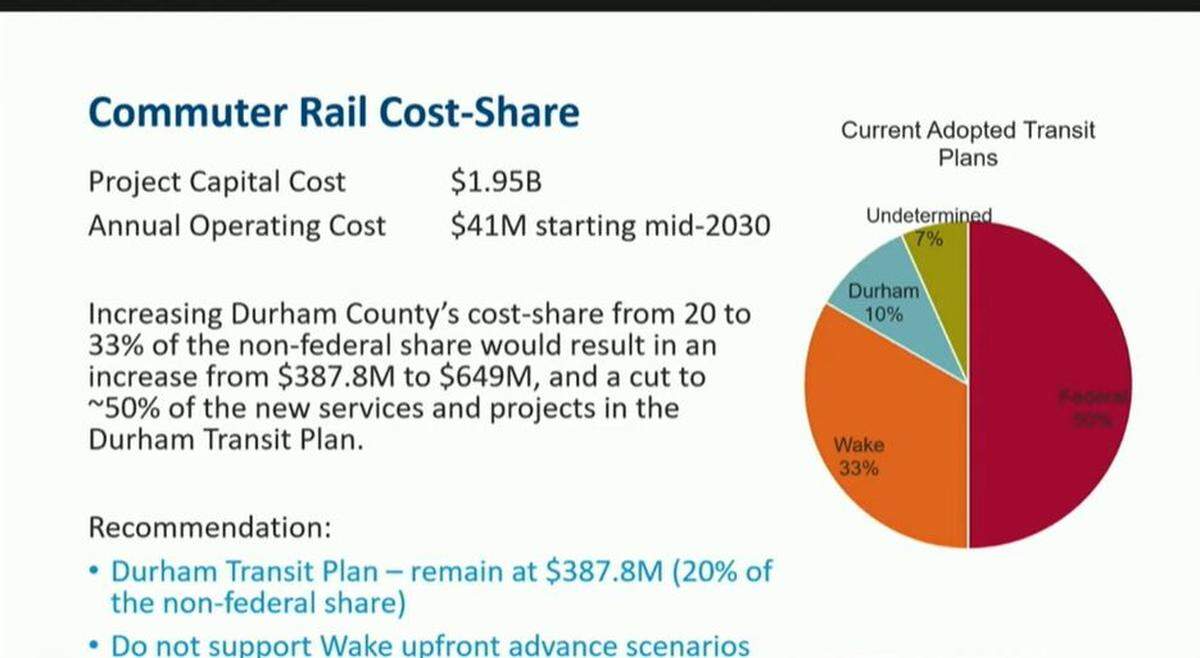
According to previous reporting from The News & Observer, the commuter rail project is expected to cost between $1.4 billion to $2.1 billion to design and build. Durham and Wake both have half-cent sales taxes dedicated to transit on this project as well.
All parties have agreed to continue to study the feasibility of the project to ensure that commuter rail can be achieved. If all goes as planned, construction would begin in 2025, with trains running in 2030.
According to planning documents, next steps include documenting existing railroad agreements that will need to be modified and new agreements that will be needed.
“We need both excellent bus and regional transportation,” said council member Javiera Caballero. “I don’t have any financial solution. But we are Durham and we are [part] of a region, and this is a region that is going to grow very quickly.”
“And we have to come up with a solution to move folks because we can’t keep widening I-40 and hoping that we’re going to solve our transit issues,” she said. “Many, if not most, of our jobs are going to be in Wake County or to the east.”
This story was originally published March 11, 2022 at 8:11 AM with the headline "‘What happened to the $167M?’ Durham wants Light Rail transparency before Commuter Rail.."