
A Durham neighborhood caught in the crossfire. What do its residents want?
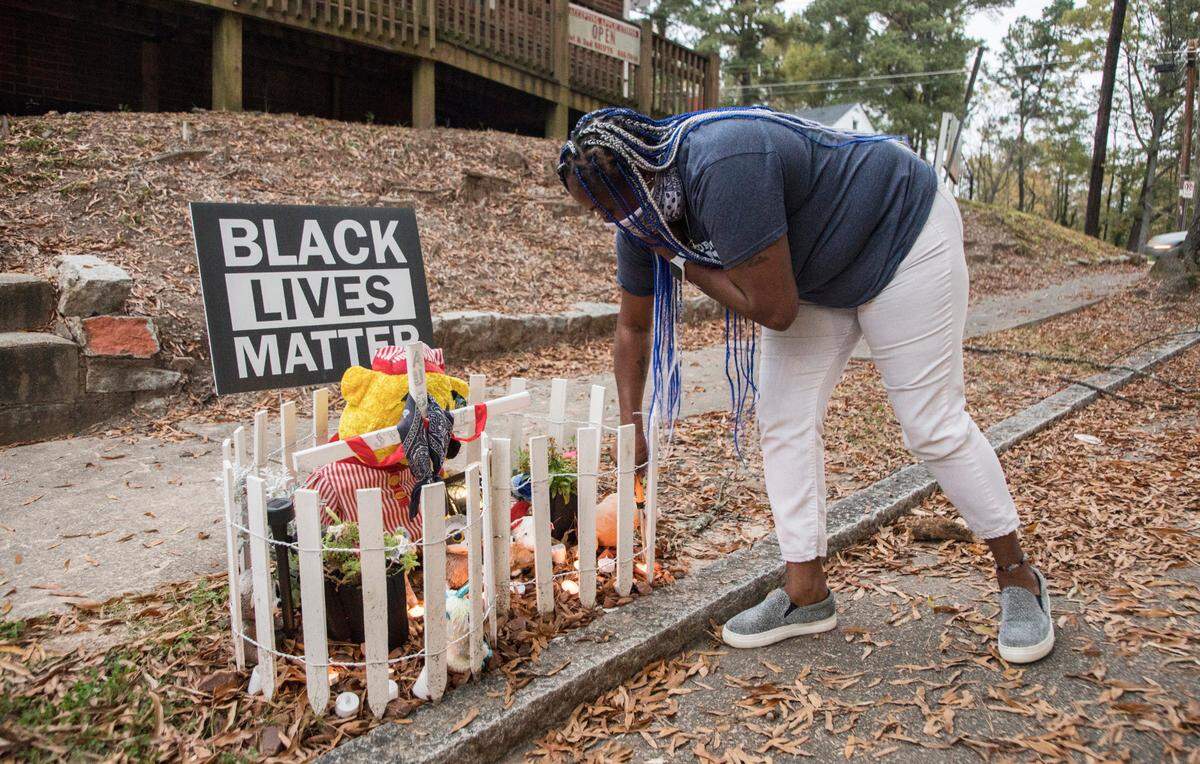
On the side of the street where Syncere Burrell died is a shrine in the shape of a heart, about three feet wide.
It has a white cross, stuffed animals and 18 candles, one for each year of Burrell’s life. A Black Lives Matter sign juts out of the dirt from behind a yellow, plush bear.
“I feel like his life mattered, you know, to me, his nephews, his sisters, brothers,” Lavern Lucier said as she stood beside her son’s memorial.
Too many young men are fighting each other in the streets, she said.
“I put it right here because that’s where we need to start it,” she said. “We need to start with our own, because that’s our issue.”
Burrell lived in Southside, what many also call Hayti, a once-flourishing hub for the city’s Black middle class that some residents say the city neglected for decades.
Now, the neighborhood is among those seeing a citywide surge in shootings. A 23-year-old man was killed on Dawkins Street last month, one of four killings in Durham within a two-week span. Residents interviewed by The News & Observer say they want change: more financial support from the city and, in some cases, more police presence.
“You see the investments that’s happened, billion dollars of investments that are happening in downtown Durham, just across the railroad tracks,” said Bishop Clarence Laney. “There is this sense of hopelessness among many people in the community.”
Laney has been a minister at Monument of Faith Church on Simmons Street for over 25 years. It’s one of at least 10 churches in and around the Hayti district.
“There are millions of dollars [being invested] in certain parts of Durham, but in other certain parts of Durham, there seems to be this disinvestment still, and I think that has to change,” he said. “There has to be an economic engine in communities in order for them to do well.”
While homicides are slightly down this year in Durham, shootings have soared. Non-domestic firearm assaults, which includes non-fatal shootings, are up 44% compared to last year and 26% compared to the previous five-year average.
Laney said his first funeral service was for a gunshot victim. The issue has been a constant in the life of his church, he said, and it’s getting closer.
“Some of the violent crimes and murders that were happening, they were not happening in the direct vicinity of the church,” he said. “Now they are.”
He says people are struggling during the pandemic, but he points too to a general unrest felt by many African American people across the country.
“We’ve had presidential leadership, or the lack thereof, who refused to even denounce the violence that was occurring and even to speak in support of Black lives,” he said, in reference to George Floyd’s death and the killing of other Black Americans by police officers.
“So as a young man, who’s already feeling hopeless, I see this played on the national stage,” he said. “’What is my incentive? No one cares about me. No one cares about my community. So why should I?’”
As of Nov. 28, 291 people had been shot in Durham this year, up from 179 at the same time last year, according to statistics the Durham Police Department provided upon a public information request from The News & Observer. Twenty-eight people had been killed.
Forty-six of those shot were 17 years old or younger, the statistics show. Fourteen were 15 or younger.
‘Those streets were calling his name’
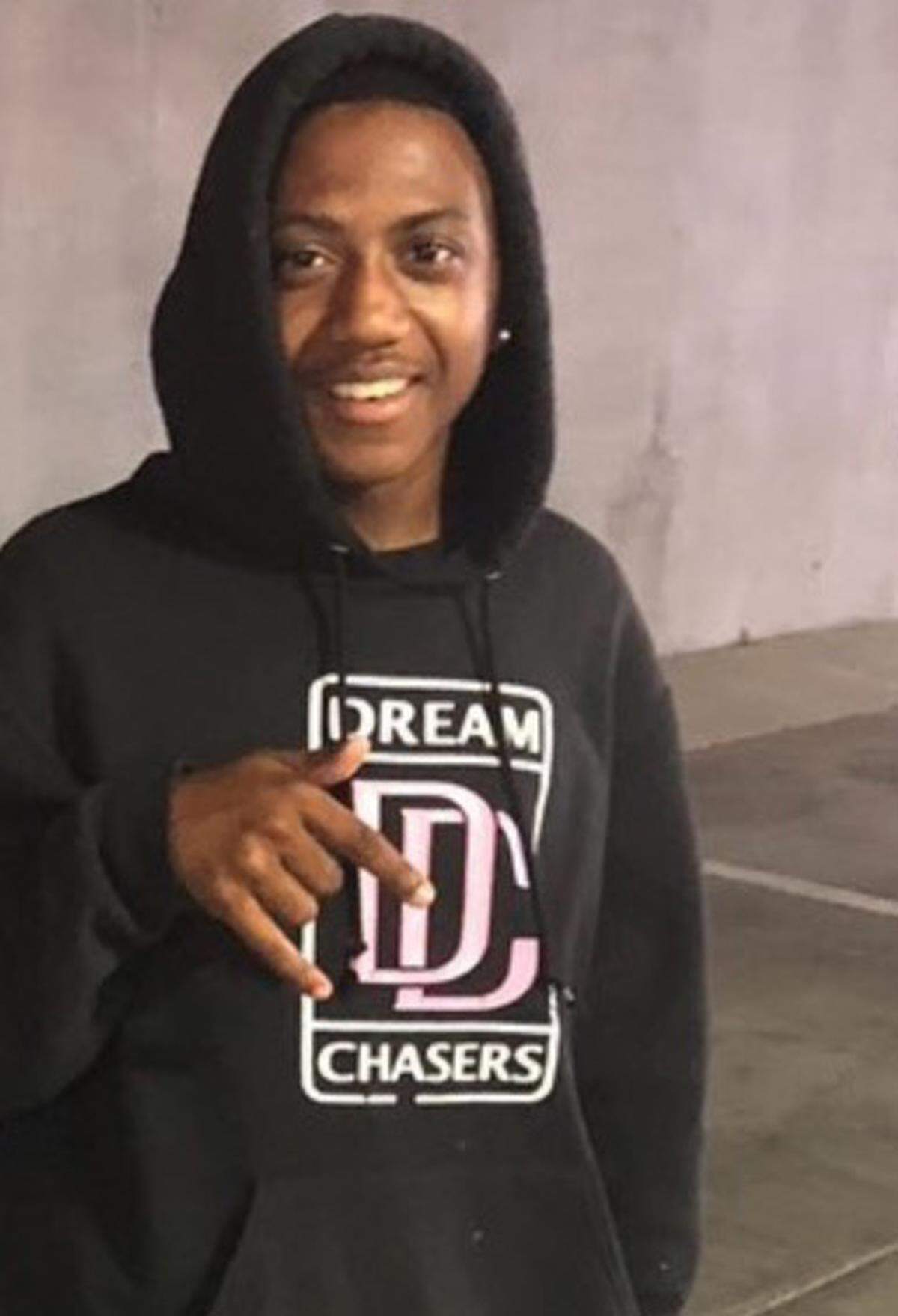
On Aug. 10, police officers found Burrell shot inside a car at Linwood Avenue and Lincoln Street.
The car was parked around the corner from his house and in front of First Chronicles Community Church, which he had attended as a boy.
Burrell’s pastor said he was respectful, always had a positive attitude, and was a leader for young kids.
“This was one of the worst days of my 21 years as a minister, when I walked out and I saw that yellow tape, blocking us from the church,” said Pastor William V. Lucas.
The church had helped many families touched by violence, but this was the first member who had been murdered, he said.
“His mother, praying, I saw her praying every Sunday. Praying for her son. And those streets were calling his name,” Lucas said.
He paused to take a breath.
“And he got to a point, that the streets, like so many others, are so much more appealing than the programs and the things that we were trying to teach,” he said.
The destruction of Hayti
Vivian Deloris Gunn, 72, remembers when Grant Street was filled with houses. And shootings, she said, were practically unheard of.
Now three squares of vacant land sit on her block. Walking up the street toward the Durham Freeway overpass, she can still name who once lived there.
Five generations of her family had lived in Hayti. She could walk to the doctor’s office, the bakery, or any of the businesses on Parrish Street, the historic Black Wall Street that included N.C. Mutual, the nation’s largest Black-owned insurance company. Families would greet each other from their front porches, she said.
“There was never any arguing, fussing or fighting in the streets,” Gunn said. People were busy working, she said.
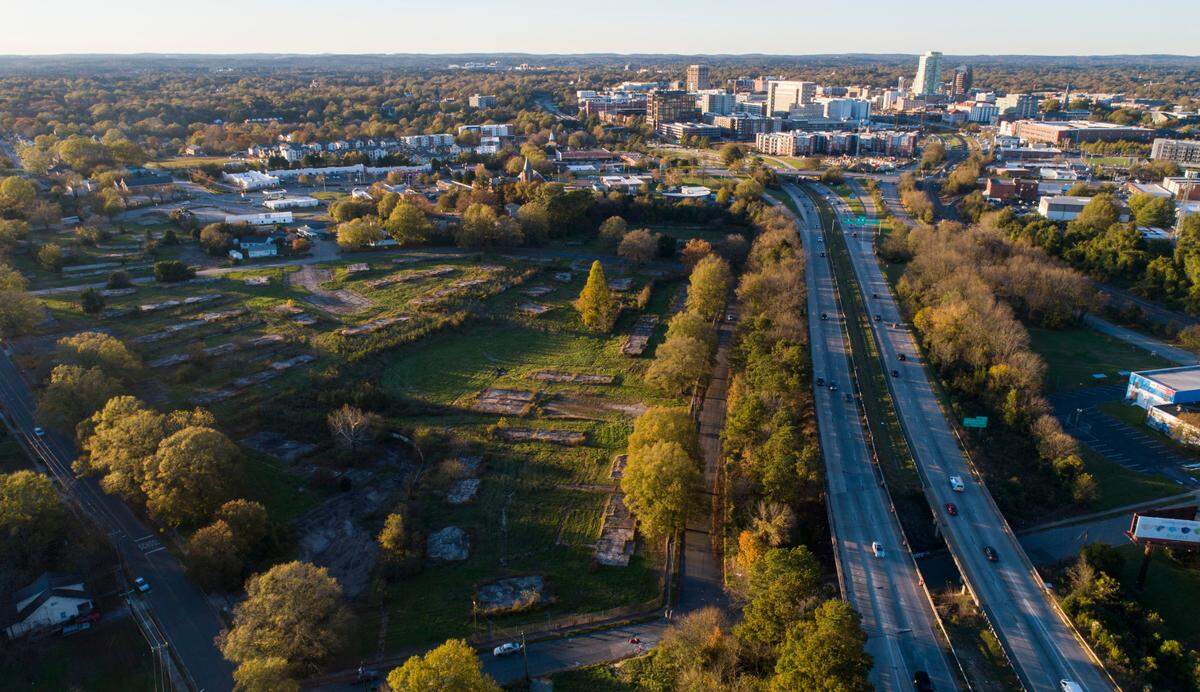
“When urban renewal came in, it destroyed that,” she said.
In the 1960s and early ‘70s, developers bulldozed swaths of Hayti for Highway 147, an outgrowth of the Urban Renewal movement when federal dollars built development projects across the nation. In Durham, the freeway displaced over 4,000 homes and 500 businesses, many run by African American families, according to Bull City 150.
In a July report to the City Council, Durham’s racial equity task force called the Urban Renewal program a “seismic tragedy in Black Durhamites’ lives,” with aftershocks reverberating in the Hayti community 50 years later.
“Employment [had been] so prevalent for African Americans that national leaders like Booker T. Washington and W. E. B. Dubois came to that area and said, ‘This is a model of what an African American community could be or should be,” said Lucas. “And fast forward to today, a lot of that has been destroyed.”
“You still have a fragmented N.C. Mutual, but the only entity that has really prospered and is really strong is N.C. Central University,” he said, citing the historically black university on Fayetteville Street. “The rest of the area has been devastated.”
“It is a historical community that has been historically forgotten,” Laney said.
Residents frustrated with Fayette Place
Laney said disinvestment in Black neighborhoods in Durham has contributed to crime in those areas.
“When there’s disinvestment, you don’t have jobs. So when you don’t have jobs, you have poverty. And we have poverty, you have hopelessness, and when you have hopelessness, you have crime,” he said. “They’re all connected.”
Take Fayette Place, near his church.
On a bright day in October, Gunn and Lucier looked through a chain-link fence on Grant Street at a plot of land so expansive, they could barely see the fence on the other side.
Behind the metal wiring lay Fayette Place, 20 acres of concrete slabs and overgrown grass. It once had around 100 two-story brick houses, a public housing project developed by Durham Housing Authority in 1967, according to Open Durham.
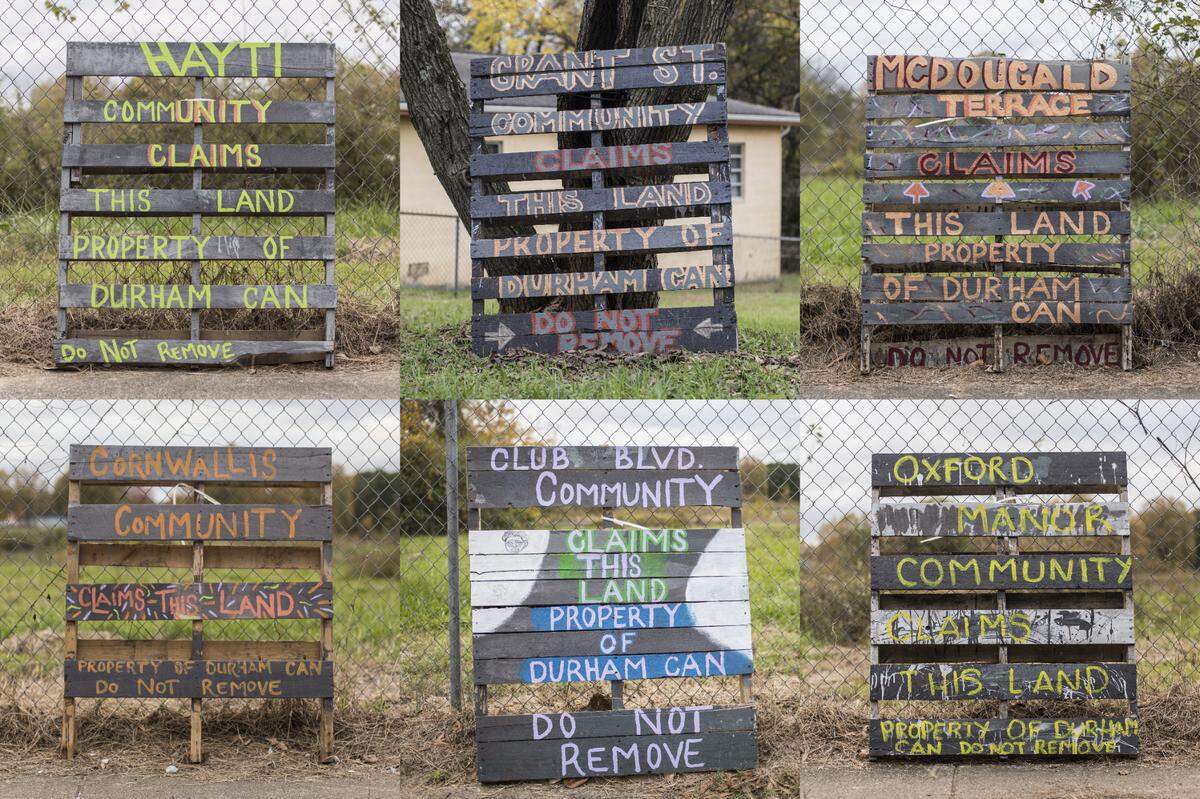
The authority sold the land in 2007 to a developer that planned apartments but never built any. The authority bought back the property 10 years later, but it never redeveloped it either, The N&O reported.
Walking in fuzzy slip-on sandals, Lucier stepped over glass and plastic bottles on the sidewalk and pointed toward a set of cement stairs left over from one of the demolished apartment foundations.
“[It] would be something great to have really affordable housing here,” she said. “I mean, ‘cause you got these steps that are leading to nowhere.”
Gunn hopes to see the site revamped in her lifetime.
“Even if you had plants there or flowers blooming, you know, that would give you some kind of uplifting feeling for you to come walking up and down this street,” she said.
To Laney, the disregard of Fayette Place is symbolic.
“Land, buildings, tell stories,” he said.
“You would not see 20 acres undeveloped in North Durham, or in Hope Valley, or in Treyburn. You would never see that near Southpoint. But because it is in a Black community, it is OK to leave it the way that it is,” he said.
“That is disinvestment. And that says to young boys and young girls, ‘My community doesn’t matter.’”
Appeals for community policing, investment
Along with reinvestment, Laney wants to see police build relationships with the neighborhood.
“So there would be perhaps a level of trust that could exist that doesn’t particularly exist now,” he said.
He doesn’t want over-policing, he said, or ShotSpotter, a gunshot detection system he sees as reactive, sending police to an area only after a shooting has occurred. The City Council rejected a free, six-month trial offer of ShotSpotter for similar reasons in September, The N&O had reported.
The News & Observer asked to speak to Police Chief C.J. Davis for this story, but a spokesperson said she was unavailable.
Harold Chestnut leads monthly Partners Against Crime meetings in Police District 4, which includes Hayti. Police do well with their resources, he said, but more officers, training and visibility could help.
Non-domestic, firearm assaults in the district are up 33% this year compared to the previous five-year average.
“Police might not be able to stop them, but they can prevent them just by being there in the community,” Chestnut said.
Convenience store worker Patrick Bailey said tighter community bonds could help reduce conflict in the neighborhood.
“Sometimes, you just need a person to talk to,” he said.
His shop, Hill’s Open Air Market on the east side of Hayti, has been struck by gunfire one time, but he’s heard shots from the parking lot and said a bullet once hit his car.
NCCU, with over 8,200 students, borders Hayti from the south.
In October, the chancellor and two students asked City Council members for more police patrols and to install ShotSpotter around the campus, The N&O reported.
One student described a stray bullet shattering her window.
Public safety approaches
In June 2019, the City Council voted 4-3 to reject Davis’ request for 18 more patrol officers, as well as a compromise that Mayor Steve Schewel proposed for nine more officers.
Mayor Pro Tem Jillian Johnson then proposed shifting the department’s $1.2 million request to increasing the city’s part-time workers pay to $15.46.
Instead of giving additional money to the DPD — a nearly $70 million operation taking up almost one-third of the city’s general fund budget — a majority of the council has favored alternatives to policing.
The city set aside $1 million in June to fund the future recommendations of a community safety and wellness task force. The decision was approved by a 4-2 vote.
But council members expressed unanimous support for expanding the county’s violence interruption program, Bull City United. The six-member team works to de-escalate tensions through mediation and peace negotiations.
In November, Pierce Freelon, the council’s newest member, pitched his own proposal: “mutual aid centers,” or neighborhood centers with food and clothing donation drop-offs.
At a news conference last month after a 15-year-old boy, Anthony Adams, was killed in a drive-by shooting downtown, Davis and Schewel said policing alone can’t stop violence, The N&O reported.
“It can’t be just the police department,” the chief said. “You can’t arrest crime away.”
The city must also support after-school care, mental health care, and drug treatment, Schewel said.
That viewpoint is one the grassroots group Durham Beyond Policing has championed since 2016.
“If we want to know how to change the course of violence in our city, we have to understand the conditions that are producing it. And we have to let those conditions inform our policies,” said Danielle Purifoy, a spokesperson for DBP.
Policing cannot change the conditions that lead some individuals into crime, she said. But livable wages and housing security for those who need it can.
“We want to get rid of the harm of policing and prisons, and we want to actually create conditions on the ground that reduce harm and violence,” she said.
Lucier still wants to see police more often.
“I just think that the police just have to be more visible,” she said. “Not just sitting in your patrol car. You can only see so much in a car.”
She also asked the city to take the free trial offer from ShotSpotter in September, The N&O reported.
Two mothers, connected by loss
After Lucier’s son died, she met other mothers who had lost family members to gun violence.
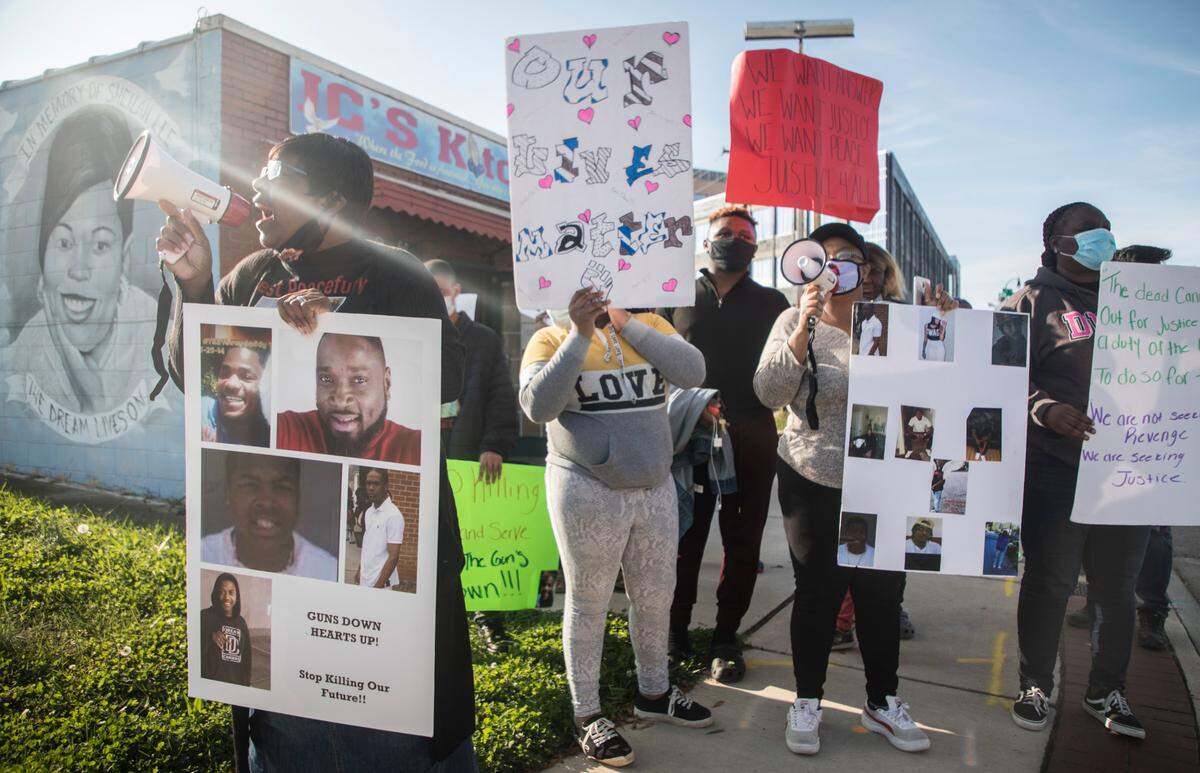
On Saturdays, she goes to a rally called “Guns down, hearts up,” outside the Police Headquarters on Main Street to protest shootings.
After Adams was killed, Lucier visited his mother at her home. Adams had been one of her son’s closest friends, she said.
“She was like, ‘my son loved your son,’” Lucier said. “I said, ’Yeah I know. They loved each other.’”
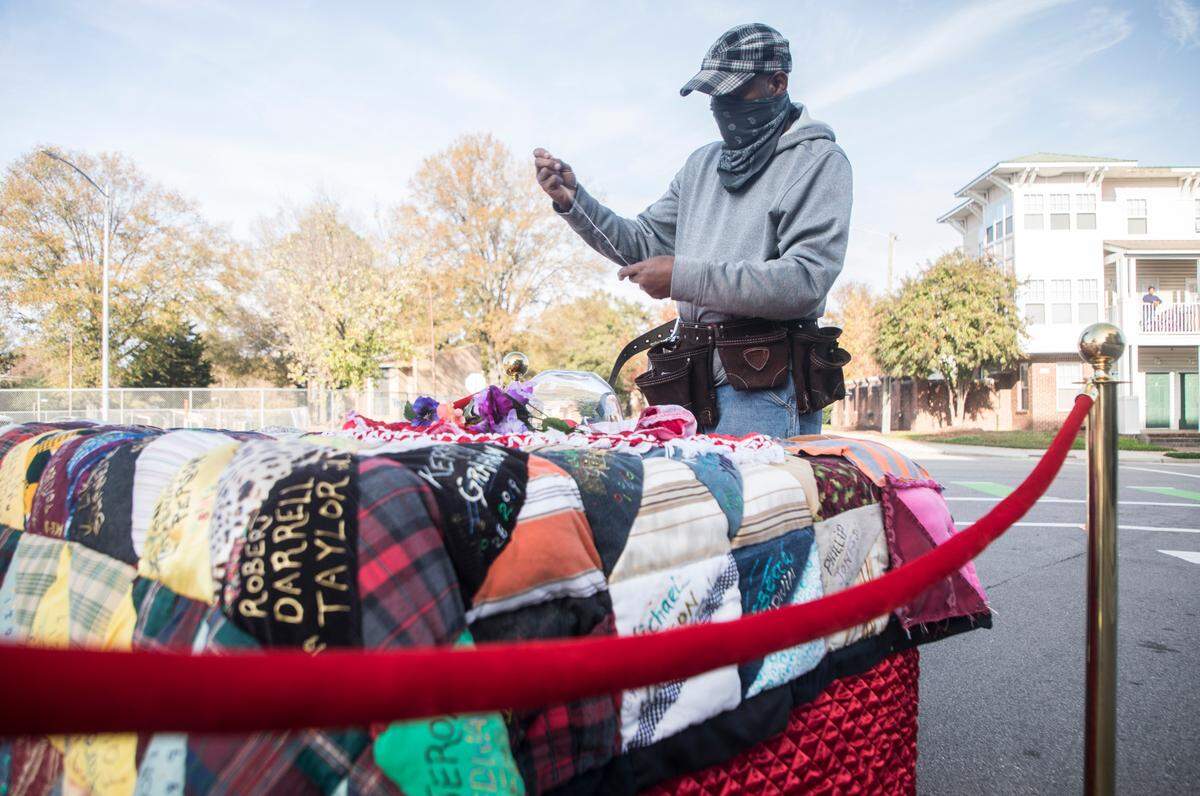
Three days after a vigil for the teen, Sidney Brodie sewed the name “Anthony Adams” into a quilt on a long row of tables as Lucier watched.
Now well over 60 feet long, Brodie’s Homicide Memorial Quilt displays the names of hundreds of people murdered in Durham County since 1997.
The patches for “Syncere Burrell” and for “Anthony Adams” are stitched side by side, just above the dates they died, “8-10-20” and “11-8-20.”
Staff writer Ashad Hajela contributed to this report.
This story was originally published December 7, 2020 at 5:45 AM with the headline "A Durham neighborhood caught in the crossfire. What do its residents want?."