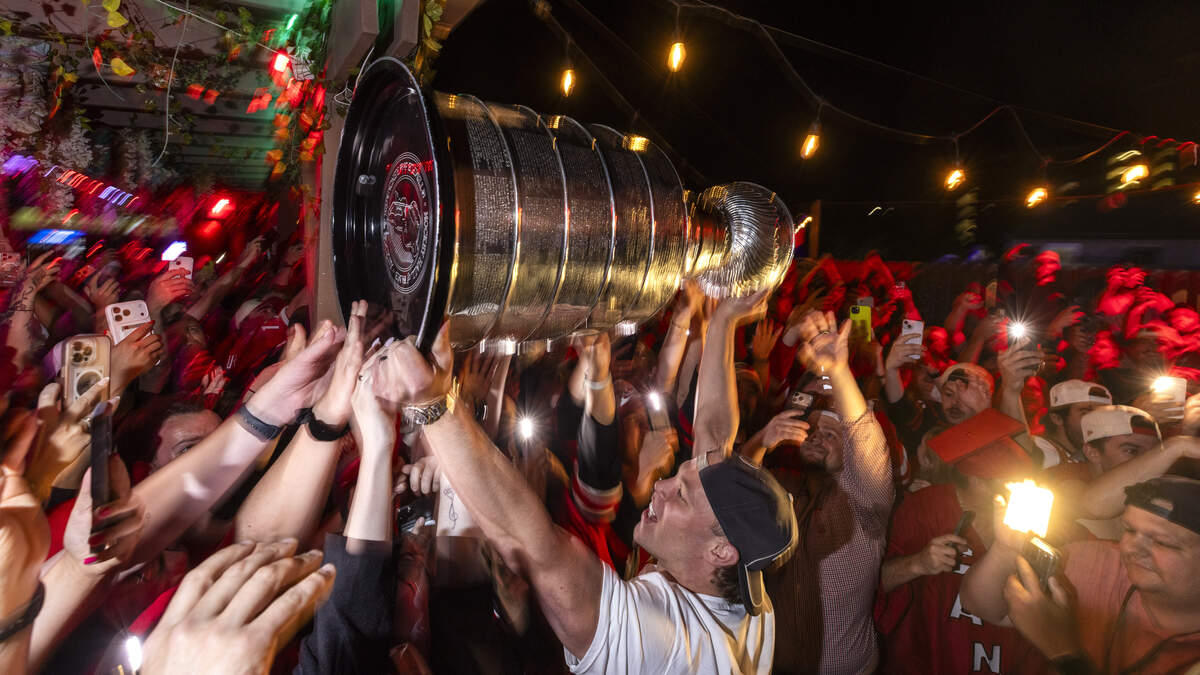
The Canes brought the Stanley Cup to party on Glenwood. But was it the real one?
AI-generated summary reviewed by our newsroom.
- The Carolina Hurricanes brought the real Stanley Cup to a Raleigh bar on Glenwood South.
- The Stanley Cup travels about 300 days each year on a championship tour, per the NHL.
- Teets bar hosted the Hurricanes and their fans as part of the traditional trophy ritual.
After reclaiming their championship title again after 20 years, the Carolina Hurricanes put the Stanley Cup trophy through its paces at a Raleigh bar.
Yes, the real Stanley Cup got its romp along Glenwood South. A fitting end to the “perfect storm” that led the team to a historic win.
Teets bar was the spot the Canes and their fans rallied around the coveted silver trophy, engraved with the names of victors before them. It’s the same ritual other teams in the league have been partaking in for decades.
The trophy hits the road for 300 days a year for the championship tour. And it’s been all over the world, according to the National Hockey League’s website, including Mexico, Japan and Germany.
But it has gone through some changes since a British Lord donated the first trophy to a Montreal athletic association.
Lord Stanley’s cup
Frederick Arthur Stanley, Lord Stanley of Preston, first purchased the trophy that would ultimately be named after him in 1892, according to the Hockey Hall of Fame.
He was a British lord who earned a post in Canada and watched an ice hockey game during his first winter.
Stanley “came to the conclusion that the fine sport of ice hockey needed a symbol for which teams from all over Canada could compete,” according to the Hockey Hall of Fame.
That symbol ended up being a 7-by-11 inch cup Stanley bought for $50. The original trophy was retired and is stored in the Hockey Hall of Fame’s vault named after Stanley.
So, if the original cup is being stored in a vault in Canada, what were Cane’s players holding over their heads at a Raleigh bar on Monday night?
The ‘presentation cup’
The silver trophy weighing in around 34 pounds and standing over 35 inches tall that Canes players hoisted above their heads and drank from isn’t Lord Stanley’s original trophy.
It’s called the “presentation cup” and has been the icon of the championship for decades, ESPN reported. Everyone from the winning team, including players and staff, gets to spend 24 hours with the trophy, a tradition that started in 1995, according to the NHL.
The trophy is so coveted that it has its own bodyguard, according to the NHL. The guard is known as “The Keeper of the Cup” and is only held by a select number of people who “always have an eye on the historic trophy.”
The names of the players on teams to win the championship are engraved around large bands at the base of the trophy.
“It takes 12 years for the bottom band to be filled with the latest championship teams, requiring the top band to be retired to the Hockey Hall of Fame,” according to the NHL. “Every 13 years a ceremony takes place during which the top band is retired so a new, empty band can be added to the bottom.”
For a player’s name to be engraved on the trophy, they are required to have played in at least 41 regular-season games — or one Stanley Cup Final game.
This story was originally published June 16, 2026 at 4:23 PM with the headline "The Canes brought the Stanley Cup to party on Glenwood. But was it the real one?."