RDU tries novel approach to stormwater flowing off its massive parking lot
AI-generated summary reviewed by our newsroom.
- RDU airport will finish its nearly 11,000-space remote parking lot by year’s end.
- N.C. State will monitor new submerged gravel wetland stormwater system at the lot.
- State regulators allowed the wetlands as a pilot study to see how they perform.
By year’s end, Raleigh-Durham International Airport will finish building one of the state’s largest paved parking lots, with nearly 11,000 spaces over 110 acres of asphalt and concrete.
The rain that falls on all that pavement, and the gunk it collects on the way, will flow into a new type of stormwater system that is still considered experimental by state regulators.
It’s called a submerged gravel wetland. There will be seven of them scattered around RDU’s Park Economy 3, ranging from a quarter to a full acre, each fenced off and surrounded by gravel and grass.
Water from the lot will enter each wetland from a pipe at one end, then settle through a layer of sandy soil planted in sneezeweed, rushes, swamp sunflowers and other wetland plants, down to gravel. Water filtered by the plants and microbes in the soil and gravel will eventually drain out the other end toward Crabtree Creek.
RDU’s contractors consulted with N.C. State University researchers on the design of the system. Over the next year, the university will monitor the wetlands and the quality of water leaving two of them.
“There’s a lot of stuff that’s being learned,” said Bill Hunt, a stormwater specialist in NCSU’s Biological and Agricultural Engineering Department. “We’re confident it’s going to work. We just don’t know exactly how well — that’s why we’re doing the monitoring.”
State regulators allowed RDU to use the wetlands as a “pilot study” in conjunction with the NCSU research, according to Mike Lawyer, stormwater program supervisor at DEQ’s Division of Energy Mineral and Land Resources.
While the approach is not approved for use in North Carolina, the engineering and technical material provided by the airport showed the system would “provide equal or better stormwater control and equal or better protection of surface waters,” Lawler wrote in an email.
Developed up North, expected to work better in the South
Submerged gravel wetlands were developed and tested by engineers at the University of New Hampshire Stormwater Center more than a decade ago. They’re widely used throughout New Hampshire and are spreading to other states, including New Jersey and Maryland.
But treating stormwater with submerged wetlands is still novel in North Carolina and other Southern states, even though, Hunt said, they’re likely to work better in a warmer climate.
“The biological transformation does better the warmer it is,” he said. “So if it worked well, which it did, in New Hampshire, it’s going to work even better here.”
A handful of small submerged gravel wetlands have been built in North Carolina, including one at the Walnut Creek Wetland Park in Raleigh. But RDU will be the technology’s biggest test by far in the state; an inch of rain falling on 110 acres of pavement will produce nearly 3 million gallons of runoff, according the U.S. Geological Survey.
On a recent rainy day, the most complete of the RDU wetlands looked like a pond. It had been raining for hours, and about 4/10ths of an inch had hit the pavement and washed into the wetland, covering the sandy surface with water.
Small plants stood in neat rows. They will eventually grow several feet high, creating a mini forest that covers the wetland surface.
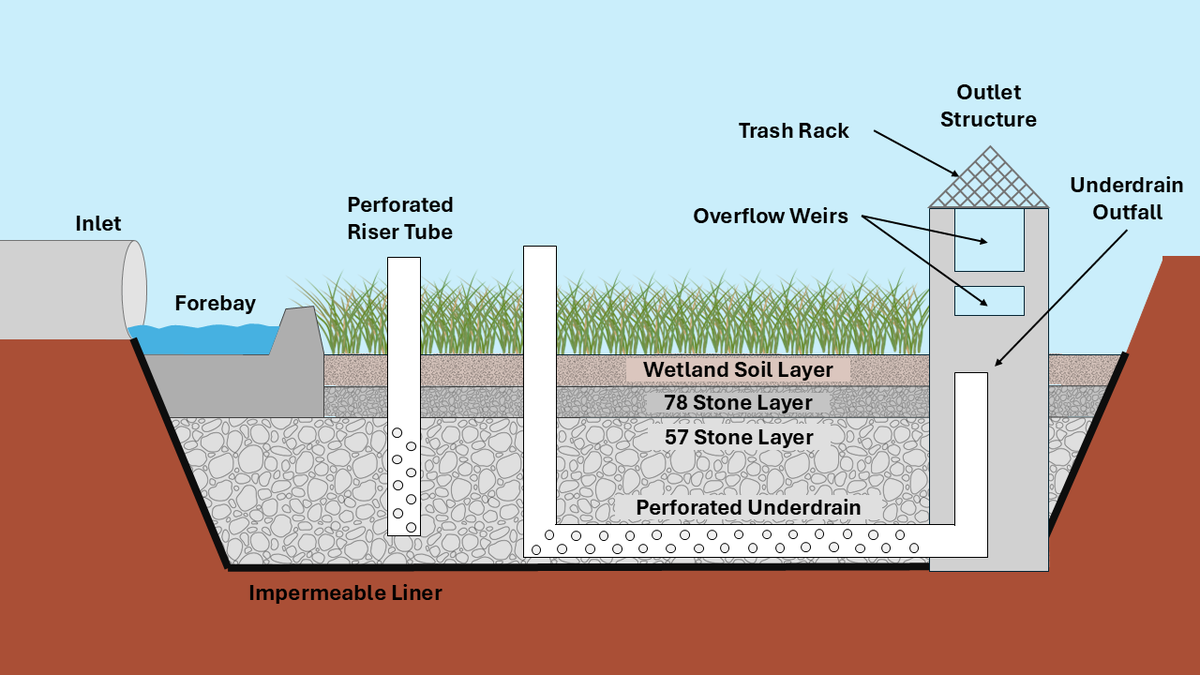
The water doesn’t remain at the surface for long, filtering down through the sand and plant roots to the gravel layers below. That’s an important feature, because ponded water can become a breeding ground for mosquitoes and attract geese, something an airport wants to avoid, Hunt said.
The soil, roots and microbes throughout the wetland help collect sediment and remove nitrogen and phosphorous from the water, Hunt said. Oil, gas and grease from the parking lot binds to organic matter at the wetland surface, where microbes go to work on it.
“These microbes, as oil and greases start coming into the wetland, their population will begin to explode,” Hunt said. “And they will eat the oil and greases and break them down to just generic water, carbon and gas. It’s cool.”
Heavy rain may be too much
The system has limits. A major petroleum spill would overwhelm the microbes, for example.
And the wetlands are designed to handle one to two inches of rain over a 24-hour period. When a hurricane hits, the basin around the wetland will fill to the level of the outfall pipe and water will drain out untreated. Storms have dropped more than 2 inches of rain on RDU twice in the past year, according to the National Weather Service.
“It doesn’t clean the big storms,” Hunt said. “It just passes the big storms safely without causing erosion.”
Downstream erosion is a concern for Jean Spooner, head of the Umstead Coalition, a group that aims to protect neighboring William B. Umstead State Park. Spooner says water flowing from the lot during construction created gullies and washed large amounts of sediment into Lake Crabtree, and she hopes the airport is taking steps to prevent that from happening after the lot is finished.
Spooner is a retired NCSU extension professor who specialized in soil science and water quality. She says her review of how submerged gravel wetlands have performed elsewhere make her skeptical they will adequately remove nitrogen from Park Economy 3’s stormwater. At the same time, she says she worked with Hunt for years and trusts his judgment.
“I’m not convinced they’re the best for this application,” she said of the wetlands. “But if you’re going to do these, the best person to oversee the construction and monitoring of them in the country is Dr. Bill Hunt.”
Creating the standards for others to follow
The day-to-day task of monitoring the wetlands falls to Anna Dias, a student working toward a master’s degree in biosystems engineering. Sensors allow Dias to monitor water levels at all seven wetlands to determine if they’re getting clogged or not working properly.
And at two wetlands, Dias collects water samples for lab tests to measure pollutants such as phosphorous, nitrogen and “total suspended solids” or TSS, which is essentially how much sediment is coming in and leaving.
“I was looking at my water quality results earlier this week, and it’s reducing TSS a lot,” she said recently.
Dias expects to continue collecting data, particularly after storms, through the summer of 2027. It will help the NCSU team determine if the wetlands have the right mix of plants, for example, or are the right size to handle the pavement. RDU is building 1 acre of wetlands for every 21.7 acres of pavement.
“This practice is very likely going to be approved across the state,” Hunt said. “So what we’re doing is fine-tuning the design standards that everyone else in North Carolina are going to use.”
This story was originally published June 4, 2026 at 5:00 AM with the headline "RDU tries novel approach to stormwater flowing off its massive parking lot."