Chapel Hill could cut Town Council seats, give mayor more time in office
AI-generated summary reviewed by our newsroom.
- Chapel Hill council voted 8-1 to pursue public discussion and a hearing on changes.
- Proposal would shrink council from 8 to 6 members and give mayor four years in office.
- Move to eliminate 2 seats could save town over $60,000 a year in salaries and benefits.
CORRECTION: Chapel Hill Town Council member Theo Nollert supported extending the mayor’s term but opposed shrinking the number of council members, because of the effect it could have on diversity.
Update: The council will hold a public hearing April 29, with a possible vote May 6.
Chapel Hill residents will talk this spring about shrinking the Town Council and giving the mayor two more years in office.
Council members launched the conversation Wednesday focusing on what a change could mean for diverse town representation and more efficient meetings. No one opposed expanding the mayor’s term from two to four years.
The other proposal — reducing the council (not counting the mayor) from eight to six members — sparked a robust conversation.
Council member Louie Rivers III said he feels “pretty strongly” about giving mayors more time to set out a vision and take bold steps.
“Yes, we’ll be stuck with someone for four years, but maybe we’ll have someone with four years in this position who has a chance to take more chances under their leadership,” he said.
Council member Theo Nollert also supported changing the mayor’s terms but not the number of council members. He asked the council to briefly discuss the options before voting Wednesday to plan a future discussion and public hearing.
The council voted 8-1 to move forward, with council member Paris Miller-Foushee dissenting. A public hearing will be held April 29, with a possible vote on May 6.
Does desire for efficiency harm equity?
A smaller council could spend less time in meetings, although that’s not guaranteed, Nollert said. But the savings in eliminating two salaries, insurance and other benefits totaling over $60,000 a year would be small, he and other members said.
“I’ve watched this council, as an outsider and then as a member, really go through a pretty significant culture change in the last few years. … I think we have good conversations. We’ve accomplished a lot of significant things together,” Nollert said.
He specifically noted police reform and the passage of the Complete Community, Housing Choices and land-use strategies and changes aimed at growing the town in new ways.
“We’re actually doing quite a lot of good things, and have done them in previous iterations of the council and are continuing to do them under this collegial iteration,” Nollert said.
A smaller council, however, could mean less representation for some groups, including younger candidates, racial minorities and people with different sexual identities, he said, and it could also give incumbents a leg up over challengers.
Miller-Foushee noted the desire for more diversity led the board — then called the Board of Aldermen — to increase its membership from six to eight members in 1975. That led to multiple African-American members serving simultaneously, openly LGBTQ members, and the state’s first Vietnamese-American elected to office, she said.
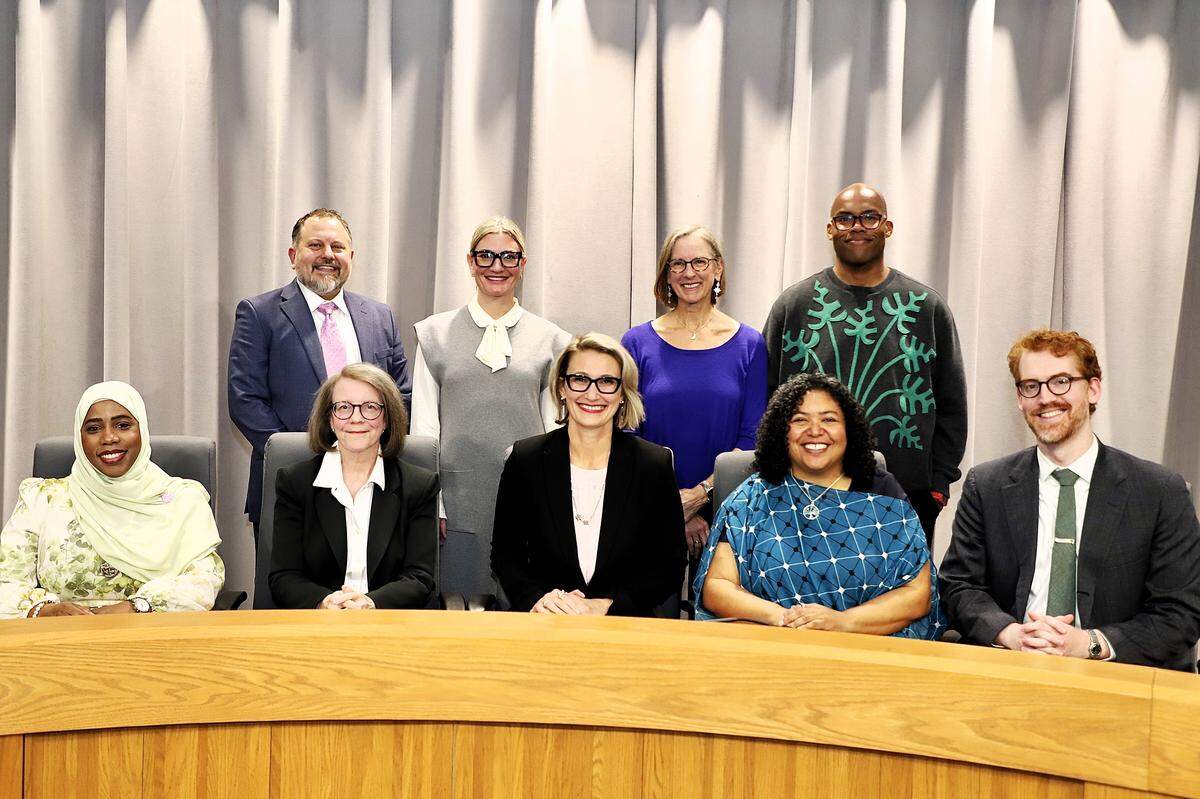
Shrinking the board now would fail to provide equity, representation and “democratic transparency at a moment when we desperately need more of all three,” Miller-Foushee said. The three-week timeline before the public hearing is short given how little residents know about what’s proposed, she said, and some “are upset and rightly so.”
“It raises the barrier to entry for first-time candidates, especially those without name recognition, without wealthy networks, without the ability to run a longer, expensive campaign, and in a town with a large student population, a transient faculty, and working families … lengthening terms and reducing seats closes doors at a time when we should be opening them,” she said.
Council member Amy Ryan agreed on the need for transparency and public dialogue, but disagreed that a smaller board reduces opportunities.
“I think the Chapel Hill voters are voting for broad representation,” Ryan said. In the 1970s, “there was a desperate, desperate problem. There were many voices in this community that were nowhere near being represented. I think we’re in a very different time right now.”
What is the process for making a change?
State law allows councils to reorganize town government and, in some cases, fill vacant seats. It also allows councils to change their town charters, redefining board membership and the length of terms in office.
One option, which Chapel Hill is undertaking, is to hold a public hearing before the council votes. Other options are:
- A town petition asking the legislature to change the city’s charter.
- Giving voters the choice in a referendum, which can only be held in even years when there are no town elections.
- Citizens can bring a petition signed by 10% of the town’s registered voters or 5,000 voters, whichever is less, to put the question to a referendum.
Smaller boards common, discussed before
The UNC School of Government reports that the average municipal board in North Carolina has five members, but it ranges from two to 11 members. Roughly 98% of those boards are elected in nonpartisan races, with elections in odd-number years.
Chapel Hill is one of several cities with eight council members plus a mayor, in addition to Winston-Salem, Greensboro, High Point, Raleigh and Henderson. Only two councils — Charlotte and Fayetteville — have more than eight members.
This is not the first time Chapel Hill has looked at shrinking its board.
In 2020, when former council member Rachel Schaevitz stepped down, leaving a vacancy, then-Mayor Pam Hemminger led a brief discussion about shrinking the board. Council members were meeting remotely because of COVID and decided to wait until more residents could join the conversation.
The idea came up again in 2021, but four members were facing re-election, and it was postponed again. Anderson was a council member at the time and supported the change, even if it meant losing her seat, she said.
While the issue needs public debate and transparency, she said, the council “is a larger than average size board, and that can be unwieldy, and it can make things more difficult sometimes.”
She also noted that the top three winners in recent elections were all women or people of color.
“I think all of us care about doing things the right way and having a process that serves the best interest of the public,” Anderson said.
This story was originally published April 16, 2026 at 7:57 AM with the headline "Chapel Hill could cut Town Council seats, give mayor more time in office."