RDU airport keeps its main runway alive, one slab of concrete at a time
AI-generated summary reviewed by our newsroom.
- Each fall, RDU shuts its main runway overnight to replace deteriorating concrete.
- Contractors have only a few hours to dig up old concrete and pour the new.
- Airport has spent $30M on runway rehab so far, as replacement still four years away.
Icelandair flight 821 from Reykjavik landed at Raleigh-Durham International Airport shortly after 7 p.m. one recent Monday. It was the last plane to use 5L/23R, the main runway at RDU, for more than 19 hours.
The runway officially closed at 7:14 p.m., and the lights in the pavement and on the approach that guide pilots were turned off.
Moments later, a convoy of trucks and utility vehicles spilled onto the darkened runway, some pulling trailers of equipment and generator-powered spotlights. They converged on a spot near the midpoint of the 10,000-foot runway and quickly got into well-rehearsed positions.
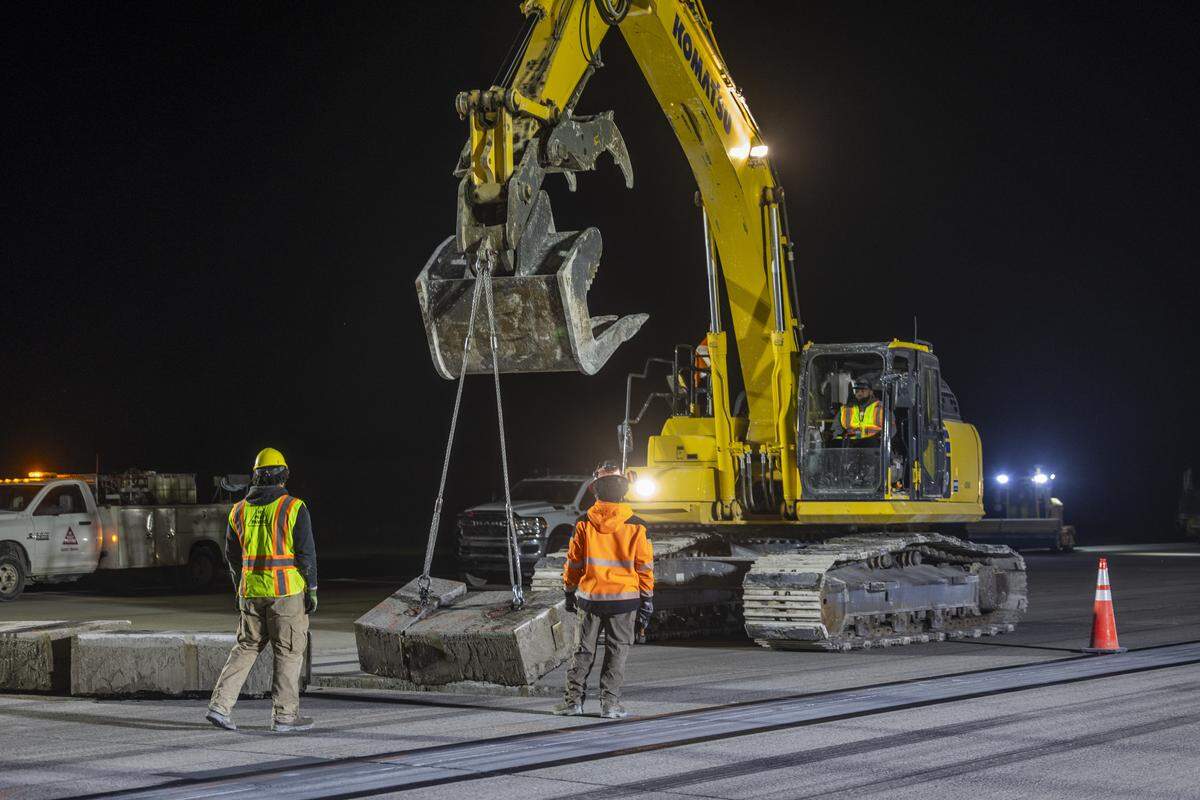
Eight minutes after the airport shut down 5L/23R, an excavator began pulling up chunks of concrete 16 inches thick from near the center line and laid them into the bed of huge dump truck.
The urgent overnight effort to preserve RDU’s runway had begun again.
The 1.9-mile-long runway was completed in 1986 and is at the end of its useful life. RDU has begun work on a replacement just to the west that it hopes will be completed in 2029.
But some of the concrete in 5L/23R is already cracking and chipping off because of a condition known as ASR, or alkali-silica reaction, related to the makeup of the stone, said Ron Jewett, RDU’s vice president of facilities asset management.
“ASR is like a cancer in the pavement,” Jewett said. “It’s an internally damaging situation, and sometimes like cancer it’s more active than it’s not.”
RDU realized several years ago that if it didn’t replace the most seriously deteriorated sections of concrete, it would have to close the runway, which is needed for long-haul flights.
So working with its engineers and contractors, the airport came up with a way to shut the runway down at night, dig out a section of damaged pavement and pour new concrete. It all has to be done quickly enough that the concrete has time to cure and harden before flights for Europe are scheduled to take off the following afternoon.
The runway was built in 25-by-25-foot slabs or panels, so that’s how the crumbling concrete is replaced. Since the spring of 2019, RDU has replaced somewhere between 350 and 400 slabs.
As Bill Sandifer, RDU’s chief development officer puts it, the airport has been “keeping that runway alive, one 25-foot-by-25-foot by 16-inch-deep piece of concrete at a time.”
7:22 p.m. First concrete slabs lifted from the runway
Hi-Way Paving won the contract to replace about 70 panels of concrete this fall. The company is based in Ohio but assembles crews from across the country for projects like this. The workers stay in hotels and work 11 days on, three days off, as the weather allows.
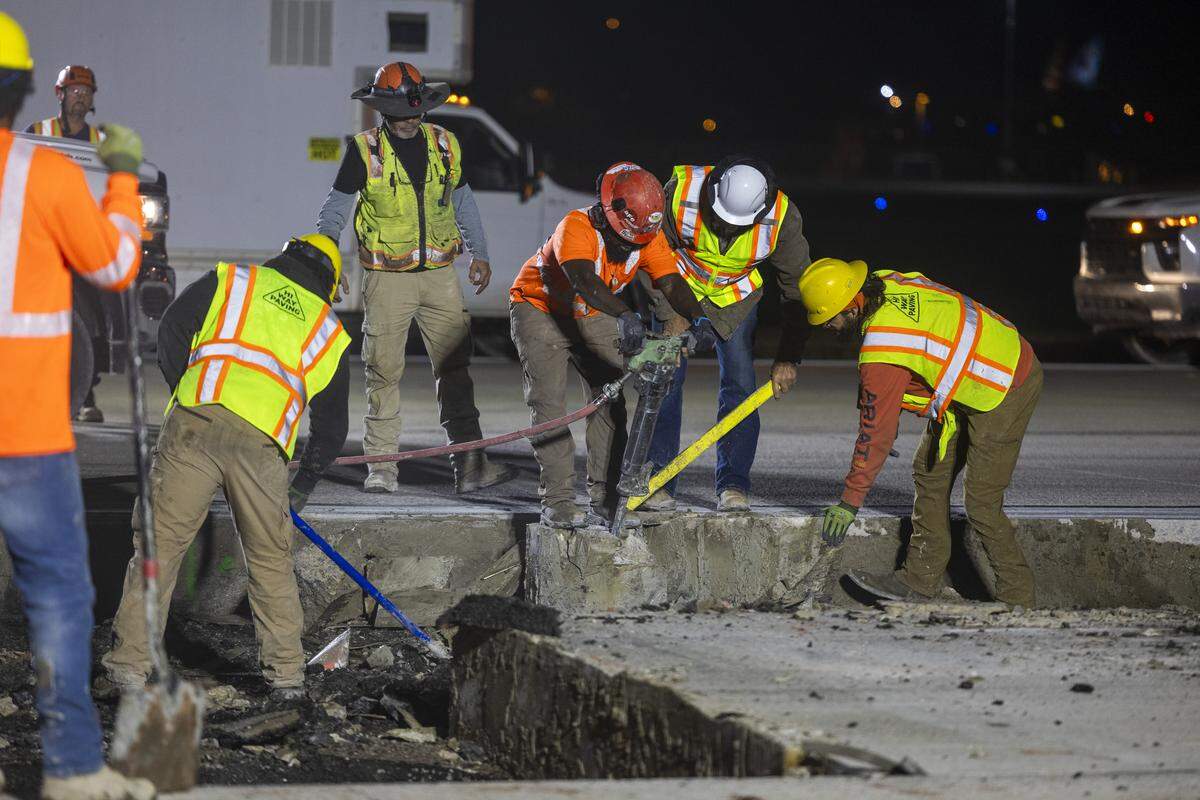
As the excavator lifts hunks of concrete, some weighing a ton, into dump trucks, nearly a dozen workers use shovels and brooms to collect pieces of asphalt left in the hole. Blue lights from the adjoining taxiways provide a backdrop, and just beyond, jets taxi between RDU’s main terminal and the 7,500-foot secondary runway on the east side of the airport.
Hi-Way Paving got started at RDU just after Labor Day. The work is done in the fall because the temperatures are right for pouring concrete — not too cold for the concrete to set on time or too hot for the airlines that have to use the shorter runway.
“We can’t do this in the heat of the summer, because planes like cool air,” Jewett said. “They lift better in cool air.”
8:36 p.m. First fresh concrete goes into the hole
Giant saws had cut the concrete two nights earlier, so it comes out fairly easily in pre-cut rectangles.
Hi-Way Paving is doing two adjoining slabs this evening, so the excavator is creating a hole 25 feet wide and 50 feet long. The operator is still removing chunks of old asphalt at one end of the hole as a front-end loader pours the first of the fresh concrete at the other.
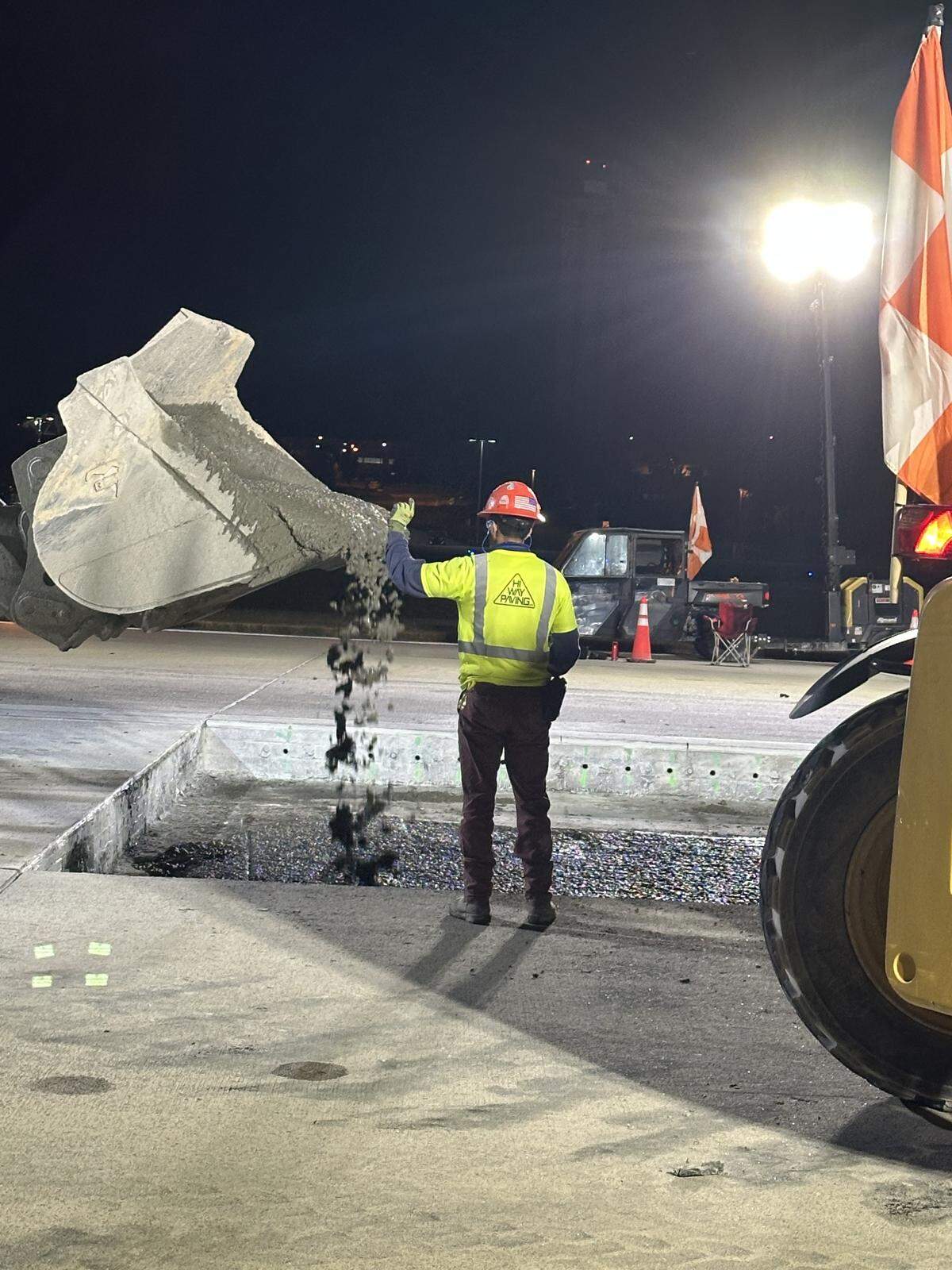
The concrete is made in a portable plant on the edge of the airfield. It’s formulated with a higher cement content to help it set faster. It’s sticky, like thick oatmeal, as it settles into the hole.
These first loads of concrete are known as the leveling course, spread across the bottom of the hole to create an even base on which the top layer will be poured. Jerry Girvan, Hi-Way’s superintendent on this project, runs the bucket of a front-end loader back and forth over the top to make it level.
The crew works nonstop but steadily; there’s no appearance of rushing. But Girvan, who lives in Florida, admits that its “stressful” demolishing a section of runway and rebuilding it in time for planes to use the next day.
It’s important that the workers hit their marks.
“The faster you get the concrete in there and laid out, gives it more chance to dry,” Girvan said. “I try to give it at least 12 hours. So if we’re done by midnight, you got 12 hours to noon. And then you’ve got a little bit of leeway in there.”
8:45 p.m. The old concrete is gone
About 1,660 cubic feet of concrete has been lifted out of the hole and loaded onto trucks. It’s hauled down the runway into the dark to an access road that leads to a crusher on the west side of the airport. There it will be broken down into a size that can be used to create the base for the new runway.
The adjoining concrete slabs create a 16-inch-high wall around the hole. Even before the excavation is complete, workers begin using a machine to drill holes into the wall three at a time. The drilling machine is loud, drowning out the sound of jets taking off and landing on the other runway.
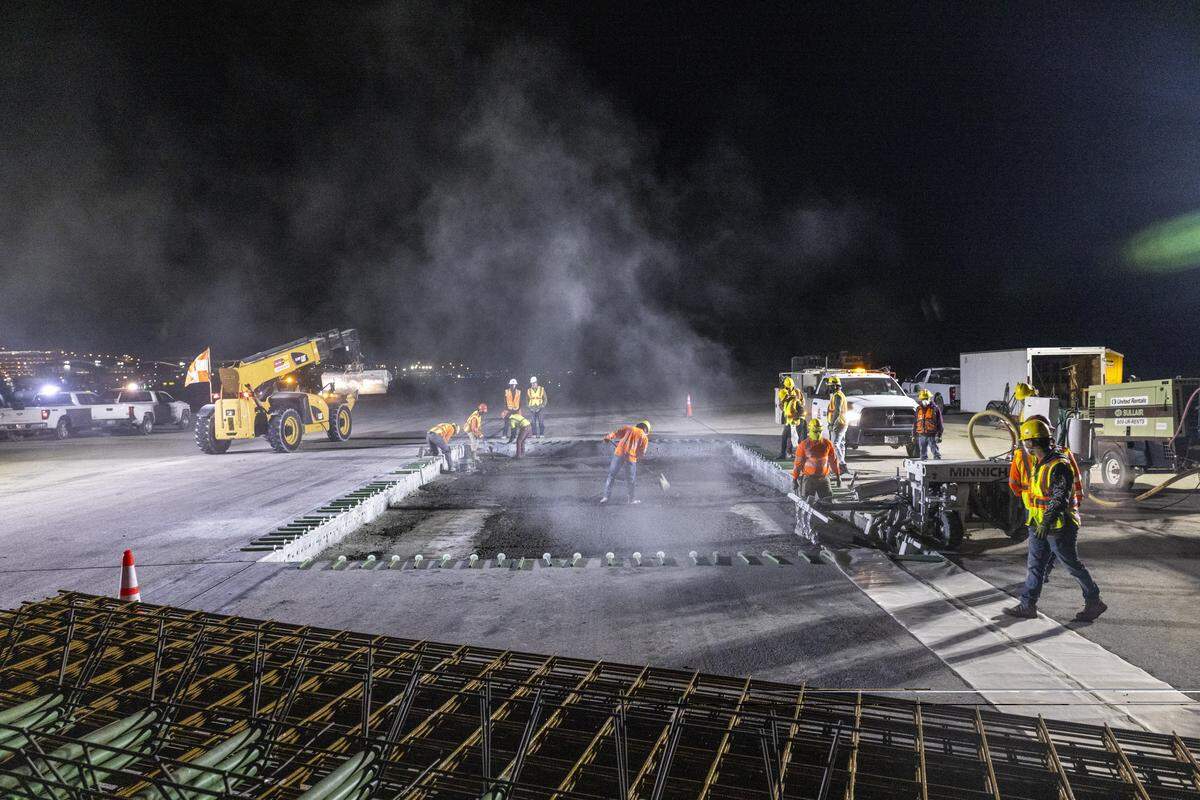
Above each hole, workers place 20-inch-long steel rods. Before they begin pouring the top layer of concrete, they’ll squirt some epoxy into each hole and then insert the rods, creating a connection between the existing concrete and the new slabs.
9:48 p.m. Final preparations for the top layer of concrete
Workers drape a layer of plastic sheeting over the leveling course of concrete, then begin placing sheets of steel mesh, supported by steel wire, on top. The steel will make the concrete stronger and help distribute the weight of planes.
As the steel is placed, workers move a large roller machine next to the hole. The machine, a triple tube roller screed or paver, is longer than the hole is wide and will roll atop the concrete to smooth it out.
The roller screed is relatively new on these jobs, says Jeno Cossette, general superintendent for Balfour Beatty, the airport’s general contractor. Cossette, who along with Girvan supervises the work each night, said it’s one example of how the company and its workers get better.
“As they do it each year, they find ways to make it more efficient and less stressful,” he said. “The screed that they flatten the concrete out with they bought specifically for these airport jobs, and it makes a world of difference.”
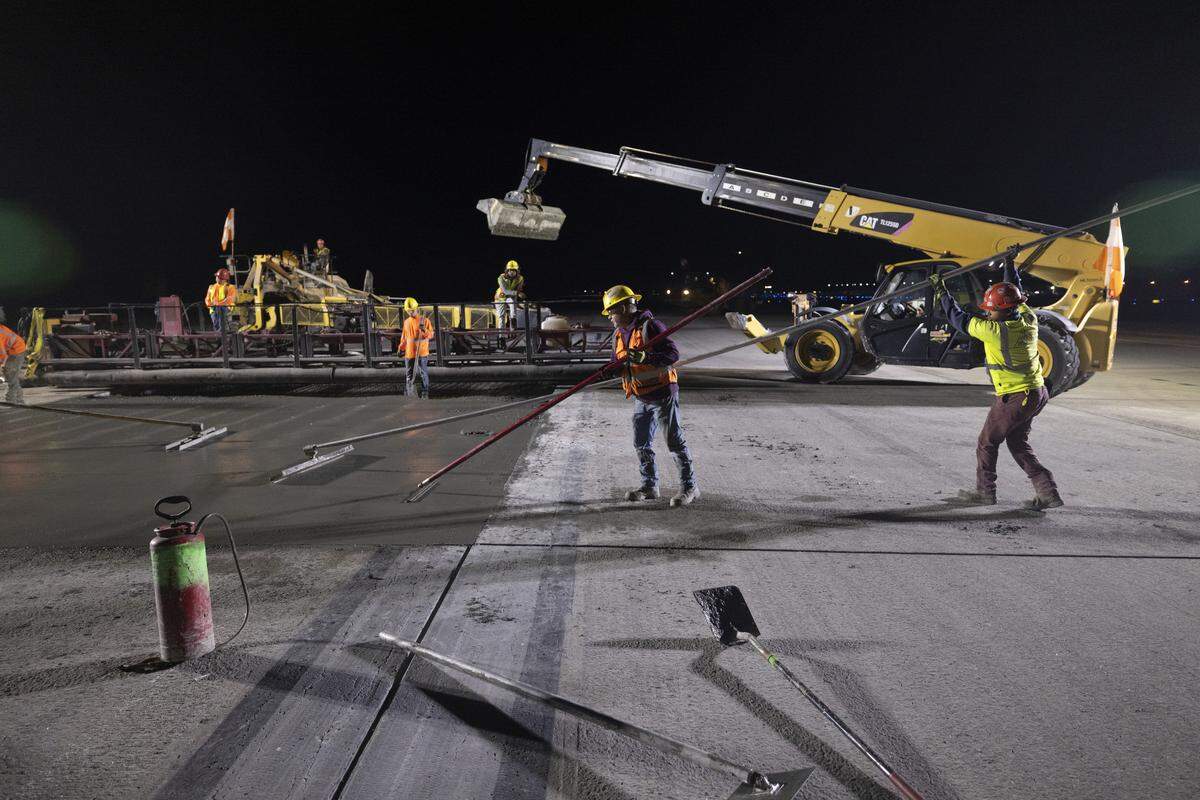
Before their first runway rehab this fall, Hi-Way Paving and its workers had four full dress rehearsals, digging up and replacing 25-by-25 slabs of concrete on taxiways that aren’t as critical as the runway.
“We don’t go on the runway until we’ve got the process ready,” Jewett said. “And inevitably we find things that need to be tweaked and fixed before we go out on the runway.”
10:02 p.m. Demolition and set-up workers leave
Hi-Way Paving has two sets of workers on the runway project — a day shift and a night shift. Both shifts work from about 6 p.m. until the old concrete has been removed and the hole is prepared for the final layer of new concrete.
The workers who leave now will be back at 7 a.m. to finish cleaning up. Any dust or detritus, known as FOD or foreign object debris, must be removed from the runway, so it doesn’t get ingested in a jet engine.
Hi-Way Paving’s contract stipulates that the runway patches be cured and ready for planes by 3 p.m. Each minute the runway must remain closed after that will cost the company $100, up to a maximum of $24,000 a day.
Hi-Way and companies that did the work before it have rarely missed the deadline. It happened once last year when a saw blade became stuck in the runway. This fall, Hi-Way was 35 minutes late one afternoon after hydraulic fluid spilled from one of the machines and had to be cleaned up.
But so far, no scheduled departures have been scrubbed because of the runway repairs, Jewett said. And despite the stakes, he said he doesn’t stay up late worrying about it.
“I sleep very well,” he said, “because there are some very good people working on it.”
10:20 p.m. Top layer of concrete begins flowing into the hole
The same dump trucks that carried away the old slabs now begin shuttling wet concrete from the plant. It’s loaded into a machine with a conveyor belt on a long boom that swings over the hole.
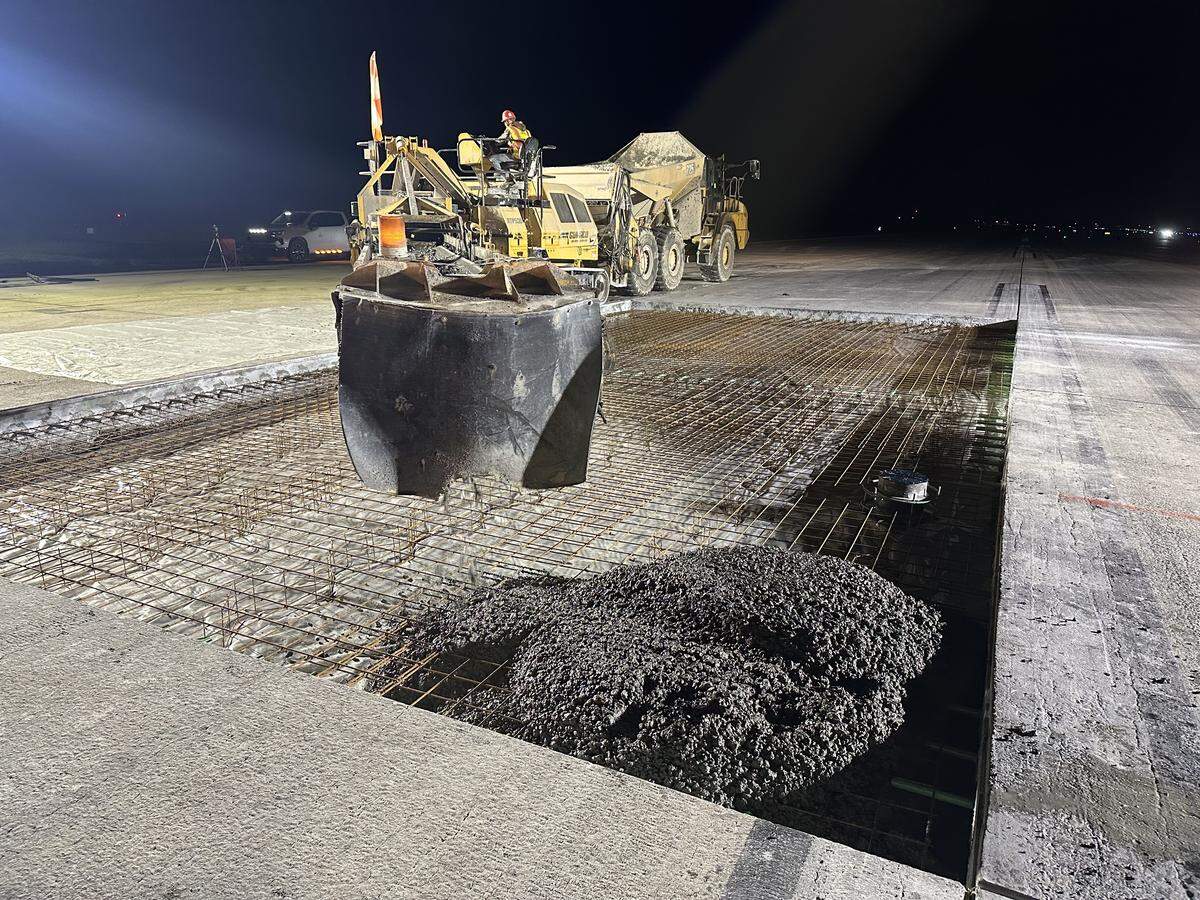
After a small amount is poured, the operator stops while contractors test the concrete’s consistency and strength to make sure it meets Federal Aviation Administration specifications. Two engineers measure the temperature and air content and how much it “slumps” after it’s released from a mold. A thumbs up means the mixture is good and the pouring can continue.
Workers use shovels and placers to move the concrete around and try to distribute it evenly. Once enough of the hole is filled at one end, the roller begins moving back and forth over it.
11:30 p.m. Final load of concrete poured into the hole
A little more than four hours after the trucks hit the runway, the last of the concrete flows off the conveyor. The roller machine makes its final pass about 11:39 p.m.
Behind the roller, men with flat tools called bull floats smooth the concrete further. Others then use a wide rake to etch grooves into the surface, which will help the wheels of jets grip the runway when they’re landing or taking off at 150 mph.
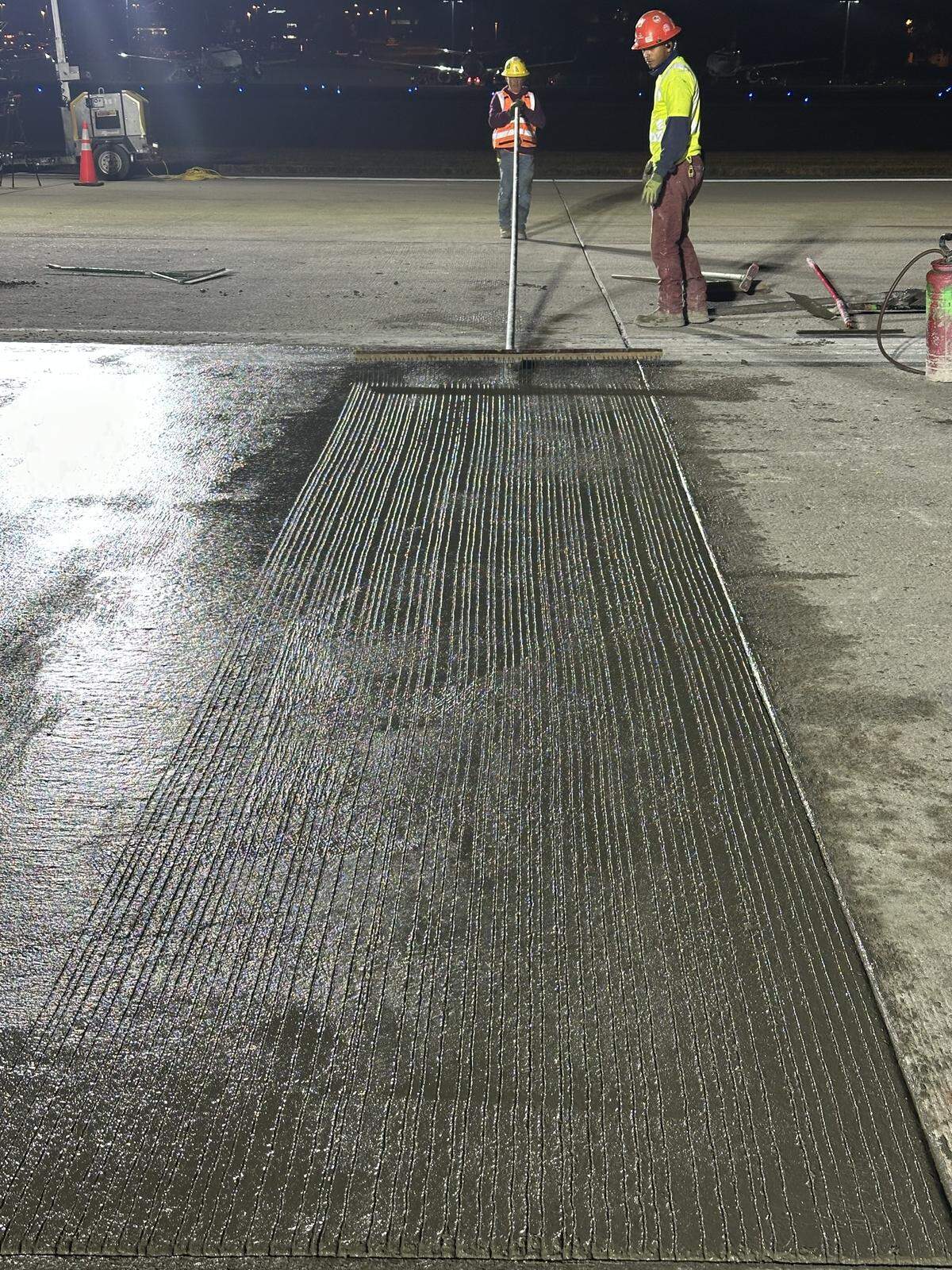
Finally, a worker sprays the flattened concrete with a curing compound that helps keep the moisture in.
The work is done by midnight.
Tuesday, 2:15 p.m. The runway reopens
A Boeing 737, American Airlines flight 2704 from Charlotte, is the first plane to land on 5L/23R on Tuesday afternoon. The new patch of concrete was cured enough that the airport could open the runway 45 minutes early.
To help determine whether the concrete is ready, engineers measure its strength by molding it into 18-inch-long beams when it’s first poured and then pressing them after eight and 12 hours until they break. In addition, a small digital thermometer embedded in the fresh concrete sends readings via Bluetooth that indicate that the internal temperature is increasing at a rate consistent with proper curing.
At 7,500 feet, RDU’s secondary runway is long enough to handle any incoming plane, Jewett said. But big planes taking off for Europe or the West Coast fully loaded with people and fuel need that 10,000-foot runway, he said.
Lufthansa’s flight to Frankfurt, Germany, was scheduled for 3:40 p.m., followed by Air France to Paris and American to London three hours later. After they take off, the airport closes the runway again so it can replace another panel or two of concrete.
RDU has spent about $30 million on this runway rescue operation so far, Jewett said. It expects to have to continue overnight patching work each fall until the new runway opens, at a cost of $7 million to $8 million a year.
The airport doesn’t really have any choice, Jewett said.
“We assess the runway several times a year, and we just did it again last week,” he said. “And we feel fairly certain that we can wait until next fall to do this again. There are times when we think we’ve got it, that the deterioration rate is going to let us have a break. But it doesn’t look like 2026 is going to give us a break.”
This story was originally published November 5, 2025 at 5:30 AM with the headline "RDU airport keeps its main runway alive, one slab of concrete at a time."
CORRECTION: An earlier version of this story incorrectly said workers were using a tool called a bowl float to smooth the concrete. The tool is a bull float.