Mass transit to RDU airport? Here’s one idea for how to make it happen
AI-generated summary reviewed by our newsroom.
- North Carolina DOT study proposes BRT station linking I-40 to RDU terminals.
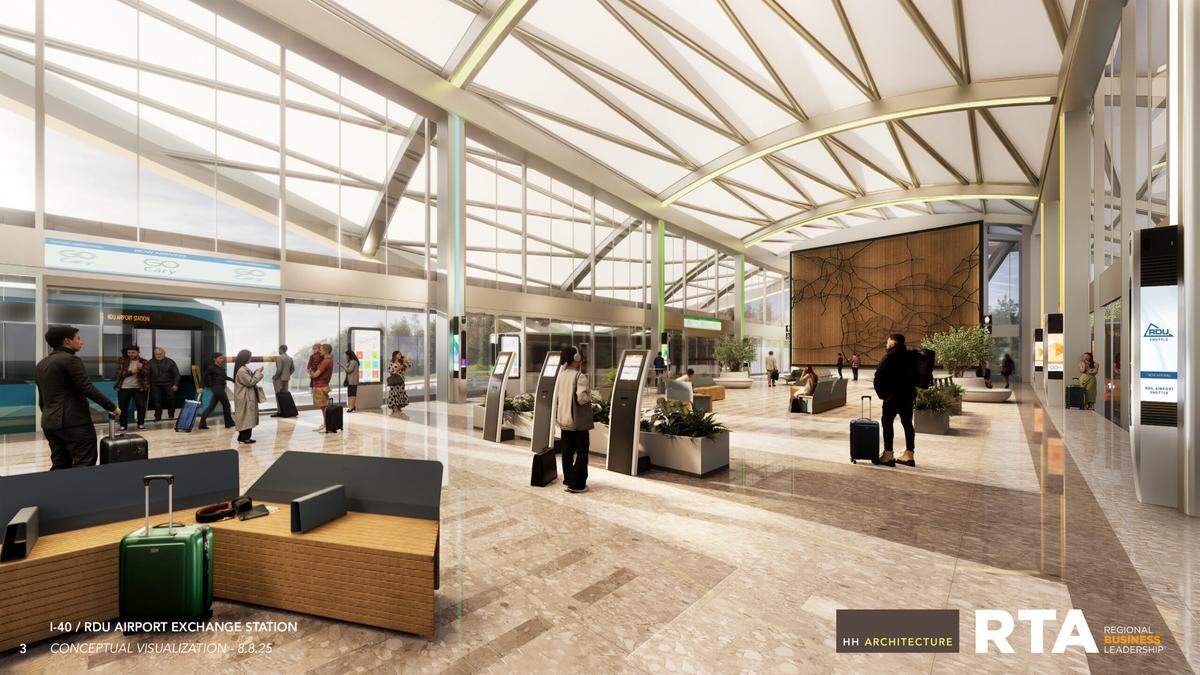
- Design features include elevated platforms, ticket kiosks, and shuttle access.
- Project timeline and responsible agencies for construction remain undetermined.
In a region where people depend on cars to get around, there’s one place many would consider taking mass transit: the airport.
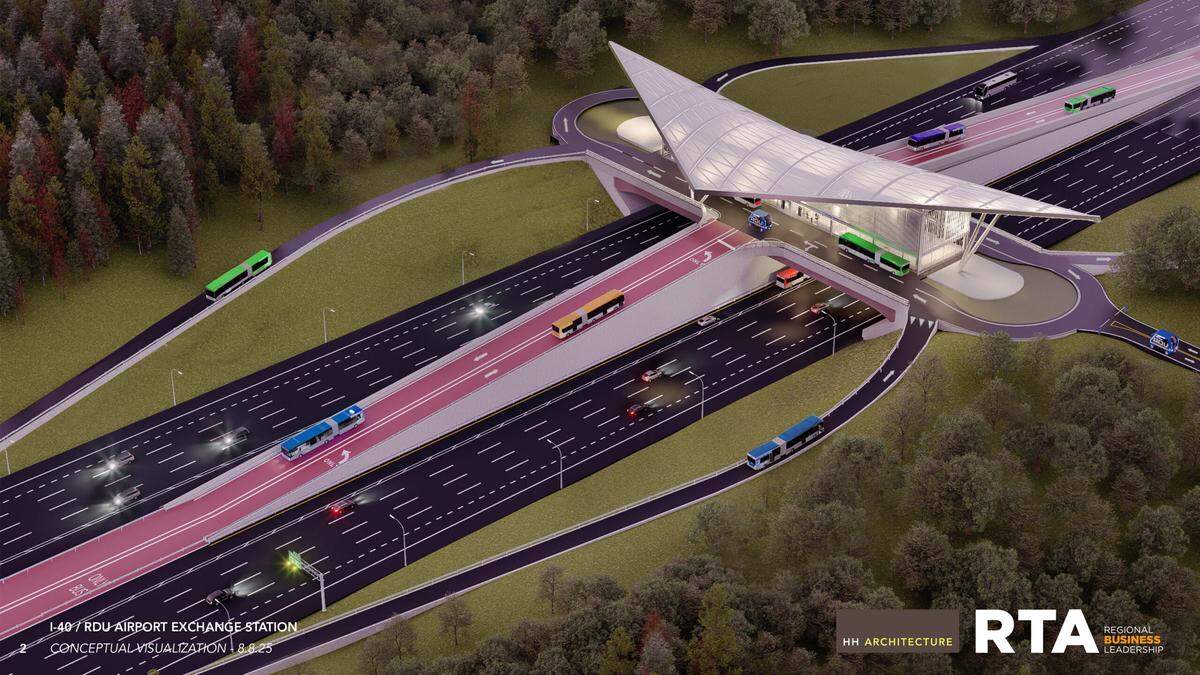
Now an idea for improving transit to Raleigh-Durham International Airport has emerged from a study coordinated by the N.C. Department of Transportation. It entails building a bus rapid transit station over Interstate 40 where people could catch a shuttle bus to the terminals, just as they do from remote parking lots now.
Conceptual drawings of the station were unveiled earlier this month at a meeting of local government and business leaders. The gathering was organized by the Regional Transportation Alliance, a program of the Raleigh Chamber of Commerce that has been a vocal supporter of BRT in the Triangle.
Joe Milazzo, the group’s executive director, says BRT should stand for “Buses Resembling Trains,” because it has some of the attributes of rail, including dedicated lanes to avoid traffic and covered, elevated platforms where people buy tickets in advance.
“We are committed to accelerating an I-40/RDU exchange station as soon as possible, along with companion I-40 BRT to link the region together,” Milazzo wrote in an email.
It’s not clear yet, though, who would build the BRT station at RDU and when.
The NCDOT study, due out in the coming weeks, offers a vision of what’s possible rather than an actual blueprint, said Brennon Fuqua, director of the department’s Integrated Mobility Division. It would be up to NCDOT, local governments and the transit agency GoTriangle to figure out how to create the station, Fuqua said in an interview.
“The next steps are how do we take this plan and put it into our prioritization as projects come forward in the future,” he said.
The NCDOT study is called FAST 2.0, an acronym for “Fast, Arterial, Street, Tactical.” It looks at how existing streets and highways in the Triangle could be expanded or altered to provide dedicated lanes for buses, one of the basic features of bus rapid transit.
How the RDU exchange might work
RDU is served by only one public bus system, GoTriangle, which operates a shuttle every half-hour between the airport and its transit center near Research Triangle Park. After 6 p.m. GoTriangle Route 100, an express bus between the transit center and downtown Raleigh, stops at the airport, though only every hour.
GoTriangle created the RDU shuttle in part because it doesn’t want its Route 100 to get bogged down in traffic at the airport terminals, said Paul Black, manager of project planning for GoTriangle. Building an exchange station out at I-40 would eliminate the need for the shuttle, Black said in an interview, and allow Route 100 to offer direct service to and from RDU.
“It gets us out of that slog through the terminals that puts us off our schedule,” he said.
The Regional Transportation Alliance enlisted an architectural firm to create images of what the exchange station might look like. It would be prominent and iconic, says Milazzo, and draw attention to transit as an option to the airport.
WSP, the consulting firm that worked on the FAST study, created a video to show how the exchange station would work. It shows buses using ramps leading from I-40 onto a figure-eight-shaped roadway above the highway, with the station platforms on either side. Airport shuttles would use a separate road to get to and from RDU.
The station would help ensure that buses move more smoothly, said Michael Landguth, RDU’s president and CEO,
“We need that BRT to be able to be on time all the time, and if they come off that roadway system into our facility, it’s going to wind up delaying them in other locations,” Landguth said in an interview. “So we will make a commitment to go out there and pick those customers up.”
BRT emerges as most likely transit in the Triangle
The development of BRT in the Triangle follows years of planning for commuter and light rail systems that were ultimately abandoned or shelved. A big challenge for the Triangle is that the region’s 2.1 million residents are scattered and commute to any one of a half-dozen or more centers, rather than a single downtown.
“We’re just too spread out,” Black said.
Bus rapid transit is far cheaper than rail and can more easily be built in increments, Black said. The ultimate vision of the FAST study is that by giving buses their own lanes and the ability to bypass traffic they will attract more riders.
Construction of the first BRT system in the state begins soon in Raleigh along New Bern Avenue between downtown and a new park-and-ride lot off New Hope Road. It’s the first of four BRT lines radiating from downtown Raleigh envisioned by the Wake Transit Plan, which was endorsed by voters in 2016 when they approved a transit tax to help pay for them.
Chapel Hill expects to begin building its first BRT line in 2027, while Durham has begun planning a BRT corridor that would connect Duke University, downtown and Wellons Village in East Durham.
“I think this bus rapid transit thing is going to grow and evolve over time,” Black said. “It’s going to be the way that we make connections in the Triangle, at least for the next generation or two.”
This story was originally published August 19, 2025 at 9:36 AM with the headline "Mass transit to RDU airport? Here’s one idea for how to make it happen."