Raleigh leaders pressed on housing promises at packed church event
AI-generated summary reviewed by our newsroom.
- Raleigh leaders face pressure for unmet promises on affordable housing goals.
- Advocates urge $200M bond while officials hesitate amid recent bond failures.
- One Wake calls for use of Randleigh Tract despite infrastructure constraints.
The Rev. Whitney Hall and her wife did all the right things. They went to school. They have full-time jobs.
“We did all of the things that we were told and were taught would allow you to build security, to buy a home, to have the things that you need,” she said. “But one thing that we have found in a day like this is we can’t afford to a buy a home here in Raleigh, North Carolina, and that is a hard truth.”
Hearing her words, the handheld church fans beat with intensity on a sweltering July day.
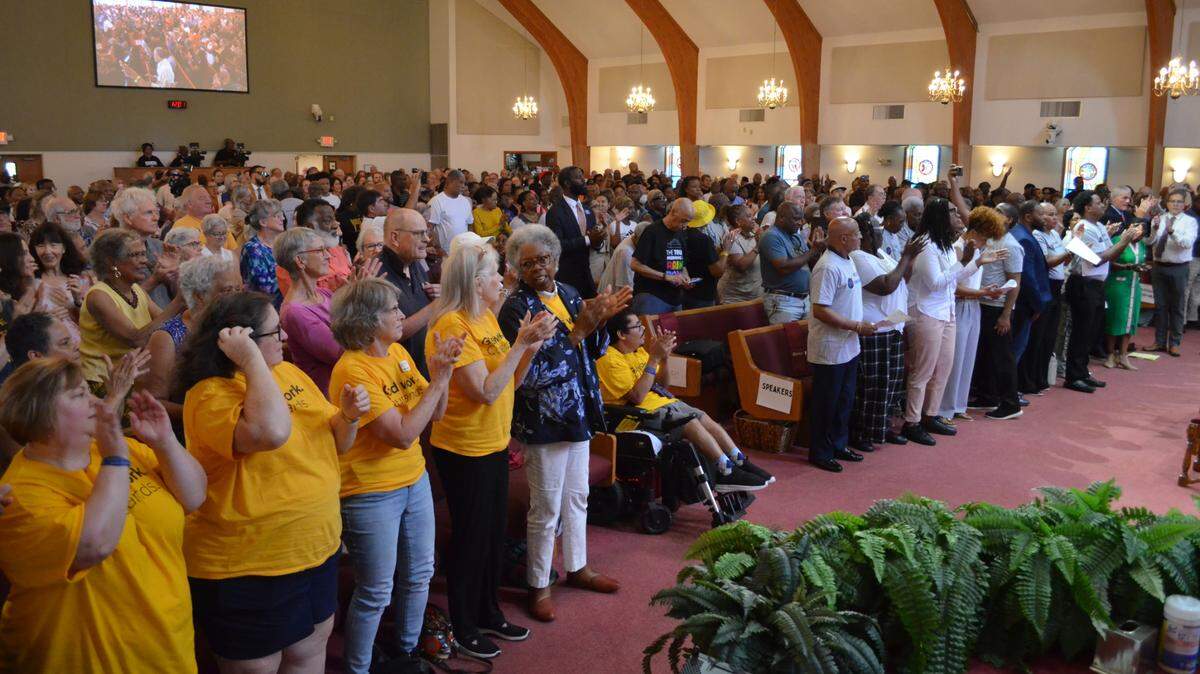
More than 1,000 people gathered in the sanctuary and two overflow rooms at Watts Chapel Missionary Baptist Church on Saturday to advocate for more affordable housing and hear from Raleigh’s elected leaders.
The assembly was organized by One Wake, a nonpartisan organization made up of religious congregations and groups in Wake County that advocates and focuses on several topics including affordable housing.
“We believe in no permanent allies,” said the Rev. Donna Coltrane-Battle. “We believe in no permanent enemies, only permanent interests in securing wins that will tangibly impact the quality of life, the respect of human dignity of all of those who are either intentionally harmed or who become collateral damage in the strategic enterprise of dominant power.”
She quoted civil rights activist Fannie Lou Hamer saying, “You can pray until you faint, but unless you get up and try to do something, God is not going to put it in your lap.”
Seven out of eight Raleigh City Council members, including Mayor Janet Cowell, were in attendance at One Wake’s assembly. Council member Jane Harrison did not attend.
They were asked if they delivered on promises they made as candidates last year to increase the city’s affordable housing budget from $30 million to $70 million, if they’d identified 100 acres of land for affordable housing and visited Nehemiah, a Brooklyn-based affordable housing development local advocates would like to see the city replicate.
City leaders acknowledged they hadn’t increased the affordable housing budget to $70 million and hadn’t identified 100 acres for future affordable housing.
The city of Raleigh’s approved affordable housing budget did increase this year, and included $11.8 million, the last bit of funding from the city’s $80 million affordable bond, and $11.6 million funded by property taxes for affordable housing.
All the city leaders agreed a new larger affordable housing bond would be needed, but some would not commit to $200 million like advocates asked of them.
While bond failures are rare, three of the five failures across the state in 2024 were in Wake County, including a $30 million affordable housing bond in Cary.
‘I think when you see some of these failures, you just want to be careful that you’re not going out and setting yourself up for failure,” Cowell said. “We haven’t even started the conversation yet, so I just want to go through the correct process with staff. I do feel confident that we will have an affordable housing bond. I feel like confident we will size it in a way that will make a dent, and will also pass.”
One Wake also advocated for affordable housing to be placed on the Randleigh Tract, more than 300 acres jointly owned by Raleigh and Wake County.
The two governments bought the property, at 3221 Auburn Knightdale Road, about 20 years ago. And there are challenges with putting affordable housing on the property, including a portion already reserved for a fire training center and plans for Interstate-540 to cut through the property.
One Wake is a member of the Industrial Areas Foundation, IAF, the nation’s largest network of faith-based organizations. One Wake’s method of accountability is similar to other Triangle IAF-organizations like Durham CAN (Congregations, Associations and Neighborhoods) and Orange County Justice United: It relies on government leaders to answer “yes” or “no” on various questions.
Cowell spoke to her pastor and other council members have spoken to their religious leaders to pursue a “collaborative dialog.”
“We understand this is a model that IAF uses, but we think for these issues, it would be better to have ongoing collaborative dialog,” she said. “They’re coming up with their numbers and targets and (city) staff is over here coming up with numbers and targets, and then we’re kind of in this awkward middle point where I think there’s a lot of good things happening, but I can’t necessarily say ‘yes’ to each question.”
The need for affordable housing in Raleigh and Wake County has never been greater, attendees said.
The North Carolina Housing Coalition estimates that 27% or 120,490 households are cost-burdened, meaning they pay more than 30% of their income on housing.
More than 72,000 rental households, or 47%, have a difficult time affording their homes. Nearly 50,000 homeowners, or 17%, have a difficult time affording their homes.
There were 779 foreclosures and 29,599 evictions in Wake County last year.
The Raleigh City Council is on a six-week break for the summer and is expected to talk about a future affordable housing bond and a transportation and transit bond later this fall ahead of the 2026 election.
This story was originally published July 12, 2025 at 5:16 PM with the headline "Raleigh leaders pressed on housing promises at packed church event."