Thousands of prehistoric artifacts found where Wake County highway opens this week
Before the trees were cut and the bulldozers moved in to build NC. 540 across southern Wake County, archaeologists followed the route, looking for places people might have lived thousands of years ago.
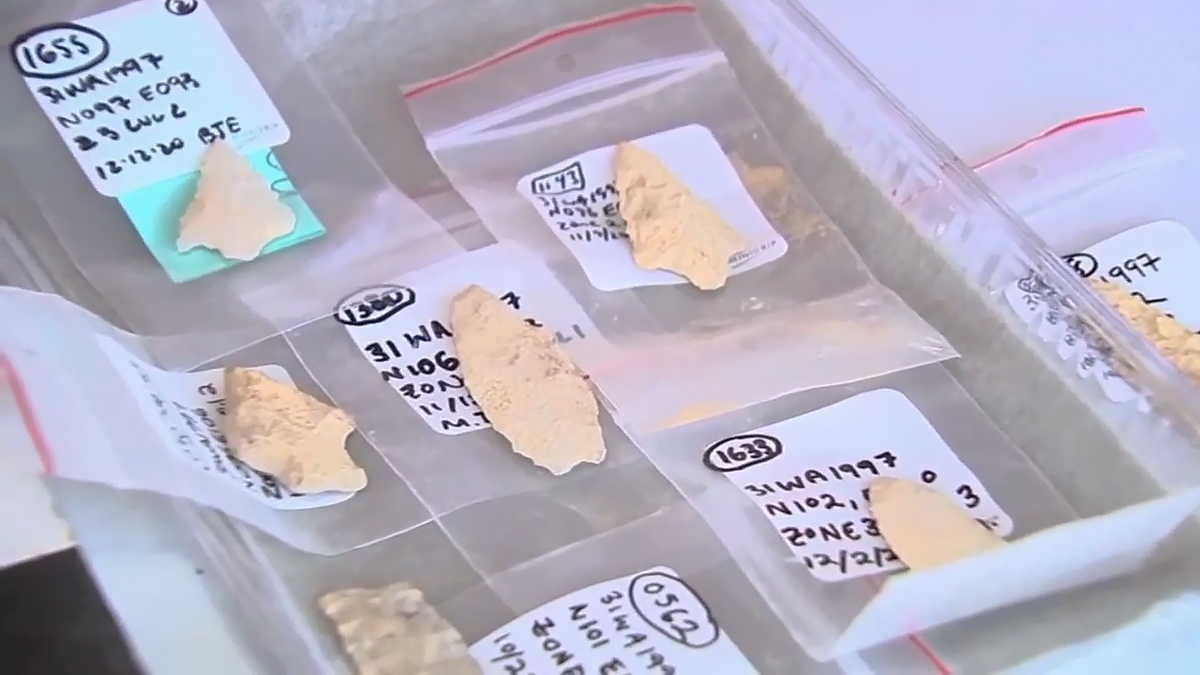
They discovered a treasure trove along a creek east of Interstate 40. Sifting through the dirt, they found more than 24,000 artifacts, including shards of clay pots and other vessels; stone points used on spears, arrows and hand tools; and at least one piece of jewelry.
As the southern leg of the Triangle Expressway opens to traffic this week, those items are poised to join the state’s archaeological collection in Raleigh. Without the work of the archaeologists, they would have been churned up and paved over by the six-lane highway.
“It was going to be blitzed by the construction,” said Matt Wilkerson, who heads the N.C. Department of Transportation’s archaeology program. “This site was pretty much smack dab in the middle.”
NCDOT is required by state and federal law to determine whether road and bridge projects are likely to destroy important archaeological sites. That falls to Wilkerson and his team of six archaeologists, with help from consultants and the Office of State Archaeology.
They evaluate between 300 and 400 projects a year, focusing on those most likely to yield results: roads built on new right-of-way and bridges where flood plains can conceal well-preserved artifacts. The 18-mile extension of N.C. 540, across fields, forests and house lots from Apex to near Garner, was a good candidate.
NCDOT’s team gradually moved the length of the future highway corridor, pushing soil samples through a quarter-inch mesh to see what showed up.
“It’s like a chess board,” Wilkerson said. “We dig holes at a certain interval. If we find something, we tighten up that interval and dig some more.”
The goal is not to find and remove every artifact in the highway’s path. Instead, it’s to document what’s there and explore more deeply the most significant sites.
“We’re after sites that have integrity, where the soils are intact,” Wilkerson said. “That way we know the materials that we’re finding are not just all jumbled up. They might actually be able to tell us a little something about the site.”
The team found artifacts in more than 150 places along the path of the highway. But only one site was so rich and undisturbed that it was considered eligible for the National Register of Historic Places. And that site needed to be excavated, because it was directly in the highway’s path.
A popular spot over thousands of years
It was on a small rise just above a creek, which likely made it an attractive place to camp. It was extensive enough that NCDOT contracted with Commonwealth Heritage Group, a consulting firm based in Tarboro, to help with the work.
Using radio carbon dating and other techniques, the archaeologists determined that most of the artifacts they found were from two distinct periods: 6,000 to 5,500 BC or middle archaic and the middle woodland era, from 300 BC and 800 AD.
In neither case does it look as if the site was a permanent settlement, Wilkerson said. People may have spent a season along the creek, before moving on. The more recent occupants in particular seem to have spent little time at the site, which may have been a satellite of a larger settlement nearby, he said.
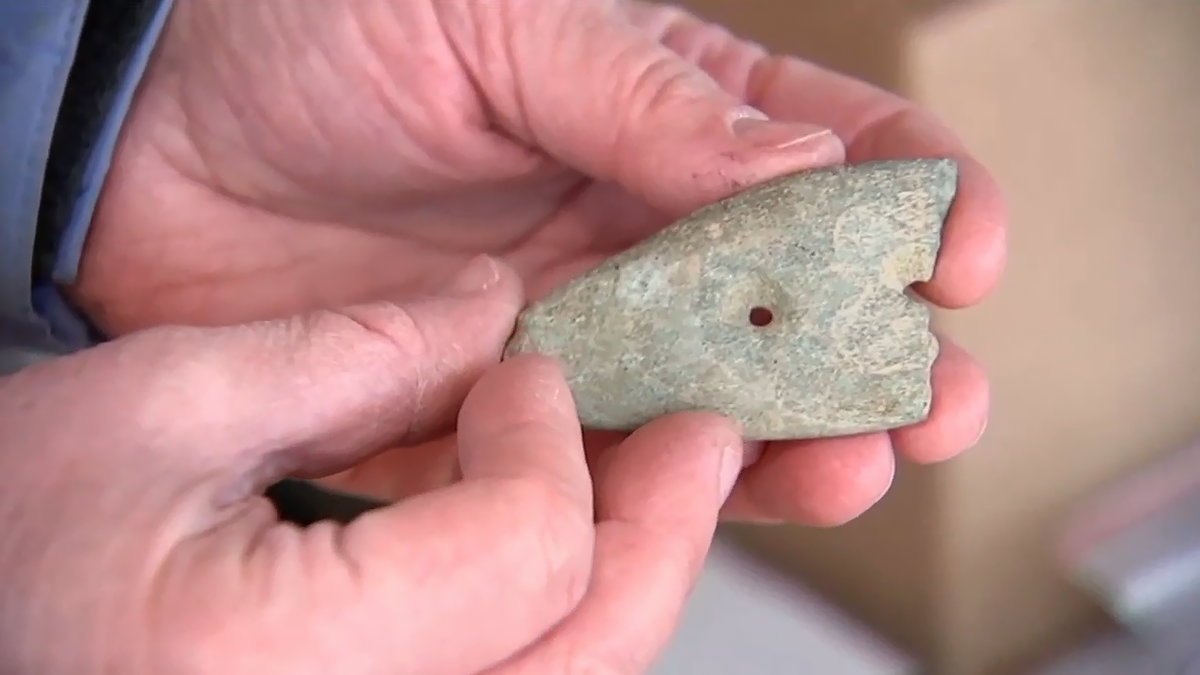
Perhaps the coolest item the archaeologists found was part of a gorget or piece of jewelry from sometime in the woodland period. The polished piece of stone was tapered on both ends and had been drilled with holes for a cord or leather strap.
“We don’t really know if it’s ceremonial or it’s just jewelry that someone would wear,” Wilkerson said. “We haven’t found many of those.”
None of what the archaeologists found at the site is a museum piece, said David Cranford, an assistant state archaeologist with the Department of Natural and Cultural Resources. But taken together, they are notable, Cranford said.
“Usually we say, ‘It’s not what you find but what you find out,’ the collective assemblage that can help tell a story,” he said. “And this was a pretty significant site.”
In particular, the concentration of ceramic pottery, the presence of a hearth or fire pit and fragments of burned walnut shells help show how people lived at the time.
NCDOT and its consultants cataloged and documented what they found; a few of the items were on display at 540 Fest, when people were invited to run and cycle on the nearly completed highway in June.
Their permanent home will be at the Office of State Archaeology’s Research Center, where they’ll be available for future study.
This story was originally published September 24, 2024 at 8:00 AM with the headline "Thousands of prehistoric artifacts found where Wake County highway opens this week."