‘Sunset clause’ or ‘drafting error?’ Fate of RDU quarry hinges on intent of 1981 permit
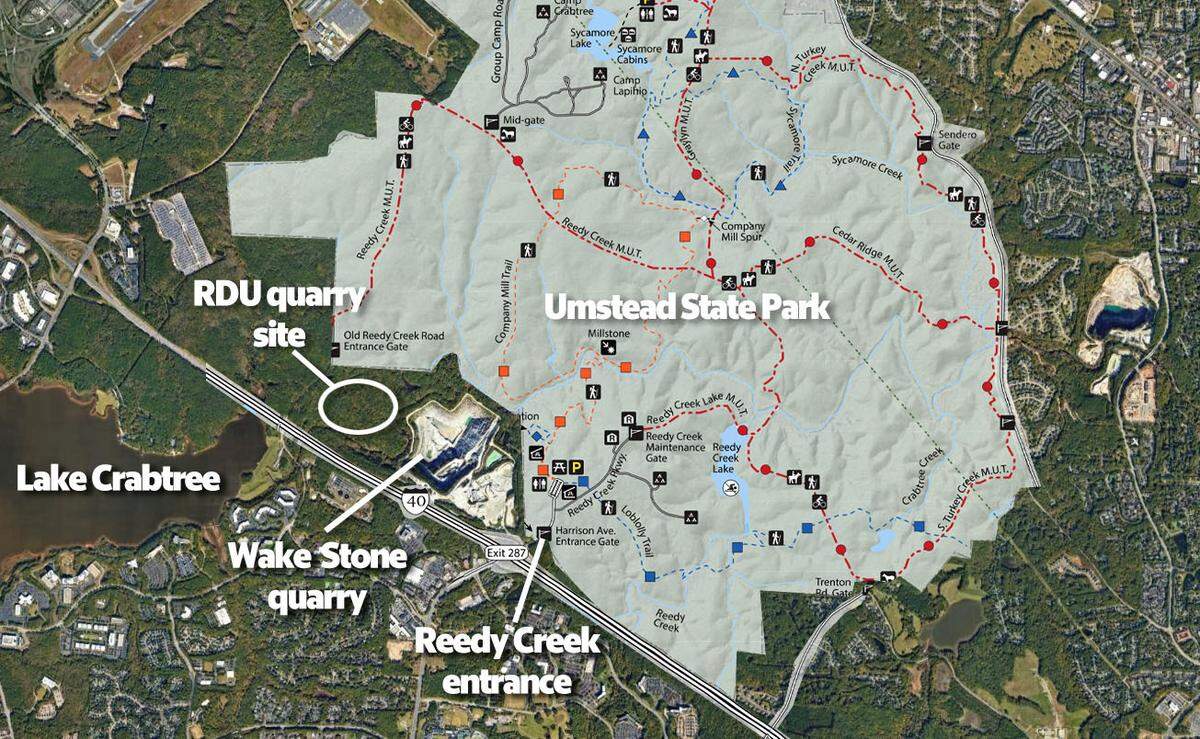
The planned expansion of a stone quarry next to William B. Umstead State Park may depend on a single word in a 43-year-old mining permit.
The word determines whether the mine’s owner, Wake Stone Corp., can continue its Triangle Quarry operation indefinitely or if it has to stop in 2031, 50 years after the permit was issued.
The Umstead Coalition, which advocates for the park, says that for decades the permit included a “sunset clause” that required Wake Stone to stop mining and donate the site to the state after 50 years.
But in 2018, the state Department of Environmental Quality changed a single word in the permit that eliminated the sunset clause. The Umstead Coalition sued the agency, and the case is now being heard before an administrative law judge.
If DEQ prevails, Wake Stone will be able to expand the Triangle Quarry operation onto adjacent property owned by Raleigh-Durham International Airport. If the coalition wins and the sunset clause is restored and enforced, Wake Stone would have to stop mining in a few years, making the RDU quarry expansion impractical.
The 1981 mining permit gave the state the right to acquire the quarry site at no cost “at the end of 50 years from the date quarrying commences or 10 years after quarrying operations have ceased without having been resumed, whichever is sooner.” At this point, with the mine still in operation, that would be 2031.
The clause remained in the permit when it was renewed in 1991, 2001 and 2011.
But in renewing the permit in 2018, state regulators at DEQ changed the word “sooner” to “later,” postponing the state’s ability to acquire the property until 10 years after Wake Stone is finished mining. The company expects to quarry stone from the RDU property for at least 25 years.
Wake Stone requested the change. The company cited the state Mining Commission’s decision in April 1981 to allow the quarry, which used the word “later.” When the actual permit was issued the following month, “later” had been changed to “sooner,” something the company says was an “editorial/typographical error.”
DEQ did not agree in 2011, when the company first made the request, but changed its position in 2018. On Tuesday, lawyers for the state Department of Justice defended that decision before Judge Donald van der Vaart at the N.C. Office of Administrative Hearings.
Regulators were simply making the language consistent with the Mining Commission’s order from 1981, said Assistant Attorney General Carolyn McLain.
“All these years later, even today, the division is not aware of a single historic document showing definitively that the change of the language from later to sooner was anything other than a drafting error,” McLain said in an opening statement.
Clause was not a mistake, coalition says
But the Umstead Coalition says the inclusion of a sunset clause in the final permit was intentional. State regulators and politicians opposed a quarry next to the park, it says, and the clause was a compromise between Wake Stone, the state Attorney General’s Office and environmental regulators to help ameliorate concerns about its impact.
That’s why Wake Stone did not contest the permit in 1981 or object to the clause for 30 years, said James Conner, the coalition’s attorney. And it was only after nearly 40 years, when no one at DEQ knew the history of the permit, that the agency agreed to make the change, Conner said in his opening statement.
“They just did it because Wake Stone asked for it,” he said. “There was no notice given to anyone, none of the proper procedures were done. It was just done by email effectively.”
The hearing before van der Vaart is expected to last several days. The case will hinge on dozens of documents regarding the Mining Commissioner’s decision and the permit, since most of the people involved in the case have died.
Only one is expected to testify: Rufus Edmisten, the attorney general at the time the original permit was issued.
In an affidavit included with the Umstead Coalition’s lawsuit, Edmisten said he, Gov. Jim Hunt and Howard Lee, secretary of what is now the state Department of Environmental Quality, all opposed allowing a quarry next to Umstead. When the Mining Commission approved it anyway, Edmisten said, the sunset clause was included in the permit to enforce Wake Stone’s public statements that the mine would operate for 50 years.
In the Spotlight designates ongoing topics of high interest that are driven by The News & Observer’s focus on accountability reporting.
This story was originally published June 18, 2024 at 5:12 PM with the headline "‘Sunset clause’ or ‘drafting error?’ Fate of RDU quarry hinges on intent of 1981 permit."