Triangle commuter rail endorsed, then shelved as focus shifts to ‘smaller bites’
The Triangle isn’t ready for commuter rail, but there are steps that local and state governments can take in the coming years to make a regional passenger rail line more likely in the future.
That’s the growing consensus among transportation planners and local politicians six months after GoTriangle completed a feasibility study for a commuter rail line between Durham and Garner.
Federal officials have indicated that they won’t help pay to build such a system now. There aren’t enough people living along the rail corridor for the project to qualify for federal construction money, says Sig Hutchinson, the former Wake County commissioner who heads the GoTriangle board.
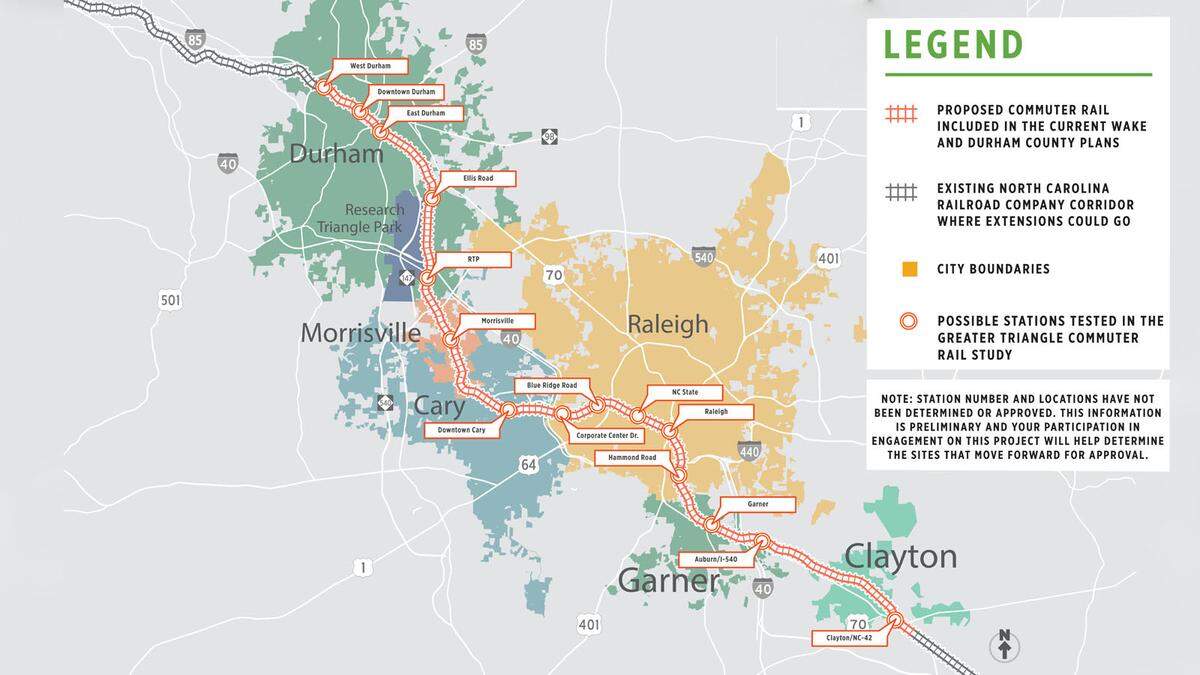
But the project remains a long-term goal, Hutchinson said. At his urging, the GoTriangle board voted last week to endorse the idea, outlined in the feasibility study, of eventually running passenger trains along 37 miles of an existing railroad corridor between Durham, Research Triangle Park, Cary, Raleigh and Garner.
“We are still 100% committed to regional passenger rail,” Hutchinson said.
But it won’t happen any time soon. Without federal support, Triangle governments would need to find the entire $3 billion or more to build the system, something they’ve indicated is “not palatable,” said Charles Lattuca, GoTriangle’s CEO and president.
“What’s coming back to us is, let’s take a longer-term approach,” Lattuca said. “Let’s see what we can do with small projects, smaller bites, to achieve a project later that will be less costly.”
Many of those smaller projects are steps the N.C. Department of Transportation or local governments want to do anyway to make the rail corridor safer or improve conditions for Amtrak and freight trains. These include upgrading signals, adding tracks and sidings or improving passenger stations.
Lattuca noted that GoTriangle and Durham County are studying how to eliminate three dangerous rail crossings in East Durham, by either closing them or building bridges or underpasses.
“If we can do that, that’s going to make a future passenger rail project much more feasible and cheaper,” he said.
Hundreds of millions set aside for commuter rail
Commuter rail remains a centerpiece of transit plans in Durham and Wake counties. Both counties are setting aside millions of dollars a year for it from half-cent local sales taxes approved by voters. Wake County has earmarked $1.2 billion for commuter rail, while Durham has allocated $195 million.
Both county transit plans still refer to “commuter rail,” a term used since the idea was conceived several years ago. Early versions emphasized moving people to and from work, with the bulk of the trains running in the early morning and late afternoon.
But the COVID-19 pandemic scrambled work and commuting schedules for many people, and the final version of the plan includes trains running throughout the day. To reflect that change, GoTriangle has taken to using the term “regional rail.”
Still, the momentum for transit in the Triangle has shifted from rail to bus rapid transit or BRT, a cheaper and more flexible way of moving people that the federal government has shown a willingness to help pay for in Raleigh and Chapel Hill.
The Wake Transit Plan calls for building four BRT lines radiating out from downtown Raleigh, and construction on the first of those, along New Bern Avenue, is expected to begin by the end of the year. Chapel Hill Transit hopes to begin building an 8.2-mile BRT line between Eubanks Road, UNC Hospitals and Southern Village in 2026.
There are no BRT lines planned in Durham, but the latest version of the Durham Transit Plan calls for studies of potential BRT routes.
In addition to endorsing the commuter rail plan, the GoTriangle board also voted last week to support a study of potential BRT routes that would connect local systems across county lines. One feature of BRT — dedicated lanes and priority at intersections — could help keep GoTriangle’s buses from getting bogged down in traffic, said Katharine Eggleston, the agency’s chief development officer.
“Year after year, our customers tell us that their No. 1 priority for improvements is buses running on time,” Eggleston said. “The simple fact is our buses get stuck in traffic.”
GoTriangle not abandoning regional rail
GoTriangle spent more than two years millions of dollars on the commuter rail feasibility study. Most of the money came from the Durham and Wake transit taxes, with a contribution from Johnston County, which is interested in possibly extending the line to Clayton.
The plan is the third attempt to develop a regional transit line that runs on rails in the Triangle.
In 2019, GoTriangle gave up on a proposed 18-mile light rail line between Durham and Chapel Hill, after the Federal Transit Administration said the project was unlikely to qualify for federal funding because of rising costs and uncertainty over acquiring the needed right-of-way.
Before that, GoTriangle’s predecessor, the Triangle Transit Authority, spent years planning a similar commuter rail system between Durham and Raleigh. That idea was abandoned in 2006 after failing to win federal support or funding.
This time, GoTriangle doesn’t want to give up on the idea of building a regional rail system in the Triangle. So while it waits for the region to grow and become denser, the agency will continue to look for ways to improve the corridor where local passenger trains might someday run.
“This is our incremental way of keeping alive this regional rail — I don’t want to call it a dream — but this priority that we have, because we know we’re going to need it in the future,” Lattuca said. “We think this region’s going to grow by more than a million people over the next 20 years. There’s going to be a lot of demand out there. And this is another way to try to meet that demand 15 or 20 years from now.”
This story was originally published August 27, 2023 at 5:45 AM with the headline "Triangle commuter rail endorsed, then shelved as focus shifts to ‘smaller bites’."