Buttigieg: Federal funding puts NC’s Alligator River bridge in rare company nationwide
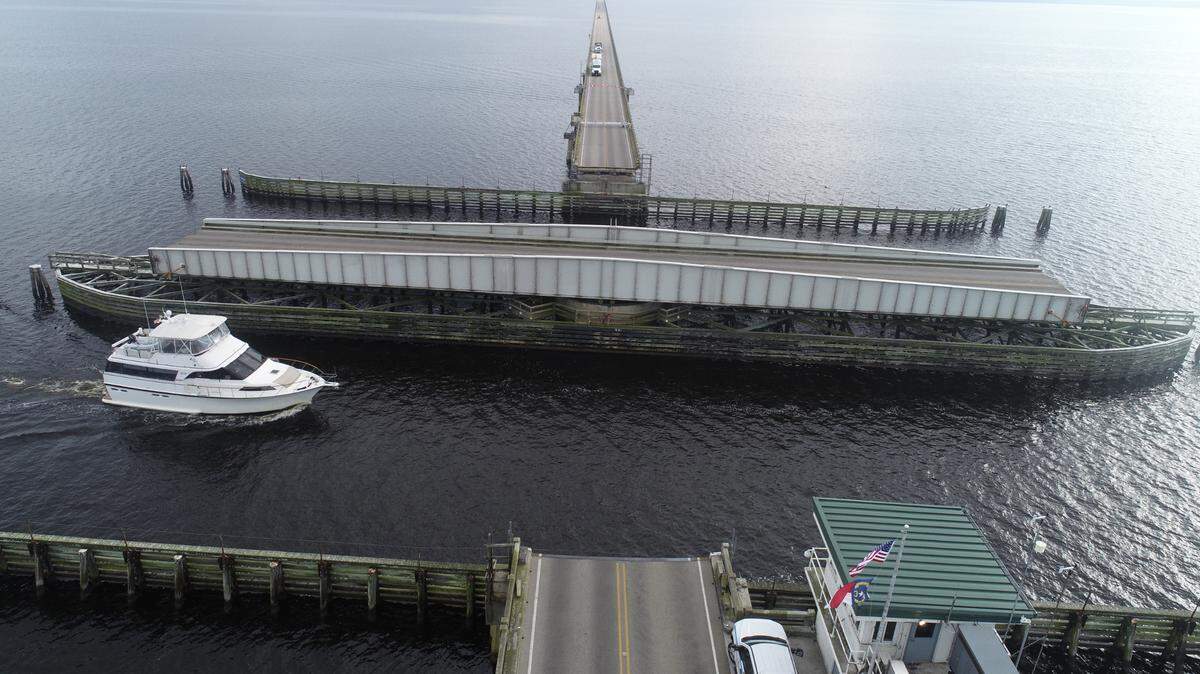
The planned new U.S. 64 bridge over the Alligator River is one of a handful of big transportation projects across the country getting a boost from a new program the Biden administration calls Mega.
The program, part of the infrastructure law passed by Congress in late 2021, made $1.2 billion available this year to help state and local governments pay for difficult but critical projects, said U.S. Transportation Secretary Pete Buttigieg.
“We got over 130 applications, and in this case we were able to fund nine projects,” Buttigieg said in an interview. “To give you a sense of how good a project had to be to make the cut.”
The N.C. Department of Transportation will receive $110 million to replace the 60-year-old Lindsay C. Warren bridge that connects Tyrrell and Dare counties. NCDOT expects to spend $268 million to build the new 3.2-mile bridge that will be both higher and wider than the existing one. A key feature will be the 65-foot clearance over the navigation channel, replacing a swing-span that brings traffic to a halt when it opens to let boats pass.
Buttigieg said the bridge, a vital link to the Outer Banks, is the sort of project Congress and the Biden administration had in mind when they created the National Infrastructure Project Assistance discretionary grant program, aka Mega. Others receiving funding this year include a railroad tunnel under the Hudson River in New York and a bridge carrying two interstate highways across the Ohio River in Cincinnati.
“The idea was to fund things that are so big and so complex that a lot of the traditional funding mechanisms just couldn’t get it done,” Buttigieg said. “And this $110 million award is going to make it possible to do this project.”
The first awards from the Mega grant program are part of more than $1 trillion Congress approved for highways, ports, railroads, airports and other infrastructure over the next five years. The money is meant to help expand and modernize the country’s aging transportation systems.
But it’s arriving at a time when construction contractors are already struggling to find workers and materials. The shortages have contributed to delays in completing projects that are already underway, including the widening of Interstate 40 south of Raleigh and the overhaul of a section of the Raleigh Beltline.
Contractors already struggle to find workers
After a dip in the early months of the COVID-19 pandemic, the number of people working in construction in North Carolina is about 6% higher than it was in February 2020, says Ken Simonson, chief economist for the Associated General Contractors of America.
“The challenge, though, is finding enough workers,” Simonson said at NCDOT’s annual Transportation Summit in Raleigh last month. “Even with a 6% increase in construction employment, we hear all the time how contractors in North Carolina and elsewhere can’t find enough workers or enough subcontractors.”
Simonson cited a federal survey from November that found that for the first time in the survey’s history the number of construction job openings nationwide exceeded the number of people hired.
“Contractors, while they have added workers, they wanted to hire twice as many people as they were able to find that month,” he said.
Buttigieg acknowledges that contractors face difficulties hiring and keeping enough workers. He said community colleges, labor unions and private companies will need to help recruit and train more people.
“The vision of this infrastructure bill is big enough that it’s really going to test the productive capacity of this country,” he said. “But we have to do it, and as we do it we’ll be setting up our economy for longer-term strength and longer-term success.”
The construction projects made possible by the infrastructure law will take a decade or more to complete, giving contractors and workers some certainty about their industry, Buttigieg said. NCDOT doesn’t plan to begin building the new Alligator River bridge until 2025.
When they aren’t stopped waiting for the swing-span to close, many drivers find crossing the current bridge a white-knuckle experience. All that stands between the travel lanes and the water are curbs and 2-foot, 10-inch railings that can feel inadequate. In contrast, the new bridge will have 4-foot, 6-inch railings and 8-foot shoulders on either side, with room for bicycles.
This story was originally published February 8, 2023 at 5:30 AM with the headline "Buttigieg: Federal funding puts NC’s Alligator River bridge in rare company nationwide."