‘Sooner’ or ‘later’? Future of Wake Stone’s quarry near Umstead may hang on one word
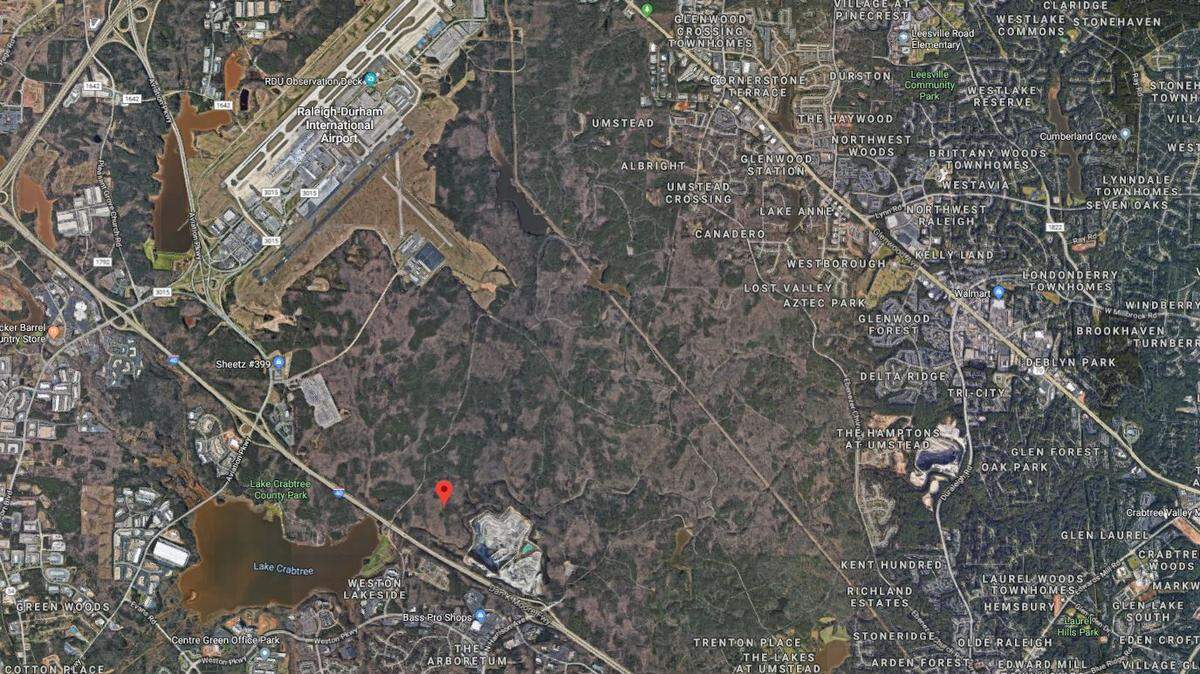
How much longer Wake Stone Corp. can continue taking rock from a quarry next to William B. Umstead State Park may come down to a single word in a mining permit issued more than 40 years ago.
The Umstead Coalition, which advocates for the park, is pressing the issue by filing suit in Wake County Superior Court. The coalition wants the court to order the state agency that regulates mining to enforce a version of the permit that includes a “sunset clause” that would effectively end mining in 2031.
Up to now, the state has stuck by a change it made four years ago to a word in that clause that allows Wake Stone to keep its Triangle Quarry open indefinitely.
The permit, granted in 1981, gave the state the right to acquire the quarry site at no cost “at the end of 50 years from the date quarrying commences or 10 years after quarrying operations have ceased without having been resumed, whichever is sooner.” At this point, that would be 2031.
But in renewing the permit in 2018, state mining regulators changed the word “sooner” to “later,” postponing the state’s ability to acquire the property until 10 years after Wake Stone is finished mining.
Wake Stone requested the change, citing the Mining Commission’s decision in April 1981 to allow the quarry, which used the word “later.” When the actual permit was issued the following month, “later” had been changed to “sooner,” something the company says was an “editorial/typographical error.”
But in its lawsuit filed last week, the Umstead Coalition argues that the change was deliberate. The coalition calls the inclusion of a sunset clause a compromise between the company, the state Attorney General’s Office and environmental regulators to help ameliorate concerns about the quarry’s impact on the adjacent park.
That’s the way Rufus Edmisten, the attorney general at the time, remembers it.
In an affidavit included with the lawsuit, Edmisten says he, Gov. Jim Hunt and Howard Lee, secretary of the state Department of Environmental Quality, all opposed allowing a quarry next to Umstead. When the Mining Commission approved it anyway, Edmisten said, the sunset clause was included in the permit to enforce Wake Stone’s public statements that the mine would operate for 50 years.
“I also find it difficult to believe Wake Stone would have accepted the permit if the use of the word ‘sooner’ was an error,” Edmisten wrote. “This was not a small or insignificant point.”
The word “sooner” remained in place through eight permit renewals and modifications.
It’s not clear why the error went unaddressed for so long, Tom Oxholm, Wake Stone’s executive vice president, said in an interview in 2020. Oxholm said the company first pointed it out in 2011 and successfully pressed for a change in 2018.
By then, the sunset clause had added significance. Wake Stone had signed a lease to mine 105 acres owned by Raleigh-Durham International Airport, across Crabtree Creek from the existing quarry. Without adequate road access or space for processing equipment on the RDU land, the company proposed bringing stone out through its existing quarry off North Harrison Avenue, something it couldn’t do if the sunset clause remained in place.
In February, the state Division of Energy, Mineral, and Land Resources denied Wake Stone’s request to quarry stone from the RDU property, citing potential impacts to Umstead State Park. The company has appealed that decision.
In an email Monday, Oxholm said the company believes state environmental regulators have reviewed the issue in great detail.
“To our knowledge they believe the word ‘later’ was appropriate and found no evidence of any reason why ‘sooner’ was ever used,” he wrote.
Buffers along Crabtree Creek also disputed
The Umstead Coalition’s lawsuit also seeks to undo changes in the mining permit in 2018 that it says reduced the protection of Crabtree Creek.
According to the lawsuit, the changes meant that the company had to maintain an undisturbed buffer measured from the center of the creek rather than the top of the stream banks, reducing the protected area by more than 5 acres.
The coalition said it had tried for two years to get state regulators to restore the buffers and the sunset clause, and that it filed the lawsuit “reluctantly.”
“We would prefer to resolve this out of court, but at this juncture we felt we had no other choice,” the group said in a statement.
A spokesman for the Division of Energy, Mineral, and Land Resources said it would not comment on pending litigation.
This story was originally published July 18, 2022 at 5:33 PM with the headline "‘Sooner’ or ‘later’? Future of Wake Stone’s quarry near Umstead may hang on one word."