Another old rail line is poised to become Durham’s next hot greenway trail
After the last freight trains rumbled along the Durham Belt Line in the 1980s, people began talking about turning the old railroad tracks into a trail that would connect north-side neighborhoods with downtown.
Now the city has received a $9 million federal grant that will allow it to finally build the 1.75-mile trail that people have been thinking about and planning for decades.
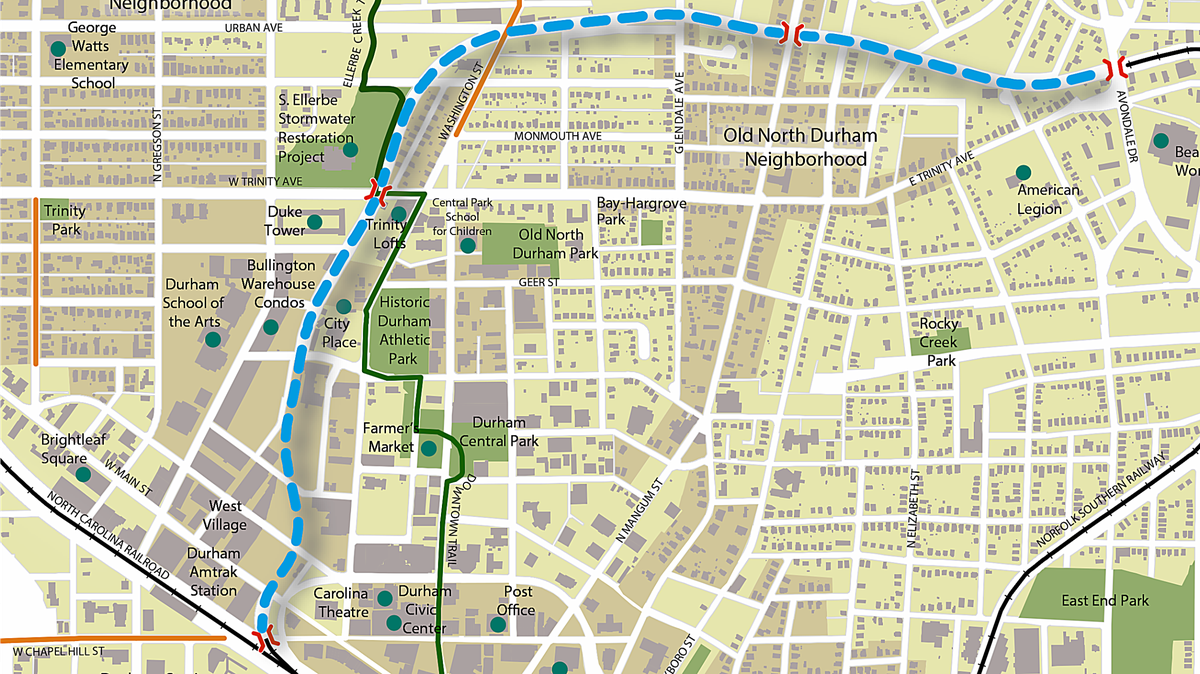
The paved trail for cyclists and pedestrians will run from West Village north across West Trinity Avenue, then turn east, where the rail corridor divides the Duke Park and Old North Durham neighborhoods. It will end just beyond where the tracks pass under Avondale Drive.
The trail will be a linear park, with benches and art and places to linger, as well as a means to get from one place to another without driving, said Niles Barnes, deputy director of the East Coast Greenway Alliance.
“It will serve people commuting, biking to work, to school, going out to shop or eat, but it will also be a place where on weekends it is going to be packed with people,” Barnes said. “I think this could be the most visited park in all of Durham, once it’s built.”
Trail a long time coming
Construction is not expected to get started until next year, but the grant from the U.S. Department of Transportation’s RAISE program is a milestone for a project that has been slow in coming.
The Belt Line was included in a joint city-county master plan approved in 2001. But the city wasn’t able to buy the 18.8 acres that make up the rail corridor until 2018, when it received a $7.8 million federal grant managed by the N.C. Department of Transportation.
Now, along with local money, the city has the $16 million it needs to build the trail, said Dale McKeel, the city’s bicycle and pedestrian planning coordinator.
McKeel said the trail will reach a part of northeast Durham not served by greenway trails, giving residents a safe, off-road way to get downtown. It will connect with the American Tobacco Trail south of the city and the Ellerbee Creek Trail, closing a gap in the East Coast Greenway, a planned 3,000-mile trail from Florida to Maine that passes through the Triangle.
There also will be about a dozen other access points as it crosses residential streets, McKeel said.
“So whereas the rail corridor sort of divided neighborhoods, this will be a way to connect neighborhoods,” he said.
The city parks department and community groups will hold events and make other efforts so residents don’t feel like the trail is simply an intrusion or something for other people to use, said state Sen. Natalie Murdock, whose district includes southern Durham County.
“I think there’s a lot of different things that we can do to make sure that folks feel like they own it, and I think Durham’s the perfect place to do it,” Murdock said. “That’s how we roll. We are an inclusive community. We want people to know, ‘This is yours.’”
Murdock chose her apartment in Research Triangle Park in part because it’s close to the American Tobacco Trail, the 22-mile greenway built on a former railroad line. She said trails and greenways became more popular than ever as people looked for ways to exercise outside during the coronavirus pandemic.
That’s one reason she thinks the Republican-dominated General Assembly set aside $29 million last fall to help complete greenway trails across North Carolina, the first spending of its kind on trails by the state.
“People like to cover the bad stuff in Raleigh, but this was one of a handful of really bipartisan projects,” said Murdock, a Democrat. “Folks see the value of it.”
A path carved out 132 years ago
The Belt Line’s arc across Durham was set in 1890. Brodie Duke built the line, mostly on land he owned, so trains from the Lynchburg & Durham Railroad, which his family partly owned, could reach Duke tobacco warehouses and factories without using the N.C. Railroad.
In 1900, Duke sold the line to Norfolk & Western, predecessor of Norfolk Southern Railway. Durham city and county and NCDOT first approached the railroad about selling the corridor in 2004.
But it wasn’t until 2017 that Norfolk Southern agreed to sell to The Conservation Fund, a national environmental group, which then sold it to the city at a discount a year later.
The tracks and many of the crossing signals remain, though overgrown in many places. Some of the tracks may be taken up, McKeel said, but many will be incorporated into the trail along with some of the signals, as reminders of the trail’s origins.
Some design challenges remain, including how to connect the Belt Line, which crosses West Trinity by bridge, with the Ellerbee Creek Trail, which begins at street level. It’s also not clear yet how the trail will cross the N.C. Railroad line and connect to the American Tobacco Campus and Durham Station, the downtown transit hub.
The downtown section of trail runs through what the city calls the Innovation District, where tech companies are moving into old industrial buildings and developers are building new apartments. Durham Central Park, the farmers market, Carolina Theatre and Historic Durham Athletic Park are all a block or two off the trail.
So is Bull City Running, the shop selling shoes and apparel that Kim Chapman and Jason Page opened off Washington Street in 2020. It’s the couple’s second, after their debut 14 years ago in the Southpoint Crossing shopping center, near the American Tobacco Trail.
Having the ATT nearby made the store a natural meeting place for fun runs and other gatherings, Chapman said. They expect the Belt Line Trail will have a similar effect.
“We’ve seen what a resource the trail is,” she said. “There’s a lot of foot traffic. There’s a lot of cycling traffic. There tends to be folks with active lifestyles who choose to live close to the American Tobacco Trail.”
This story was originally published January 26, 2022 at 8:30 AM with the headline "Another old rail line is poised to become Durham’s next hot greenway trail."