You’ve seen sanitation scores displayed at NC restaurants. What do they mean?
Any time you’ve eaten at a restaurant in North Carolina, you’ve probably seem them: posted cards displaying the establishment’s sanitation score and corresponding letter grade.
It’s required to be that way under state law, which says grade cards must be located in a clearly visible place where they can be readily observed by the public when entering the restaurant.
But have you ever wondered how the scores are calculated, or what the final number displayed in the restaurant actually means?
To answer those questions and many more, The News & Observer dug through North Carolina’s Rules Governing the Protection and Sanitation of Food Establishments and spoke with Shane Smith, the food protection and facilities branch head for the state’s Division of Public Health within the N.C. Department of Health and Human Services.
Here’s what we learned.
What is the purpose of sanitation scores?
N.C. General Statute 130A-248, which regulates food and lodging establishments, gives the state Public Health Commission the authority to adopt rules “governing the sanitation of establishments that prepare or serve drink or food for pay” for the protection of public health.
Those rules are officially called the Rules Governing the Protection and Sanitation of Food Establishments, and they include the state’s Food Code, which is generally modeled after the U.S. Food and Drug Administration’s Food Code — “a model for safeguarding public health and ensuring food is unadulterated and honestly presented when offered to the consumer.”
Overall, the rules and the Food Code are intended to provide regulations that reduce the risk of foodborne illnesses in food establishments.
The rules outline the procedures for routine inspections of food establishments that assess their adherence to the rules and food safety criteria in the Food Code, which is reflected in sanitation scores and corresponding grades.
How are restaurant sanitation scores determined?
Smith said inspections are risk-based, meaning they focus on five key, overall risk factors that contribute to foodborne illnesses:
▪ Improper holding temperatures for food.
▪ Inadequate cooking of food, such as undercooking raw shell eggs.
▪ Contaminated equipment in the establishment.
▪ The establishment using food from unsafe sources.
▪ Poor personal hygiene of the establishment’s employees.
In each inspection, restaurants start with a score of 100%.
For any violation of the state’s Food Code, points are deducted from the overall score. The point values differ for each specific violation and how severe of a risk it poses to public health, and they may also depend on whether it’s a restaurant’s first violation of that kind or a repeat violation.
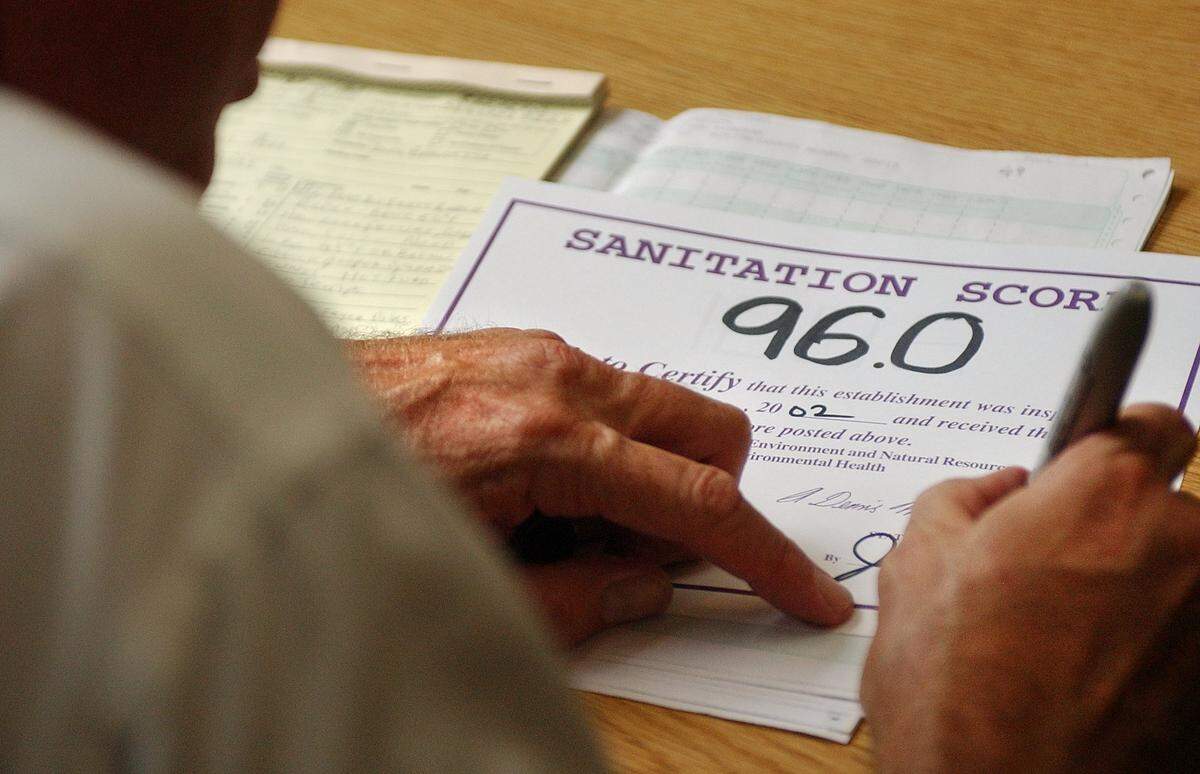
The end score you see displayed in a restaurant represents the establishment’s score for their most recent inspection, and any score below 100% means that the restaurant had some sort of violation during the inspection.
Each score is a snapshot of a restaurant’s adherence to the rules at moment in time, Smith said, but in general, a higher sanitation score represents less risk factors that were present during the inspection, compared to a lower score.
How do restaurant inspections work?
The state’s sanitation rules outline how a typical inspection of a food establishment should work.
▪ The “regulatory authority” — a state-registered environmental health specialist — enters the food establishment and provides identification and their purpose for visiting the establishment.
▪ The regulatory authority, or inspector, asks for the person in charge of the establishment and invites the person to accompany them during the inspection. If there is no designated person in charge at the time of the inspection, the inspector can ask any employee to accompany them.
▪ The inspector performs the inspection, filling out an inspection form and noting the establishment’s adherence to or violation of the standards listed in the sanitation rules. The form must include:
- The name and mailing address of the food establishment.
- The name of the establishment’s permit holder.
- The permit status of the establishment.
- The score given to the establishment during the inspection.
- The standards listed in the state rules.
- An explanation for any points deducted during the inspection.
- The signature of the regulatory authority.
- The date of the inspection.
All restaurants start with a score of 100% for each inspection. Any violations to the state standards result in points being deducted.
What are the grades restaurants can receive?
Based on their adherence to the state standards and any violations the inspector observes, food establishments receive an overall score for each inspection that translates into a letter grade.
A score of 90% or higher equals an A grade.
A score of 80% or higher, but lower than 90%, equals a B grade.
A score of 70% or higher, but lower than 80%, equals a C grade.
Under state law, establishments must have a grade of at least a C, or a score of 70%, to operate. An establishment’s permits are immediately revoked if it receives a score of less than 70%.
The highest score an establishment can receive is 100%, Smith said.
What are the penalties for violations?
The state regulatory standards list 56 possible violations to the state Food Code and corresponding point deductions that restaurants can receive during an inspection.
Possible violations and deductions include:
▪ Employees violating rules on keeping their hands clean and properly washed can result in up to four points being deducted from an establishment’s overall score.
▪ Employees violating rules on bare hand contact with ready-to-eat food can result in up to four points being deducted.
▪ An establishment not properly following rules on date marking and disposition of food can result in a deduction of up to three points.
▪ A violation of rules regarding washing fruits and vegetables can result in a deduction of up to one point.
▪ Not properly following rules on acceptable hot and cold holding temperatures for food can result in deductions of up to three points.
▪ Not properly cleaning and sanitizing food contact surfaces can result in a deduction of up to three points.
The inspector may deduct none, half or all of the possible points for each “core item” violation, depending on the severity of the violation or whether it is a repeat or recurring violation.
▪ A core item relates to the general sanitation, operational controls, facilities or structures, equipment design or general maintenance of the establishment.
Some violations can be corrected during the inspection and result in no more than half of the possible points being deducted for that violation.
▪ For that to be possible, the violation cannot have been documented in the previous inspection.
▪ It must also be noted on the inspection form that the violation was present but was corrected during the inspection.
▪ If the violation is not corrected during the inspection, the inspector may deduct half or all of the possible points.
How often do restaurant inspections take place?
Under state law, restaurants must undergo between one and four inspections per year.
The exact number depends on the type of restaurant and the risk level they are assigned, which depends on factors such as how many potentially hazardous foods the establishment heats and cools. There are four risk types, with Risk Type 1 establishments being inspected the least often and Risk Type 4 establishments being inspected the most often.
▪ A Risk Type 1 establishment is classified as any establishment that prepares no potentially hazardous foods, or foods that have to be time- or temperature-controlled for safety purposes. An example of a Risk Type 1 establishment is a drink stand with multi-use — instead of single-use or disposable — utensils.
▪ A Risk Type 2 establishment cooks and cools no more than two potentially hazardous foods and receives raw animal food ingredients in ready-to-cook form. Examples of Risk Type 2 establishments include fast food restaurants and some meat markets.
▪ A Risk Type 3 establishment cooks and cools no more than three potentially hazardous foods and receives raw animal food ingredients in not-ready-to-cook form. Examples of Risk Type 3 establishments include some grocery store delis and some sandwich shops.
▪ A Risk Type 4 establishment cooks and cools an unlimited amount of potentially hazardous foods, serves highly susceptible populations and uses specialized food preparation or cooking processes. Examples of Risk Type 4 establishments include any full-service restaurant, some grocery store delis and school lunch rooms.
Regardless of an establishment’s risk type or assigned frequency of inspections, inspections are always random, Smith said — not announced in advance — so restaurants do not know exactly when the inspector will show up and perform the inspection.
Can restaurants request a redo?
The state standards outline a process for restaurants to request a do-over inspection in order to raise their score and letter grade.
▪ The re-inspection must be requested by the permit holder of the restaurant.
▪ If the restaurant has not had their permit revoked — meaning they received at least a passing grade on their previous inspection — the inspector will make an unannounced inspection within 15 calendar days from the date of the request for the re-inspection.
▪ If an establishment has been closed for failing to comply with the state Food Code or for receiving a failing grade, the regulatory authority may schedule a re-inspection to consider the issuance or re-issuance of a permit.
This story was originally published December 15, 2021 at 8:15 AM with the headline "You’ve seen sanitation scores displayed at NC restaurants. What do they mean?."