The Josephus Daniels house is gone, but the cannon on his front lawn has a new NC home
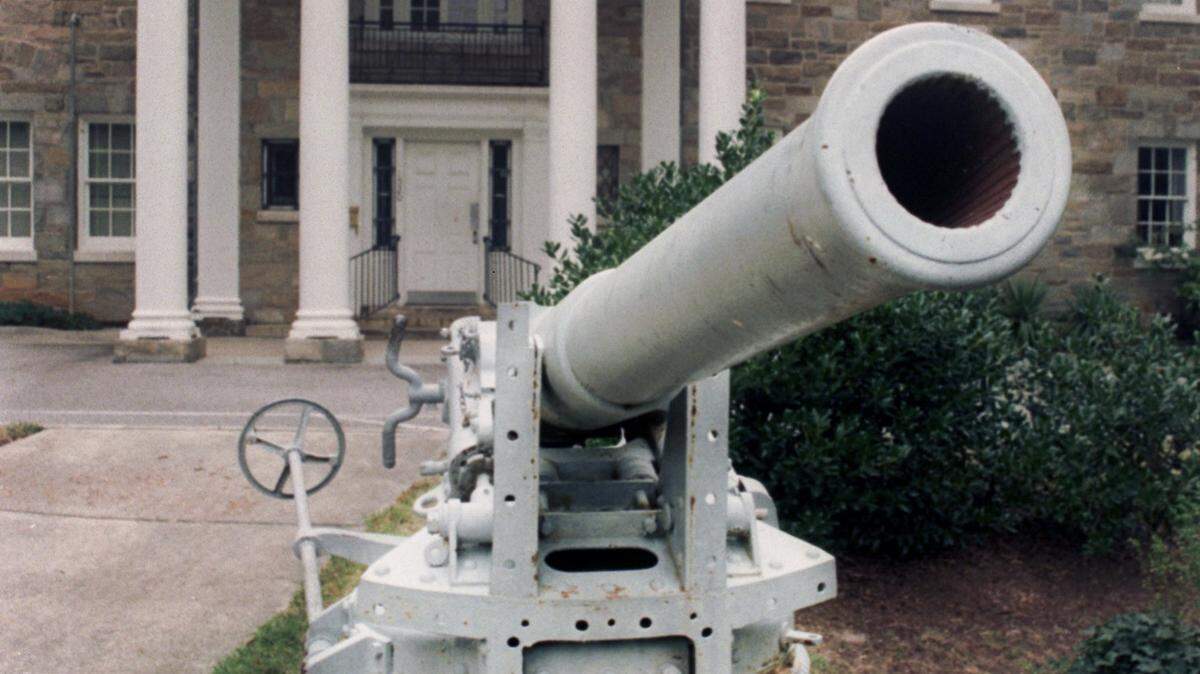
A World War I-era cannon that spawned a legend about land-locked Raleigh having the world’s smallest naval base and that reportedly annoyed the U.S. senator who lived across the street will soon have a new home.
The gun and its turret stood for decades in front of Wakestone, the former home of Josephus Daniels, long-time owner and publisher of The News & Observer until his death in 1948. Daniels was also U.S. secretary of the Navy from 1913 to 1921, which is how he came to acquire the gun.
Wakestone, one of three National Historic Landmarks in Raleigh, has been demolished to make way for new houses on the edge of the Hayes Barton neighborhood. But the cannon, a German L/30 quick-firing 88-millimeter deck gun, has been saved and will go to the state’s Graveyard of the Atlantic Museum in Hatteras.
After restoration, the gun will be mounted on the museum’s front porch, said Joseph Schwarzer II, director of the N.C. Maritime Museum System, which also includes museums in Beaufort and Southport. The gun will be an unusual artifact in a museum dedicated to the coastal waters for which it is named.
“We focus on the shipwrecks and maritime history of the Outer Banks. If we start collecting naval ordnance, we’re going to be overwhelmed very quickly,” Schwarzer said. “But this one we can make an exception for because it touches on the Outer Banks in so many ways.”
The first connection is the Daniels family, which has a long history on the Outer Banks and remains prominent there today. It was a Daniels, John Thomas Daniels Jr., who photographed the first powered flight by the Wright brothers at Kitty Hawk in 1903.
The second tie, Schwarzer said, is that the gun was likely taken from a German ship that the U.S. acquired just after World War I. That connects it to the German navy’s activities off the North Carolina coast, where U-boats sank several ships during the war.
The final fact that makes it relevant to the museum is that the gun likely came from one of the vessels that Army Gen. Billy Mitchell and his pilots bombed to prove that airplanes could sink ships. Schwarzer said it’s thought the gun came from either the German cruiser Frankfurt or the battleship Ostfriesland, both sunk by Mitchell’s pilots outside Chesapeake Bay in 1921.
Mitchell organized a second demonstration that sank decommissioned U.S. battleships Virginia and New Jersey near the Diamond Shoals Lightship off Cape Hatteras in 1923.
World’s smallest naval base?
Before it puts the gun on display, The Graveyard of the Atlantic Museum will do more research on its origins and how it came to be on Daniels’ front lawn.
As one version of the story goes, U.S. Navy regulations would not allow such a weapon to leave Navy property, so in deference to the former boss the land around the gun’s mount in Raleigh was declared a Navy base.
But while the Navy certainly had to let the gun go, it never established a base in Raleigh, says Daniels’ great grandson, Frank Daniels III.
“That’s lore,” Frank Daniels said. “I do not know who started it. Josephus may have started it. He was a very good storyteller, so I have no doubt he did not mind that kind of story being repeated.”
Josephus Daniels may have fed the tale to Jack Alexander, who wrote about him for the Saturday Evening Post in 1947. Alexander ended his article by saying that Daniels had asked his successor, Edwin Denby, for “a gun of some kind” and that Denby declared Wakestone a naval base to get around the rules.
Another story surrounding the gun is that it bothered U.S. Sen. Jesse Helms, who lived across Caswell Street, down range of the gun. Though Helms, a Republican, and Daniels, an ardent Democrat, might have been devoted to different political parties, they lived in different eras; Helms did not move to Caswell Street until 1955.
By then, Wakestone was home to three Masonic lodges, including Raleigh 500, of which Helms was a member.
Others found the weapon’s presence less menacing. David Woronoff never met his great grandfather Josephus Daniels, but he remembers as a young boy visiting his grandfather, N&O publisher Frank Daniels, who lived next door to Wakestone.
“He’d walk me around the block and put me on the cannon, and we’d have this pitched naval battle,” Woronoff said.
Schwarzer said other neighborhood kids were apparently fond of the gun as well.
“While we were moving it, one of the neighbors came over and said, ‘I’ve lived here for over 65 years. When you’re cleaning out the bore of that, you’ll find a great number of plastic soldiers, among other things,’” he said. “So I told the conservators to be aware of that.”
Restoration to take a year or more
The conservators are at Clemson University’s Warren Lasch Conservation Center in North Charleston, South Carolina, where the gun is now.
The Lasch center has experience preserving metal marine artifacts, including the H.L. Hunley Confederate submarine raised from Charleston Harbor and a gun from the USS Maine, the battleship whose sinking in Cuba in 1898 was used as a pretext for the Spanish-American War. The gun had stood for decades as a memorial at the U.S. Navy Yard in Washington, D.C.
The conservators will remove layers of paint from the Daniels gun to get down to the base metal, and then see if they can get the various parts to move again. So far, the metal looks good for having spent nearly a century out in the elements, Schwarzer said.
“If you could look through the paint, it looks to be in surprisingly good condition,” said Schwarzer, who said the conservation work is expected to take more than a year.
The Graveyard of the Atlantic Museum came to acquire the gun because of a reappraisal of Josephus Daniels’ place in history. In addition to being a National Historic Landmark, Wakestone was a Raleigh Historic Landmark, which afforded it some legal protection.
But the Masons, who had long been frustrated finding a buyer for historic property that could not be redeveloped, went to the city last year to ask that the landmark status be rescinded. They argued that the landmark designation honored a man who used his newspaper, the N&O, to promote white supremacy and helped foment the violent overthrow of a mixed-race government in Wilmington in 1898.
The Raleigh Historic Development Commission and the City Council both agreed. Free of the landmark status restrictions the Masons sold Wakestone to a developer, Beacon Street Caswell LLC, which demolished the building last month.
Schwarzer said Beacon Street offered to donate the cannon to the N.C. Museum of History in downtown Raleigh. The director, Ken Howard, said he didn’t have anywhere to put it and contacted Schwarzer to see if he might want it. (Frank Daniels III said if the museums didn’t take the cannon, it would likely have ended up in his yard in Tennessee.)
Schwarzer said the museum will present the gun with information about the Daniels family of the Outer Banks, Billy Mitchell’s demonstrations and the German naval presence off the coast during World War I. The racism of Josephus Daniels won’t be the focus, even if it played a role in the museum acquiring the gun.
“May we address it in some of our interpretation? Yes, we may point out that that was an unfortunate view on his part,” he said. “But am I going to dwell on it? No.”
This story was originally published September 3, 2021 at 3:23 PM with the headline "The Josephus Daniels house is gone, but the cannon on his front lawn has a new NC home."