
‘Doing something bold.’ Before the Greensboro Four, there was Durham’s Royal Seven.
In the summer of 1957, seven young Black women and men stepped through the swinging doors of a segregated ice cream parlor in Durham and changed North Carolina history.
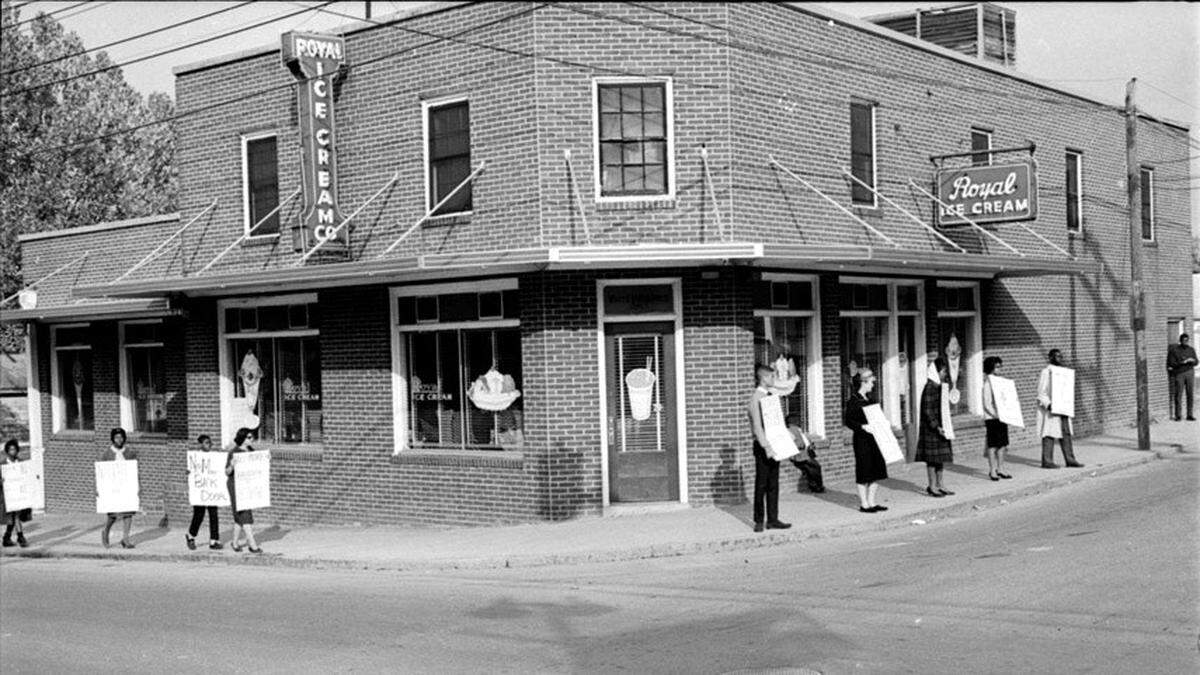
North Carolina’s place in the civil rights movement is largely synonymous with the Greensboro sit-in at a Woolworth’s counter in 1960. But three years prior, a group known as “The Royal Seven” challenged segregation at Durham’s Royal Ice Cream Parlor at the corner of Dowd and Roxboro streets.
The sit-in on June 23, 1957, led to a court case that reached the N.C. Supreme Court and tested the legality of segregated spaces.
Wednesday, on the 64th anniversary of the sit-in, the Museum of Durham History commemorated the legacy of the demonstration and its participants. One of the Royal Ice Cream Parlor’s two remaining storefront signs was dedicated, and it will be on permanent display in the museum, a symbol of one of the city’s pivotal moments in civil rights history.
“These were working people, regular folks who decided that they were willing to sacrifice some of the things that they had to deal with in order to put forth the commitment to civil rights,” said Eddie Davis, a historian and former Durham City Council member, in an interview. “So it’s important for us to recognize that and appreciate what they had to risk.”
The Royal Seven were Rev. Douglas E. Moore, Virginia Williams, Vivian E. Jones, Mary Clyburn Hooks, Claude E. Glenn, Jesse Willard Gray and Melvin Haywood.
They entered the ice cream shop that summer day in 1957 and refused to move from their booths in the white section. Police arrested them and charged them with trespassing.
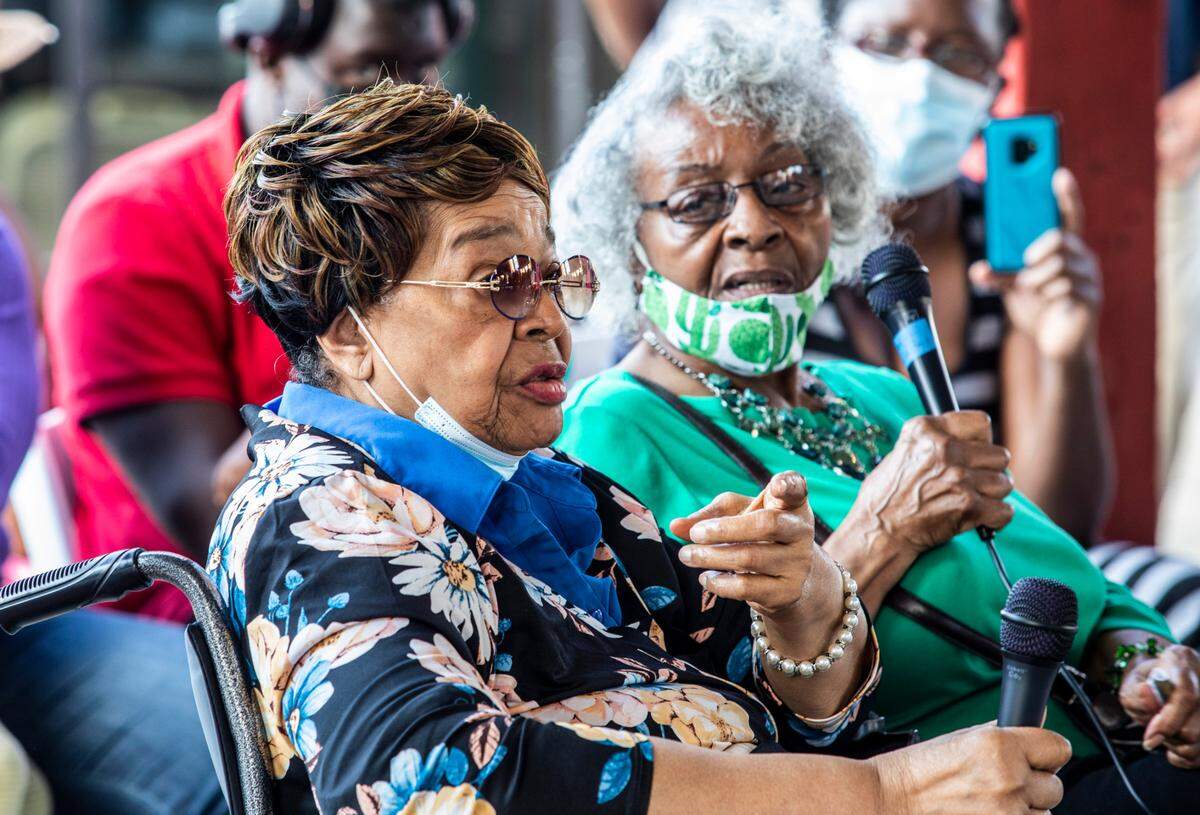
The two participants who are still alive — Williams and Hooks — were honored Wednesday. Both 84, they sat side by side in front of a small crowd and shared memories from that moment decades ago.
The Royal Ice Cream Parlor used to sell the best ice cream in town, Hooks said. The white section included space to sit down and enjoy a meal, whereas the Black section only offered a take-out window with enough room to stand.
That day, the group assembled at Asbury Temple Methodist Church — where Moore, a contemporary of Martin Luther King Jr., was pastor — to plan the protest, according to the North Carolina Highway Historical Marker Program. They headed over to the Royal Ice Cream Parlor.
The parlor had a swinging door that divided the Black and white sections. Whoever entered first would push the door hard enough so that everyone else could file through, Williams said.
“When we went in there, the white people jumped up and ran out like we was some animals or something,” Hooks recalled.
Williams was the last to enter. Walking through those doors, she said she wasn’t afraid.
“I was just determined to, I think, do what my father had wanted to do but knew he couldn’t do it,” she said in an interview.
‘Help correct history’
After they were refused service, the Royal Ice Cream Parlor’s manager called the police, who took the group to the magistrate’s office. At the office, a white police officer told Williams, who was 20 at the time, that if she were his daughter, he would have taken her across his lap and spanked her.
“And I just said, ‘If I were your daughter, I wouldn’t be down here for this,’” Williams said. “‘I’d have been over there eating ice cream.’”
The case was first heard in Durham Recorder’s Court, where each of the Royal Seven was initially fined $10. They unsuccessfully appealed to the county’s Superior Court and the N.C. Supreme Court, both of which upheld the guilty verdict.
The U.S. Supreme Court refused to hear the case, saying the Royal Seven’s rights had not been violated, Williams said.
Black attorneys William A. Marsh and Floyd McKissick were involved with the group’s legal defense. Both of their sons were both present at the dedication. McKissick’s son, former N.C. Sen. Floyd McKissick Jr., said he appreciates the opportunity to recognize the sit-in and to “help correct history.”
“We need to get our history straight, we need our facts straight and give recognition and credit where it’s due,” he said. “Because the Royal Ice Cream Seven, when they went out there, they were doing something bold, they were doing something courageous. They were doing something that hadn’t been done in the state of North Carolina and in the city of Durham.”
The Royal Ice Cream Parlor was later integrated in March 1963.
The original building that housed the Royal Ice Cream Parlor was torn down in 2006, according to the Open Durham website. A state historical marker was unveiled in 2008 at the site, where Union Baptist Church now sits.
Williams said she thinks the Royal Seven sit-in didn’t receive as much attention as the Greensboro demonstration in 1960 because it occurred in June, when students were out of school.
Additionally, at the time, Hooks said some members of the Black community were upset with the group for demonstrating at the Royal Ice Cream Parlor because it was a popular location among Black Durham residents.
“They said, ‘Y’all had no business going in there, disturbing them people, they ain’t bother nobody,’” she said in an interview. “And I thought they were crazy.”
Preserving history
Alice Sharpe, who sits on the museum’s board of directors, donated the Royal Ice Cream sign in honor of her parents. Patrick Mucklow, the museum’s executive director, said the donated sign once hung over the loading dock at the ice cream parlor, and was lost in a private collection for a few decades.
The other sign, which originally hung in front of the ice cream parlor, is now in Provident1898, a ”Black-centric” co-working space in the historic N.C. Mutual Life building.
Sharpe, a Durham native, remembers as a child that people on her street hunkered down because the Ku Klux Klan planned to ride through town. The Royal Ice Cream Parlor sit-in underscores just how laden Durham is with civil rights history, she said.
“I do hope that more people will see that there are many opportunities, where not a whole lot of money is necessary to preserve history for so long, and to share it with other people,” she said. “And maybe we’ll understand each other a little bit better.”
William A. Marsh III, a former district court judge and the son of William A. Marsh, said the story of the Royal Seven is integral to truly understanding Durham history and the city’s foundations.
“Because we’re not just a university, we’re not just the ‘City of Medicine,’” he said. “But Durham is a special place.”
Mary Clyburn Hooks, who now lives with her son in New Jersey, said she used to be ashamed to talk about her involvement in the sit-in; she feared she might face difficulties in getting or keeping a job because she had been arrested.
“I love Durham,” she said. “And that’s why I tried as hard as I could to make it better.”
Hooks and Williams have passed on the stories of the sit-in to younger family members, some of who attended the dedication in Durham.
Hooks’ daughter, Kiesha Hooks-Lee, said she recalls being in college when she first definitively heard about the event from her mother and understood its significance. Hooks-Lee, an educator, said she would invite her mother to speak to children at her school for Black History Month events.
“My mom’s story was such an untold story for so long,” she said.
Amari Lee, one of Hooks’ granddaughters, came from college at Penn State University to attend the dedication. She calls her grandmother her “superhero,” and said she often heard the story about the sit-in — something Lee’s mother made sure of.
Lee said she’s glad others have the opportunity to learn more about the sit-in and the contributions her grandmother made towards advancing equality and equity.
“I want her to know, and I want my little sisters and young people to know that she did it first,” Lee said. “And even when you don’t get recognized, it’s important — what you do is important and you should still do it.”
The Museum of Durham History is at 500 W. Main St., Durham. For details, go to museumofdurhamhistory.org.
Maydha Devarajan is an intern at The News & Observer, supported by the North Carolina Local News Lab Fund at the North Carolina Community Foundation.
This story was originally published June 24, 2021 at 6:35 AM with the headline "‘Doing something bold.’ Before the Greensboro Four, there was Durham’s Royal Seven.."