Campaign says 8 police reforms can’t wait. How Triangle agencies limit use of force.
Corrected at 12:36 a.m. on June 15. See details in story.
He has lived both sides of the conversation about policing black and brown America, but nothing hit as hard as seeing George Floyd killed by Minneapolis officers, Carrboro Police Chief Walter Horton said.
“There were three people holding that man down. I can’t think of any reason to do that,” Horton said. “Basically, (Officer Derek Chauvin) was looking like he was proud to be just sitting on that man, like he accomplished something by taking the breath, the air, out of that man.”
Floyd’s May 25 death and the protests that followed have renewed calls for law-enforcement agencies to re-examine how police use force in their communities.
N.C. Gov. Roy Cooper on Tuesday announced a Task Force for Racial Equity in Criminal Justice will seek evidence-based strategies to eliminate systemic racism in the justice system, from law enforcement to the courts.
Cooper also said the N.C. Department of Public Safety has asked the State Highway Patrol and other state law-enforcement agencies to review their use of force policies and require officers to intervene if a fellow officer uses excessive force.
Roughly a thousand people die each year at the hands of law enforcement, according to the research collaborative Mapping Police Violence. Roughly 24% of those killed are African American, despite black people making up only 13% of the nation’s population — making black people three times more likely to be killed by police than white people, the collaborative found.
In North Carolina, the total number of people killed by law enforcement officers since 2013 ranges from a high of 37 in 2016 to a low of 22 in 2017, it reported. Roughly 40% of those killed were black, while 50% were white. Black people comprise roughly 22% of the state’s population.
#8CantWait police strategies
The conversation has put a spotlight on #8CantWait, an eight-point strategy for limiting use force.
Campaign Zero, an initiative associated with activists in the Black Lives Matter movement, developed the strategy after analyzing police department policies in 91 of the nation’s 100 largest cities, including Durham, Raleigh, Charlotte, Greensboro and Winston-Salem. It recommends:
▪ Banning chokeholds and strangleholds
▪ Requiring police to de-escalate situations
▪ Requiring police to warn before shooting
▪ Requiring police to exhaust other tactics before shooting
▪ Requiring officers to intervene when a fellow officer uses excessive force and to file a report
▪ Stopping shooting at moving vehicles
▪ Requiring police to use only the force necessary
▪ Requiring officers to report every time they threaten or use force
The average department analyzed had three of those policies at the time of the study, Campaign Zero found, but those that had clear limits on when and how police could use force “had significantly fewer police killings.”
The study examined the number of people killed by police, as well as the size of the police force, the number of arrests, how many times officers were assaulted, the city’s minority population size and median income, and the level of income inequality.
Campaign Zero reported that departments with more than three strategies in place — the average department — had 15% fewer people being killed for every additional strategy that was implemented. Departments following all eight strategies could expect to see at least 72% fewer people killed than departments with none of the policies in place, it concluded.
Raleigh, Durham act on policies
At least 15 people have been killed in officer-involved shootings in Raleigh and Durham combined since 2013. In some of those cases, the person killed had fired a weapon at officers; one case eventually was determined to be a suicide. Another man was severely beaten this year but lived; the officers involved are being investigated for excessive force.
With each new case, the voices for change grow.
Raleigh protesters last week called for Police Chief Cassandra Deck-Brown and Mayor Mary-Ann Baldwin to resign. Deck-Brown joined the city manager in asking for an independent review of how Raleigh police handled the George Floyd protests, and members of a newly created Police Advisory Board could be appointed next week.
On Tuesday, Deck-Brown told the City Council that five of the 8 Can’t Wait strategies were already in the department’s use of force policy, including requirements that officers report when they use force and intervene if they see another officer using deadly force.
The remaining points — banning chokeholds and strangleholds, requiring officers to de-escalate situations and prohibiting officers from shooting at moving vehicles, were implemented that day, Baldwin said on social media Tuesday night.
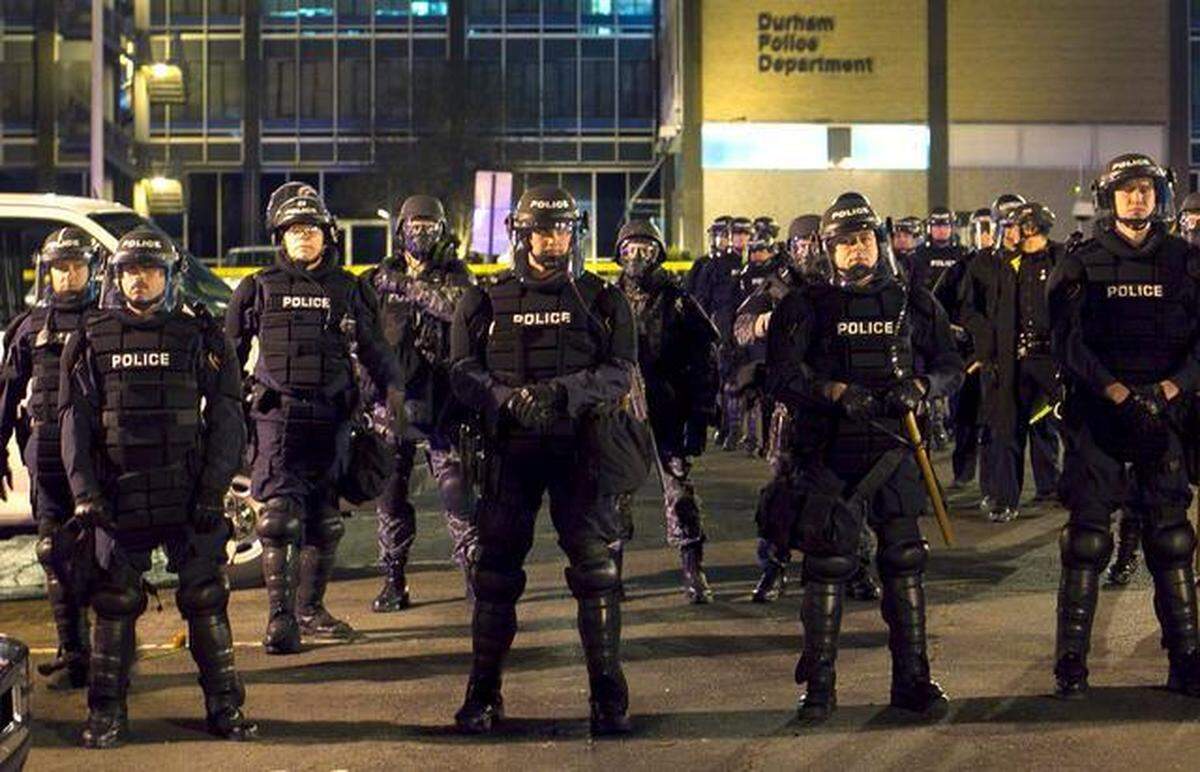
“I clearly don’t want to see anything like what we just saw (in Minneapolis) occur within our department or what we’ve seen across the United States,” Deck-Brown said. “We do strive to be the best department that we can be, and as an accredited department, policy does matter and I believe that it does make a difference in terms of what we do and how we do it.”
In Durham, Mayor Steve Schewel joined Baldwin and other mayors this month in signing a pledge from former President Barack Obama to reform use-of-force policies.
The Durham Police Department already includes most of the 8 Can’t Wait strategies and will clarify those policies in the department’s training that are not explicitly written, Police Chief C.J. Davis said.
Durham has had incidents in which force was used, Davis said, but she “wouldn’t call it a problem.” The department tracks them to see if there is a pattern or a potential problem, she said. Officers have been let go for using force inappropriately, misconduct and other issues, she said.
The 8 Can’t Wait strategies are only a part of what shapes a law enforcement agency, Davis said. She and other chiefs already work to identify problems, weed out bad officers, and hire and train the rest in best practices for a safer community.
“I’m not saying that our people don’t have the best intentions sometimes, but unfortunately, judgment sometimes comes into play, and we just want to make sure we have the best of the best in the department,” Davis said in an interview with The News & Observer. “This work is too serious for us not to treat it with a very, very close and surgical eye, and we’ll continue to do that.”
Reform or defund police
D’atra Jackson, national director for BYP100, and other supporters of a parallel movement to disinvest in the police, said reform isn’t the answer. Those solutions focus on individuals who abuse their power, she said, when it’s the institution that is the problem.
“We have seen that through centuries, and racial equity training is not going to solve that,” Jackson said.
Data from Campaign Zero appears to support that claim. Of the eight cities studied that did not report any police-involved deaths, it found only one — Plano, Texas — had more than two or three use of force policies in place.
The report also shows that of the eight cities with six or more policies in place, only two had rates of police-involved killings lower than roughly five per 1 million people. The highest rate of deaths per 1 million in population among those cities was in St. Paul, Minnesota, where seven policies were in place and roughly 17 people had been killed per 1 million in population.
Only 10 cities reported a higher rate of police-involved deaths than St. Paul. The next highest ranked city was Baltimore, which was at No. 20 despite having implemented six of eight policies. Roughly 13 people were killed per 1 million people, the report showed.
The 8 to Abolition campaign opposes the 8 Can’t Wait campaign, calling it “dangerous and irresponsible, offering a slate of reforms that have already been tried and failed.”
Instead, the group offers its own eight-point platform for defunding and abolishing police and prisons, while investing in housing, community self-governance and programs to build safer, healthier communities.
Reform efforts, budget concerns
Horton said his heartbeat still goes up when he drives up on a checkpoint or is stopped by police.
In one instance, he was stopped while driving off-duty in a nearby county. Still wearing his gym clothes, he told the officer his wallet was in the back with his weapon.
He kept his hands visible and followed every instruction, Horton said. A fellow officer driving ahead of him also stopped when he saw what was happening, he said.
“If I feel that I’m being mistreated, I’ll ask for the officer’s information and name, and then I’ll leave that encounter and go contact the supervisor,” he said. “I’m not going to get in an argument on the side of the road with a police officer.”
Calls to defund small-town police departments don’t consider all the facts, Horton said. An online search shows Carrboro officers start at roughly $38,000, the Triangle’s lowest starting salary. The 39-officer Carrboro department has two vacancies and a $488,291 policing budget. The rest of the department’s $4.2 million budget pays for employee salaries and benefits. (The number of police vacancies has been corrected.)
“We’re going to have a hard time keeping good people and finding good people” if the department receives less money, Horton said. “We’d rather work short than bring somebody else bad into this police department. It’s not good for us, and it’s not good for the community.”
Carrboro and Chapel Hill have had tough conversations about law enforcement since the 2011 Occupy Movement and the 2012 armed police response on West Franklin Street when protesters had occupied a vacant building were arrested.
The incident sparked outrage and Chapel Hill’s Community Policing Advisory Committee, created just a few months earlier, took on the role of reviewing the police response. Chapel Hill now tracks and evaluates when its officers use force.
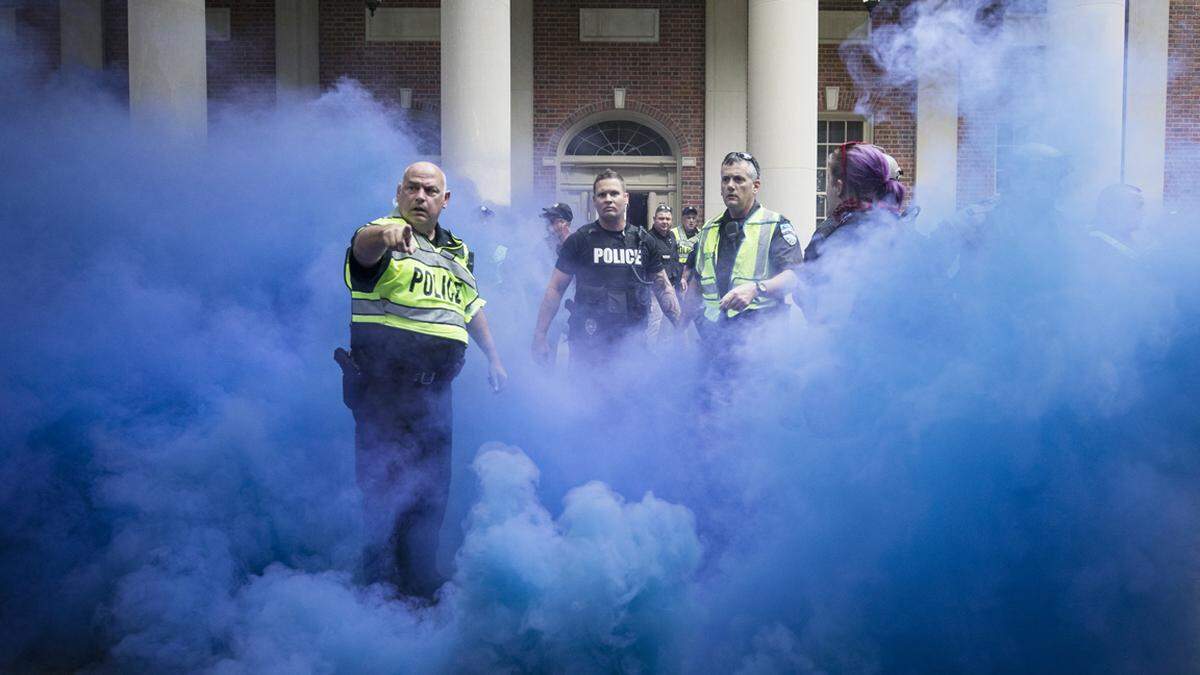
The town also has tackled police militarization — using military equipment and tactics — and racial disparities in police stops. Recently, the Silent Sam Confederate statue protests on UNC’s campus raised questions about pepper spray and other crowd-control tactics.
Chapel Hill’s use of force policy aligns closely with policies in Raleigh and Durham, and Police Chief Chris Blue said his team is revising it to further clarify de-escalation, which is part of the agency’s training.
They don’t have everything figured out, Blue said, but in general, he has seen fewer force reports and a greater focus on warnings and citations instead of arrests.
“I do think some significant events in our community’s history — not just Silent Sam — have all contributed to philosophical shifts in how we police, have all engaged our community in wanting to understand better how the police department behaves, and in just about every instance, some policy improvements and more thoughtful approaches to our work have resulted,” he said.
Carrboro meets half of the 8 Can’t Wait strategies, Horton said. Others are either not part of the town’s training, such as chokeholds and strangleholds, or the way a particular type of force is used may depend on the situation in which an officer finds himself, he said.
An officer responding to an active shooter isn’t going to warn the gunman before shooting, he said. In some cases, an officer might have to shoot at a moving vehicle, like when a man drove his Jeep in 2006 through a crowd of UNC students on campus.
“We’re going to do our best not to use deadly force, and in fact, there have been some cases where officers were completely justified in using deadly force, but they didn’t,” Horton said. “That’s how we train, how we police. We don’t want to go out here thinking it’s the wild, wild West and abusing our power.”
This story was originally published June 12, 2020 at 5:50 AM with the headline "Campaign says 8 police reforms can’t wait. How Triangle agencies limit use of force.."