
How you can spot — and for goodness sake, stop sharing — the fake news on Facebook
Do us all a favor, friends and family.
When you see that Facebook post about a woman in Wilmington giving birth to 18 babies, or a “thug” pulling a gun in a Raleigh Walmart to break up a fight, apply just a smidgen of skepticism before liking, commenting or God forbid sharing.
Although it has always been the case that we should verify a source of information before believing or spreading it, the problem has become much harder to deal with during election season, as “fake news” armies have taken over social media with the purpose of swaying the opinions of potential voters.
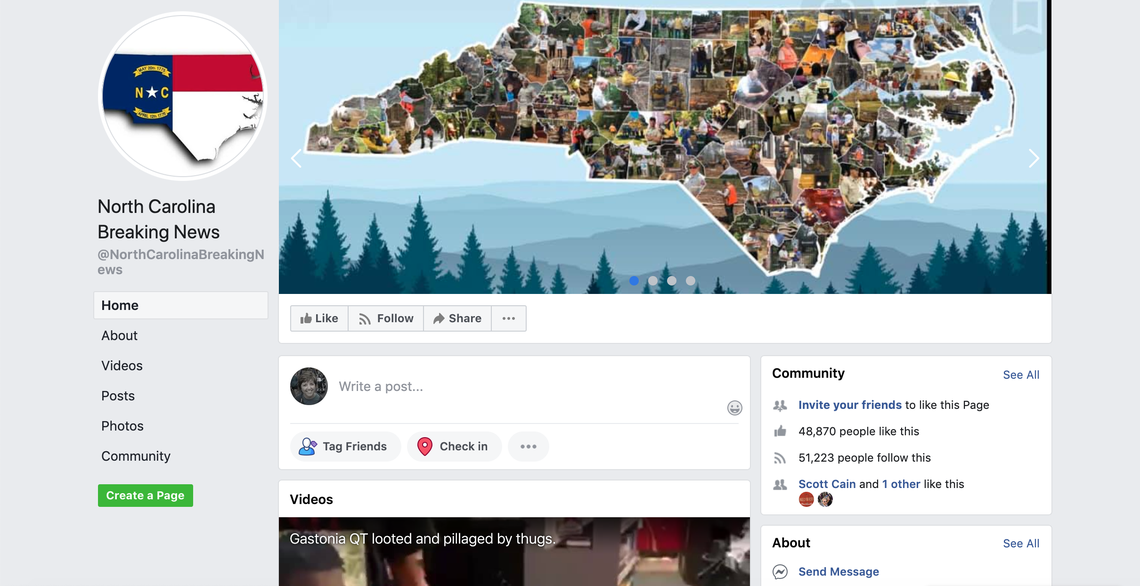
In North Carolina, a Facebook page identifying itself as North Carolina Breaking News, made news itself by posting numerous false stories (some even appear to be posted in Russian — make of that what you will) and stories lifted from other sites without attribution. (On Tuesday afternoon, Facebook took the page down. By Tuesday night, another page had sprung up with content similar to the page that Facebook had removed.)
One of the go-to practices of the North Carolina Breaking News page, which at its peak had more than 50,000 followers, was taking viral internet stories from other states, sometimes years old, and rewriting them to falsely assert that the events happened in North Carolina. In many cases, racial or politically charged terms such as “thug” are added.
On Tuesday morning, the page posted a story about a man in Salisbury, N.C., who allegedly was being fined $750 a day by the city for having “racist signs” in his yard. That story appears to be lifted from a story last year out of Chicago. Another story claimed to be about a Chapel Hill woman being kidnapped by an African American man and forced to watch the show “Roots.” That appears to be out of Iowa.
Be wary of ‘satire’ and ‘parody’ labels
The administrator of the North Carolina Breaking News Facebook page told The News & Observer on Monday that “truth is not the goal” and that the site’s aim was to help President Trump get re-elected.
That page labels itself a “satire/parody” page, but its content doesn’t fit that description. Many fake news organizations hide behind that label, because that seems to earn them a pass from Facebook.
Satire or parody sites typically have a comedic or jokey bent, such as with the site The Onion (that’s not to say that some people have not been fooled by The Onion, which offers up headlines like “Jimmy Carter Added to Mount Rushmore After Becoming 5th Former President to Bowl Perfect 300”).
But sometimes, as the journalism advocacy organization Nieman Lab points out, satirical news can be very difficult to spot.
A good rule: Don’t share information from a so-called satirical site as if it were true, or if you think your friends and family will believe it’s true. Because intentions aside, satirical news is not true.
If you actually care about truth, no matter which side you favor in politics, how do you figure out what’s real and what’s not?
Did you see it on Facebook?
If a story or post was shared on social media, particularly Facebook or Twitter, that doesn’t mean it’s not true. If it’s not from a source you recognize, you should be on high alert.
More and more, sites with names that sound like legitimate news organizations are popping up on Facebook to promote false news.
As with the North Carolina Breaking News page, they will post some real news and some news releases to give them an air of legitimacy, and then slip the false news in. Last year, The New York Times wrote about sites claiming to be local news sites in Michigan that were created to spread partisan content. These sites use that model: legitimate news, press releases, slanted political content.
Google is your friend
It just takes a few seconds to Google either the headline or a few keywords of the story you’re seeing.
For example, if you Google the names from a Feb. 13 North Carolina Breaking News post about Cary, N.C., student-athletes supposedly filing a lawsuit to keep transgender students from participating in girls sports, you’ll see it’s actually a story out of Connecticut. (North Carolina Breaking News even added what appears to be a fake quote from former North Carolina governor Pat McCrory about transgender people).
Don’t share that. If you want to share the true version of the story out of Connecticut, go ahead. But don’t share something that is obviously false and has false details.
Alexios Mantzarlis, News & Information Credibility Lead at Google, tells The News & Observer, “As a former fact-checker, I would encourage your readers to take a look on fact-checking websites they trust to see whether the story they’re looking at has been addressed. For its part, Google has made available to the public a dedicated search portal that returns fact checks from across the world.”
That fact-check toolbox is available here: News & Information Credibility Lead at Google.
Additionally, Snopes.com, FactCheck.org and PolitiFact.com are all great non-partisan sites that investigate the accuracy of viral stories or political claims. You can trust them.
Dig deeper
Most times, for bizarre or viral content, a Google search will confirm or deny the legitimacy of a story.
But sometimes you might have to go a little deeper.
Try to determine whether the site itself is legitimate. Often, all that takes is a click to the site’s main page, then look for a box or tab that gives information about the organization (often labeled “About”).
Warning signs might be if the “about” section is vague about its owners or mission, if the description expresses partisan views or if the site labels itself satire or parody.
You can also Google the author of an article or search for the author or the site’s Twitter handle. Take a look at the type of content they write about or share.
Other red flags
▪ Spelling errors and grammatical mistakes.
Even the best journalists make typos here and there, but if a site has numerous spelling and grammatical errors, be wary. Does the site use lot of ALLCAPS and go overboard with eye-popping punctuation? It’s probably not reputable. Similarly, if a site publishes a story with a dateline of Fayetteville, S.C. (yep, that’s North Carolina Breaking News again), and the content of that post is written in Russian, those are two giant, fill-up-the-sky red flags.
▪ Vague sourcing.
If the references in stories are “sources say” or “a North Carolina news outlet reports,” be skeptical. Especially if that site isn’t linking to the sources they are referencing. That means they are likely either making up or stealing content.
This story was originally published February 18, 2020 at 3:52 PM with the headline "How you can spot — and for goodness sake, stop sharing — the fake news on Facebook."
