Durham Housing Authority sees eviction filings rise while actual evictions decrease
A legal group in Durham is challenging the Durham Housing Authority’s claim that recent reforms have led to fewer evictions at its properties.
Before it evacuated hundreds of residents over carbon monoxide concerns, DHA was under fire for its rate of eviction filings — much higher than housing authorities in Charlotte and Raleigh. Legal Aid of NC, which offers legal guidance for issues like safety, housing and income, says DHA is the reason for increased eviction filings in Durham County.
Eviction filings are the first step in the process of taking an eviction case to court, where a judge decides whether the resident can stay in the home. In Durham, most eviction cases are resolved before the court hearing.
DHA had nearly 850 eviction filings in 2019, around 20 times more than the filings from Inlivian, the Charlotte Housing Authority, and more than 30 times more than the Raleigh Housing Authority. Inlivian, which has nearly 2,000 more units than DHA, had around 50 total eviction filings in 2019.
But DHA evicted fewer people in 2019 than in the previous two years, cutting evictions by 30% since 2017.
The housing authority announced reforms to its evictions process in August.
In announcing the reforms, Anthony Scott, DHA’s chief executive officer, said: “Recognizing that our residents are the most likely to experience financial stresses that hinder their ability to pay rent, today we are announcing comprehensive changes that we think will significantly reduce the number of evictions from DHA properties.”
The reforms included:
▪ More information in eviction notices on how to avoid being evicted, including arranging payments, rental assistance resources and other lease information.
▪ A new general counsel to review eviction notices that residents didn’t respond to.
▪ Working with a local community agency to help families at high risk of eviction.
▪ Working with political leaders to fix consequences of landlord/tenant laws.
One of the other process changes that DHA made was notifying residents of a court judgment when they did not appear for their small claims court date. NC law doesn’t provide judgment notice for small claims defendants who don’t appear. DHA says households who don’t appear are most at risk of eviction.
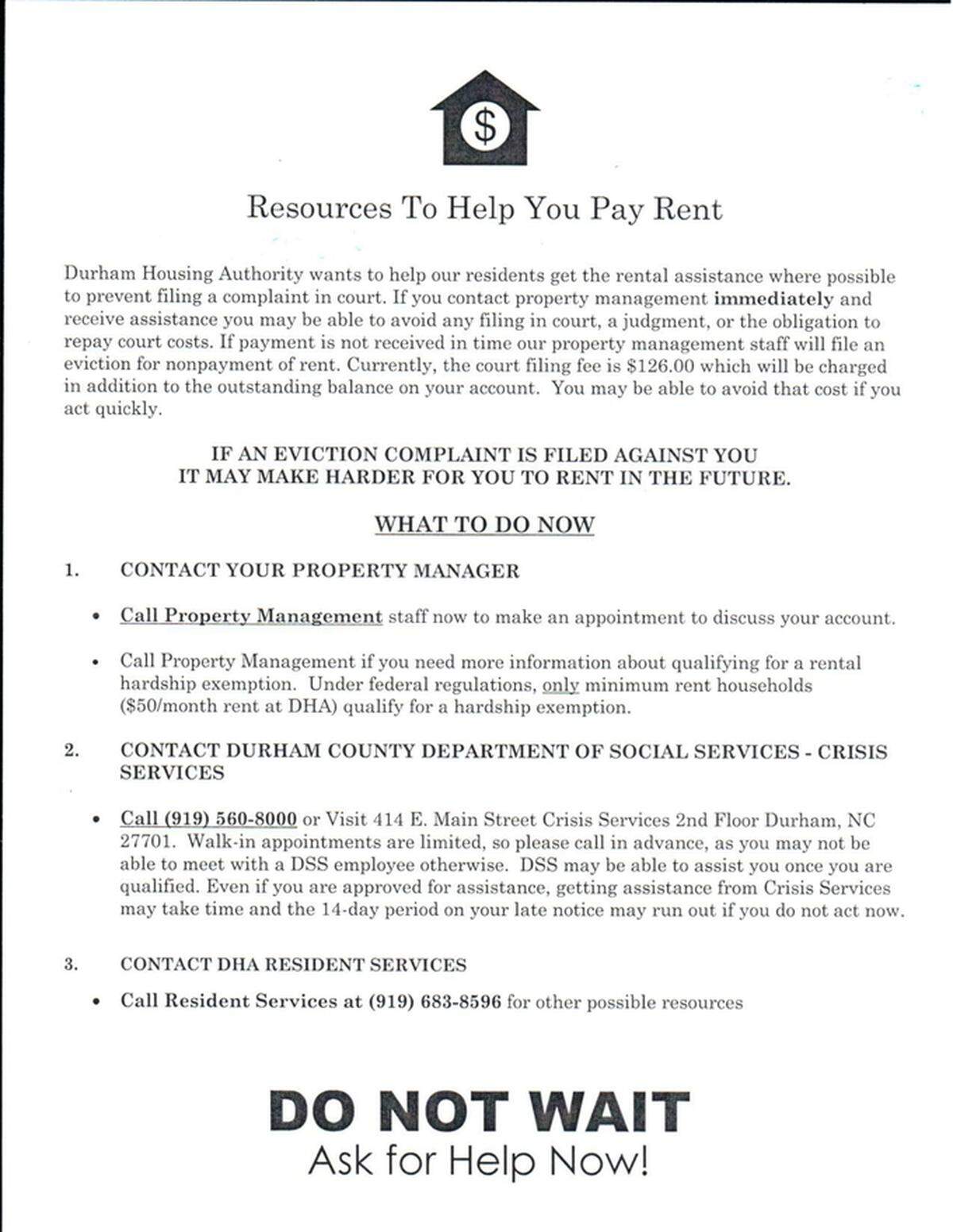
In December, DHA announced that eviction filings had “decreased by approximately half” since the reforms. From August to the end of the year, the agency had 42 eviction filings per month, half of the monthly average from January through July, but still more than Raleigh, Charlotte and Greensboro housing authorities.
Peter Gilbert, a lawyer with Legal Aid of NC, disagrees. “There doesn’t appear to be any real substantive changes,” he said.
A month later, the agency had to evacuate more than 200 families from McDougald Terrace to nearby hotels, due to carbon monoxide leaks in their units. Because of the evacuations, DHA announced on McDougald Terrace tenants won’t have to pay February rent, the second month in a row.
There will also be no new payment-related eviction filings for January rent at all DHA properties until the McDougald Terrace issues are fixed, because the agency is focused on putting all resources toward repairs.
Carl Newman, general counsel for DHA, said the hold on new eviction filings is “because we take evictions very seriously.”
‘No peace’ at Oxford Manor
Dionne Garrett wants to move now, away from Oxford Manor — a DHA property.
She’s had eviction filed twice against her in the past year and a half. The first time, she said, DHA accused of her owing four months in rent, but she hadn’t been notified until the fourth month.
The court process took over half a year before it was dismissed. Soon after, Garrett found out from her property manager that her rent increased.
“If it was some type of retaliation, I don’t know,” she said.
When she didn’t pay the increased rent, DHA took her back to court, but the judge dismissed it quickly.
Garrett has already applied to other apartments in Durham, partially because of the issues she’s had with two back-to-back eviction filings in a short time period and also because of the crime around her unit. Her son was injured in a drive-by shooting last year.
“There’s just no peace out there,” she said.
At a protest at DHA’s main office on Wednesday, current and former DHA residents protested poor housing conditions and the hardships that eviction filings have caused.
“We cannot have a program for housing for people who are in poverty and put them back on the street,” said Barbara Lyons.
Lyons led a chant before the crowd entered DHA’s board of commissioners meeting: “Pharaoh, let my people go!”
Durham County evictions
On Thursday, the council saw a presentation from Gilbert regarding a rise in evictions in Durham County in the past year. Legal Aid of NC began a $200,000 contract with the city last year. This helps fund more attorneys, paralegals and office space for the nonprofit to provide eviction diversion to Durham residents.
Although Durham County has one of the higher eviction rates in the state, the number of eviction filings had been steadily falling over the past decade.
In 2010-2011, there were over 14,571 filings and nearly 8,633 court judgments granted. Eight years later, those numbers had dropped to 9,441 filings and 4,852 judgments granted.
But in 2018-2019, filings increased by 507 from the previous year, the first increase since 2010. Court judgments still steadily declined.
“The reason it went back up, most of that increase is due to DHA filings,” Gilbert told the council.
For its program with the city, Legal Aid of NC served 538 eviction cases in 2019, preserving housing in 70% of the cases it closed. 46 of them were from DHA public housing and 93 from other federally subsidized housing.
The overwhelming majority of its clients were black women, more than half with children. Nearly all had a household incomes below $35,000. More than a third had a household income below $10,000.
”We were only able to represent about 5% of Durham families facing eviction with that funding level,” Gilbert said, of the original $200,000 city contract.
The city will be voting on a new contract with Legal Aid soon, increasing the budget to $500,000 — coming from Durham’s dedicated housing fund — with the goal of serving twice as many households. It would provide funding for six new attorneys, two paralegals and a community resource coordinator.
Mayor Steve Schewel and Jillian Johnson, the city’s mayor pro tem, met with Scott in December to talk about eviction numbers and begin a conversation on how to reduce them, but Schewel said the McDougald Terrace issue has delayed those talks.
“I think that we’ll continue that discussion because you’re right, it’s very important,” Schewel said.
‘Lack of trust’
In an interview with The News & Observer, Gilbert suggested ways to reduce the high number of eviction filings, including abolishing the minimum rent which Gilbert says makes up around 10% of DHA households that were evicted. Around 500 DHA households pay minimum rent.
In public housing, rent is capped at 30% of household income, but those with no monthly income pay the minimum rent of $50. “If you have zero income, you should pay zero rent,” Gilbert said.
Gilbert also suggested DHA wait longer before filing evictions and stop new eviction filings altogether until they know why they have so many, as the Richmond Redevelopment and Housing Authority did in 2019.
The filing fee for an eviction case is $126, which Carl Newman said is repaid by tenants in most cases after the court case is resolved.
“They’re spending as much to resolve the case as they’re charging in rent,” Gilbert said. “Put that same time and energy that they’re putting into the court system into working with the tenants.”
“The big picture is, there’s a lack of trust because of DHA’s history.”
One suggestion, which residents have also mentioned during protests, is making it easier for tenants to pay their rent. Gilbert and others have said DHA should bring back its old system of bringing payment into the property office and receiving a receipt, instead of the current system of online payment or eight off-property payment locations.
Carl Newman said DHA doesn’t have a current plan for a rent collection change, but the agency understands that the way tenants pay is part of the issue.
“Part of it [high eviction filings] is certainly in rent collection,” Newman said. “If you have a slightly worse percentage of rent collection, you have a lot more eviction filings.”
Gilbert said the authority puts the burden on tenants to ask property managers for rent help and the process should be more proactive. In its December statement on eviction diversion, DHA said residents should be encouraged to contact management if they are unable to pay rent.
Newman said tenants reaching out to property managers has been the most helpful in bringing down evictions.
“What we’re most focused on is that the number of people who are actually evicted is going down, not up,” Newman said.
This story was originally published January 31, 2020 at 5:58 AM with the headline "Durham Housing Authority sees eviction filings rise while actual evictions decrease."