NC county removes portrait of famed judge and slavemaster from courthouse wall
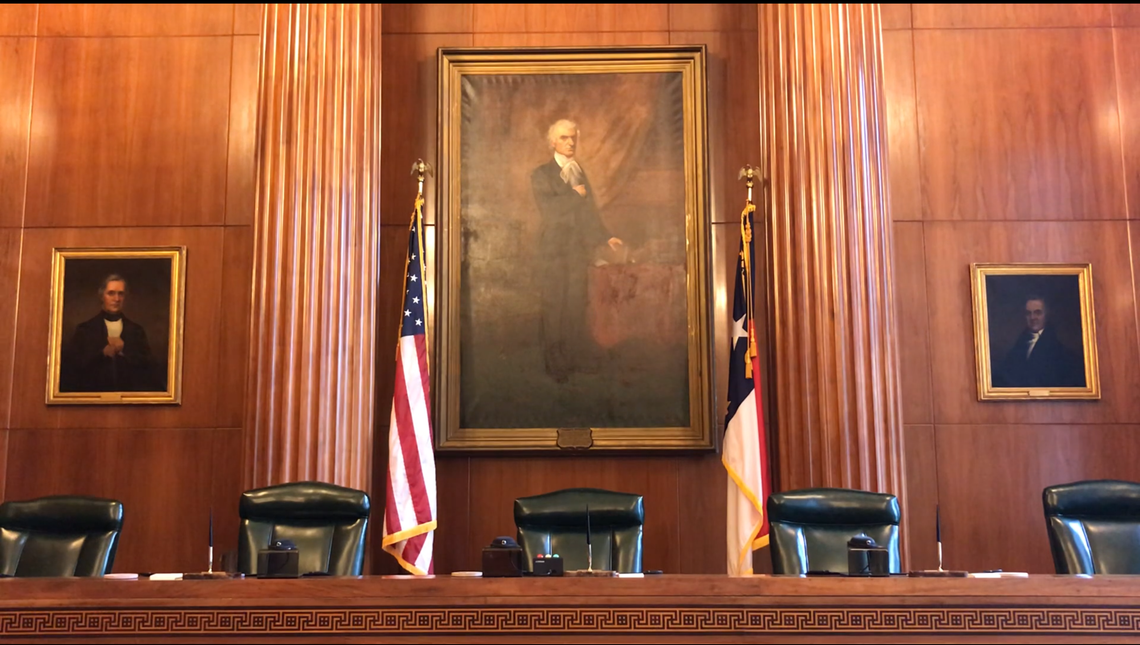
The portrait of a former N.C. Supreme Court chief justice and racist slave owner will no longer hang in Orange County’s historic courthouse in Hillsborough.
Senior Resident Superior Court Judge Carl Fox asked the county last week to remove former jurist Thomas Ruffin’s portrait from the wall of the second-floor courtroom “because of his racist past and his participation in slave trading and slave ownership,” according to a news release Wednesday.
Orange County Manager Bonnie Hammersley agreed, and the portrait was removed. The Orange County Board of Commissioners issued a statement Tuesday night supporting the move.
“As the truth about Ruffin’s life and work becomes more widely known, it is increasingly difficult to justify his portrait in a position of special honor in any courthouse,” the commissioners said in the news release.
The historic courthouse, built in 1845, is still used for judicial hearings and offices. Ruffin’s portrait, a copy of one commissioned by a UNC honor society, has hung in the courtroom since a 1993 renovation.
Ruffin was a Hillsborough lawyer, Alamance County farmer and trustee at UNC-Chapel Hill. He joined the Supreme Court in 1829 and served as chief justice from 1833 to 1852.
He also owned and lived the later years of his life in the Ruffin-Roulhac House, which now serves as Hillsborough’s Town Hall. He is buried in the St. Matthews Episcopal Church Cemetery in Hillsborough.
Court-supported violence
While Ruffin was “nationally recognized during his lifetime for his keen judicial mind,” the county news release said, he is now better known for his support and practice of slavery.
Fox’s petition to the county noted Ruffin’s ruling in the 1829 case State vs. Mann, which Fox said “rivals the Dred Scott decision in its horror and inhumanity,” according to a news release. It was one of hundreds of decisions that Ruffin made as a judge.
The case involved a Chowan County man who was found guilty of assault for shooting a young black female slave named Lydia in the back as she fled “his chastisement.”
Ruffin overturned the verdict, although there was no legal or statutory precedent to support his decision, saying, “The power of the master must be absolute, to render the submission of the slave perfect.”
The decision gave slave owners and traders clear authority to practice extreme physical abuse — something with which Ruffin was intimately familiar, according to research from UNC law professor Eric Muller and Commissioner Sally Greene, an independent scholar.
Plantation owner, slave trader
Orange County records show Ruffin owned at least 27 slaves — men, women and children — on his plantation, which lay just east of Swepsonville in southern Alamance County. Until 1849, it was part of Orange County. He also held another 39 slaves as collateral on loans made to their owners, Orange County Register of Deeds Mark Chilton said in an email interview.
Life on Ruffin’s plantation was cruel. In one instance, his overseers burned Ruffin’s slaves, “rubbing salt and pepper into their wounds,” Muller and Greene wrote in a News & Observer op-ed.
Ruffin, himself, reportedly caned a young female slave named Bridget who trespassed onto his property, and after an argument, gave him “a look of insolent audacity which Patience itself could not swallow,” he later wrote.
His business dealings ranged from selling off members of the families who worked his land to a silent partnership with a South Carolina slave trader, who “bought people in the border states and sold them at a profit in the deep south,” the researchers said.
Ruffin probably “traded in the ownership of well over 100 human beings,” Chilton said Wednesday.
The state’s top court also is reconsidering Ruffin’s place in its history. N.C. Supreme Court Chief Justice Cheri Beasley appointed a committee in 2018 to examine the history of Ruffin and others with ties to racism and white supremacy who have portraits in the court’s collection. The committee could wrap up its work later this year.
In the news release, the county commissioners commended Fox, who is black, for his “exemplary leadership in recognizing the silent but very real impact that the portrait of Ruffin could have on the interests of fair and impartial justice in Orange County and in taking appropriate action.”
This story was originally published January 22, 2020 at 10:20 PM with the headline "NC county removes portrait of famed judge and slavemaster from courthouse wall."