
It’s a banner year for sea turtles along the North Carolina coast. What’s behind it?
The baby sea turtle at Topsail Island is lively, flapping its tiny flippers. Once it is gently placed in the sand, volunteers herd it into the waves.
For volunteers, it’s like watching your kid head off to kindergarten for the first time.
This has been a boom year for sea turtle nesting on the Atlantic coast.
Terry Meyer, coordinator for the Topsail Turtle Project at the Karen Beasley Sea Turtle Rescue & Rehabilitation Center in Surf City, said the North Carolina coast harbors at least 2,000 sea turtle nests. That’s 320 more than the previous high of 1,680, she said.
At last count from Meyer, Topsail Island was hosting 172 of those nests, with a month left in the season.
It’s clear that turtles are laying eggs at record-breaking numbers.
What’s less clear is exactly why. It’s a complicated story involving turtle behavior and decades of conservation activity.
‘Pretty much an egg factory’
Jerry Reynolds, head of outreach at the North Carolina Museum of Natural Sciences, has some hunches about the banner year for loggerhead turtle nesting.
“They’re pretty much an egg factory,” Reynolds said of the turtles.
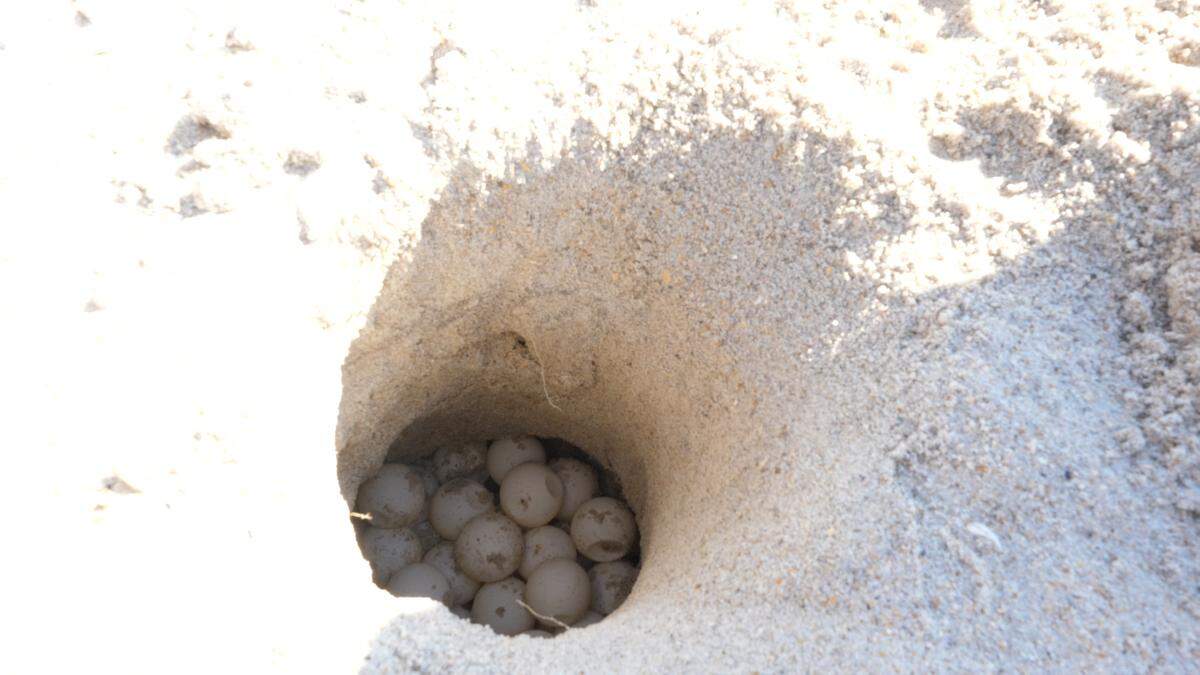
Each female can produce up to six nests each season, which lasts from May to August.
“They come in and lay roughly 120 eggs, and usually in about 10 to 14 days, another 120 eggs,” Reynolds said.
All that nesting is exhausting. Imagine using flippers to crawl across the beach in a body that can weigh up to 350 pounds, according to the University of Georgia Savannah River Ecology Laboratory. That’s why loggerheads lay eggs every two to four years instead of every year.
That behavior could be one of the reasons for a record-breaking year. Reynolds explained that sometimes turtles’ breeding cycles overlap and there can be a larger number of nests than average. Or perhaps turtles have had a lot of luck the past few years finding food, which helps them nest more frequently.
Excavating baby turtles
On the north shore of Topsail Island, Connie Pletl began to scoop away the sand covering a loggerhead nest. She wasn’t having any luck finding the remains of the 155 eggs buried there: no soft, leftover shells or even a rotten smell to let her know she was nearing a nest.
After several minutes of digging, she triumphantly lifted a squirming baby turtle from the hole. The crowd below her on the beach cheered. Pletl handed the hatchling to another volunteer, who placed it carefully into a blue plastic bucket.
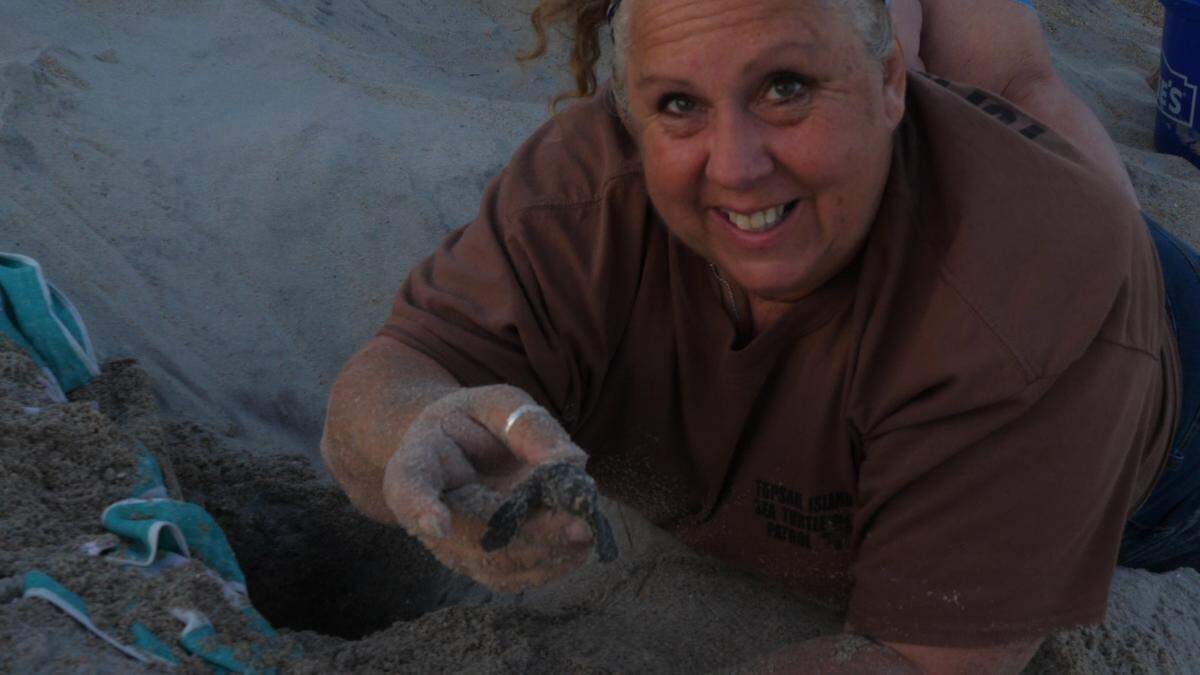
Pletl is a Topsail Turtle Project coordinator for the north end of the island. She was doing what she called an analysis of an already hatched nest, where volunteers count the eggshells, dig out live turtles and look for unhatched eggs.
Polly Rosenberg and her beach walking partner, Suzanne Livingston, have found four nests so far on Topsail Island. Rosenberg explained that the walkers start morning patrols of their assigned mile of coast starting in May, looking for the tell-tale marks of a female turtle dragging her body across the sand.
Livingston said that the turtles tend to pop out of the sand on average 60 days after the eggs are laid. However, the hatchlings can be days early, or arrive far past their due date.
“It depends on the summer, it depends on the nest,” said volunteer Trudy LaBell. “There’s not a usual. Every nest is different.”
LaBell said that beach walkers sat at this newly excavated nest for seven nights waiting for the eggs to hatch.
The excavated baby turtles were named as they emerged from the sandy depths, and soon Charlie, Charlotte and five other turtles were scratching at the bucket’s sides for freedom.
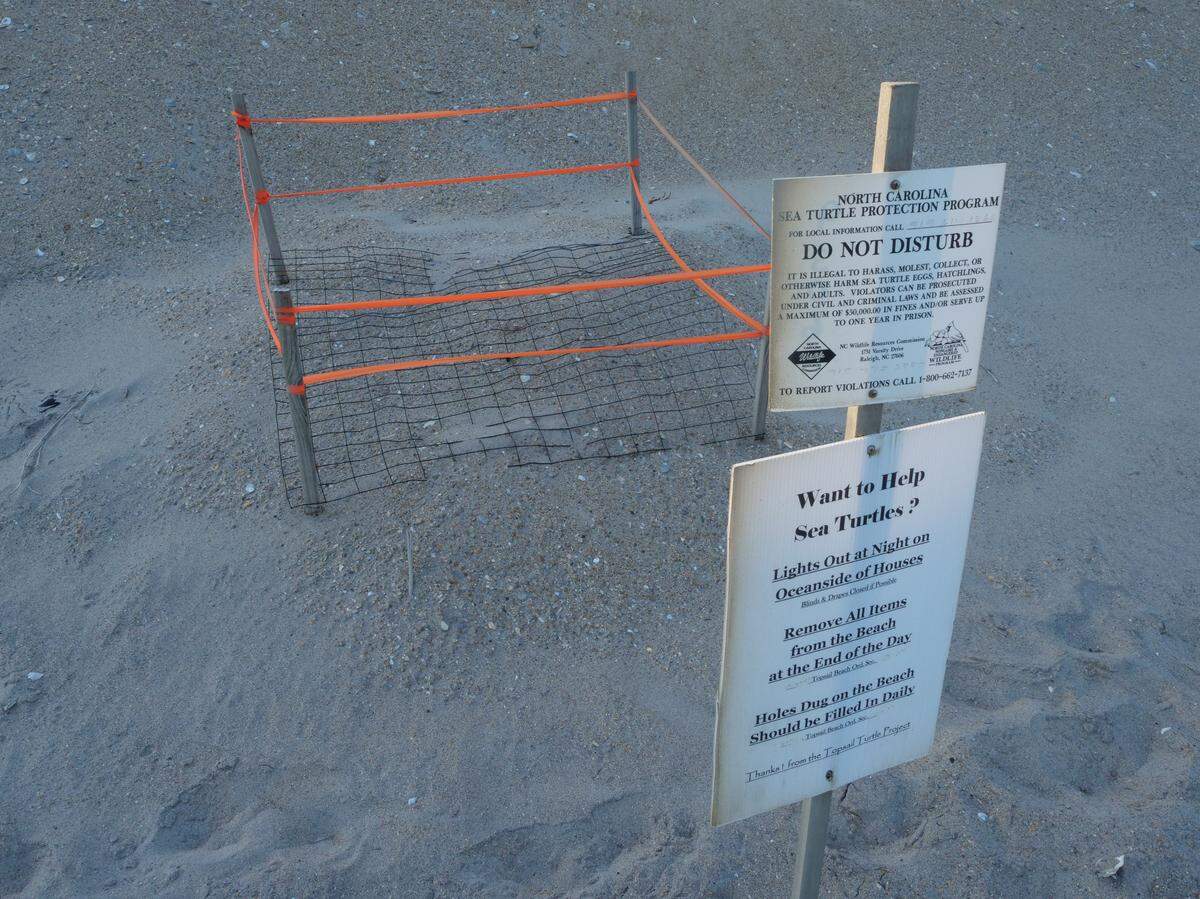
Then came the moment the crowd was waiting for: the hatchlings’ release into the ocean. Spectators were briefed on staying behind a line drawn in the sand to avoid stepping on sea turtles — according to the U.S. Fish and Wildlife Service, killing sea turtles can lead to thousands of dollars in fines.
The baby turtles, barely palm-sized, wriggled from the volunteers’ grasps and flapped their tiny bodies toward the roaring surf. The volunteers waded into the water with them, human nest mothers making sure no one washed back onto shore.
Decades of conservation work paying off
Another potential reason for the surge in sea turtle nests this year: conservation efforts like the Topsail Island patrols and other endeavors.
Reynolds remembers stepping into bait shops on Topsail Island as a kid and seeing baby sea turtles sold as pets.
“They just didn’t have any protection,” he said. People would dig into turtle nests and regularly net or hook them as bycatch.
Now, turtle monitors protect protect eggs from predators and people.
“It’s a short but dangerous walk,” Reynolds said of the hatchlings’ crawl to the ocean. “If a nest hatches in the morning there are seagulls. At night the crabs will get them. We give them safe passage, but once they reach the ocean then everyone wants to eat them.”
Reynolds named boat strikes as another hazard that can kill or injure sea turtles. And bright lights on the beach can attract hatchlings, who veer off course to streetlights and starve or get eaten by predators.
The National Oceanic and Atmospheric Association estimates that only one in 1,000 to one in 10,000 sea turtles survives into adulthood. That’s why conservation efforts have been so vital to their survival.
“If we look at the long-term trends in a lot of places, we’re seeing growth over time in sea turtle populations,” said Susan Piacenza, an assistant professor in biology at the University of West Florida. She mentioned conservation efforts such as turtle excluding devices on trawling nets to reduce the number of turtles drowned by fishing vessels.
The hard part of marine conservation is all the waiting. Because it takes around 25 years for a turtle like the loggerhead to reach reproductive age, the effects of conservation can take awhile to show up, Piacenza said.
She said she’s excited to see increases in sea turtle numbers, but she worries about some threats that are harder to control. Pollution can affect water quality and sea turtle health, and plastics in the water can kill turtles who feed on them.
And climate change is a huge source of concern for biologists worldwide, according to Piacenze.
“Especially when we have these signs of recovery after a lot of hard work, it’s something that’s looming over us and we’re not sure what’s going to happen,” she said.
The turtle obsessed
At around 10 p.m. on a Saturday night, three turtle test sitters were waiting in the dark. They pointed out the depression in the ground that indicated baby turtles on the move beneath the sand’s surface.
Coordinator Pam Kosar explained that babies leave the nest through what she called, “the elevator effect.” Hatchlings are out of their shells for around a week before they even start to move toward the surface. As they begin to move upwards, sand fills in the spaces they have just vacated, lifting them up. The sand spilling in below them can make it look like they are boiling toward the surface.
Sometimes turtles can dribble from a nest, and sometimes they all erupt at once and are gone into the waves, said volunteer Rebecca Martin. That unpredictability can make volunteers resort to drastic measures.
Coordinator Marie Palmer recounted that one day she got a call that a sea turtle was on the beach. In her scramble to get there on time, she passed an unmarked police car in a no passing zone and was pulled over. Frantically, she explained about the turtle and that she had to get to the beach. The officer ended up giving her a warning rather than a ticket.
When the ordeal was over, Palmer asked if he wanted to come see the turtle. “He came!” she said.
According to the night crew, the rush of the volunteer work can also make “turtle widows” out of their partners, at least the ones who aren’t as turtle obsessed.
‘Just like a mother turtle’
The next morning, volunteers found a nest laid too close to the water, where the eggs could drown. Volunteers needed to relocate them.
Palmer carried a blue bucket full of eggs to a dune where Pletl waited, hole already dug in the sand. The eggs were covered with a folded towel containing sand from the bottom of the original nest.
“We’re trying to recreate this nest to be close to the nest they came out of,” explained Palmer. The sand would go into the hole first, and the eggs would be placed in the same order as the original nest.
Pletl said that relocated eggs have the same hatching rate as ones from natural nests.
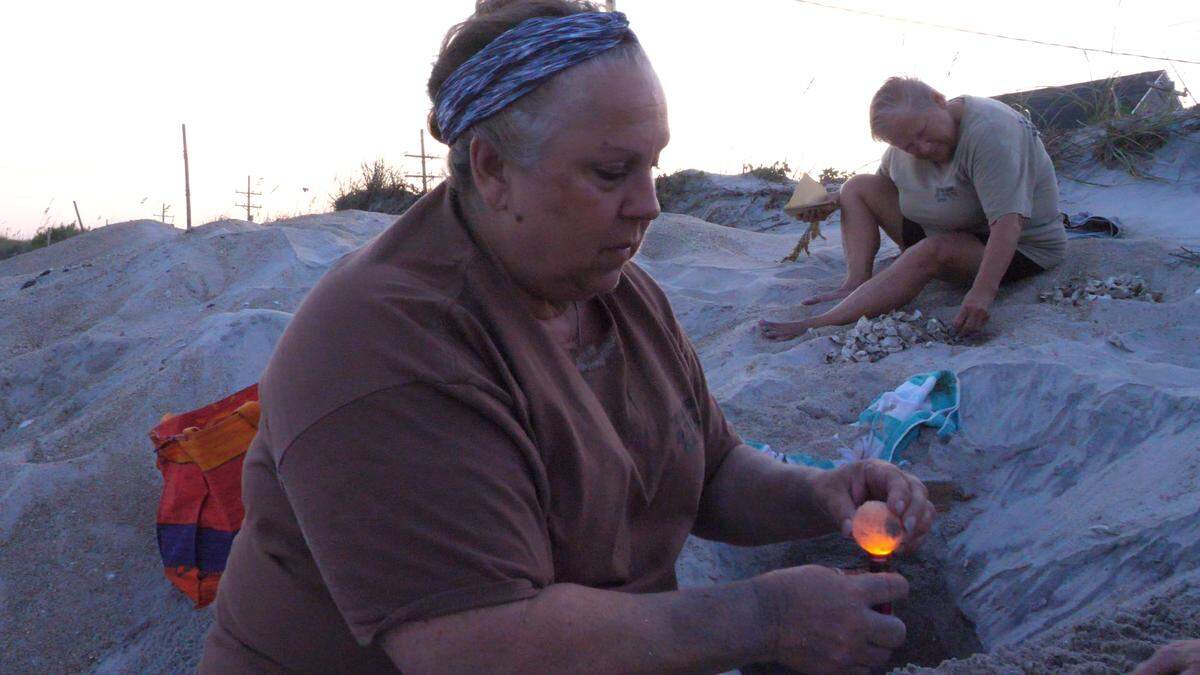
Coordinators needed a DNA sample from a single egg, so they selected one. It was cool, dented at the slightest pressure and felt a lot like a ping pong ball.
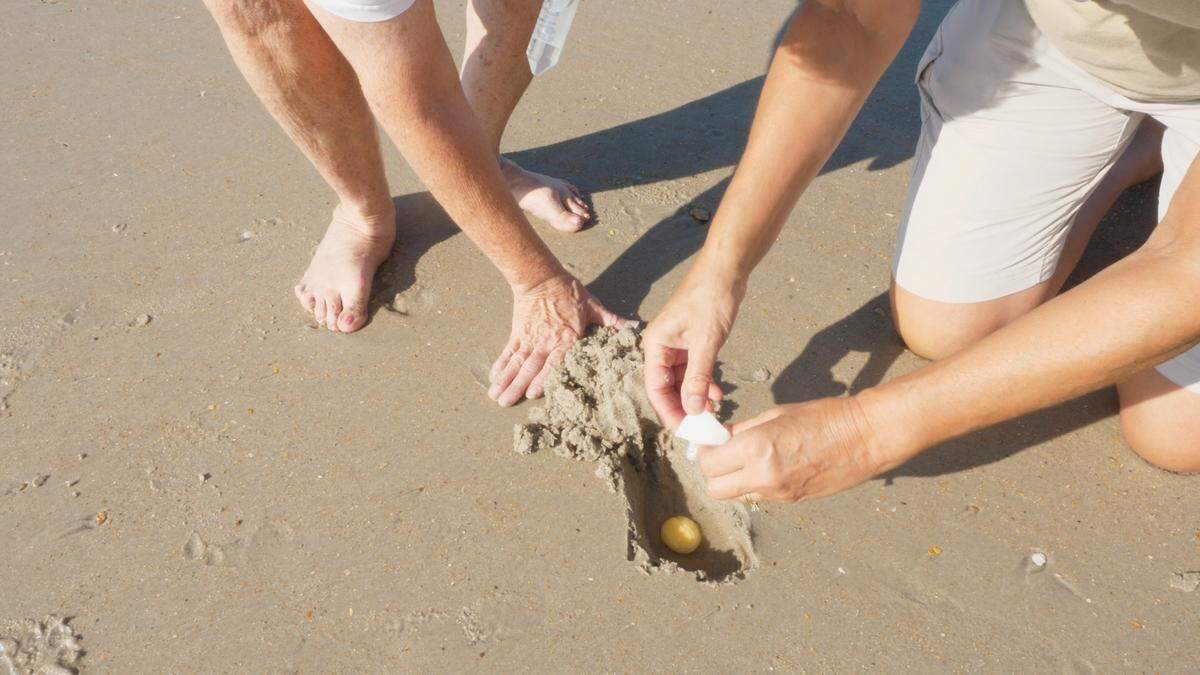
Pletl dug a shallow hole in the sand, then cracked the egg into it and covered the yolk with sand. The shell would be tested for the mother’s DNA, used to track her nesting habits.
When the soft eggs were safely buried in the dune, Pletl slapped her arms down onto the new nest a few times.
“Just like a mother turtle does!” she said.
This story was originally published August 7, 2019 at 6:52 PM with the headline "It’s a banner year for sea turtles along the North Carolina coast. What’s behind it?."