‘Protect our community.’ How Black leaders are tackling hesitancy over COVID vaccine
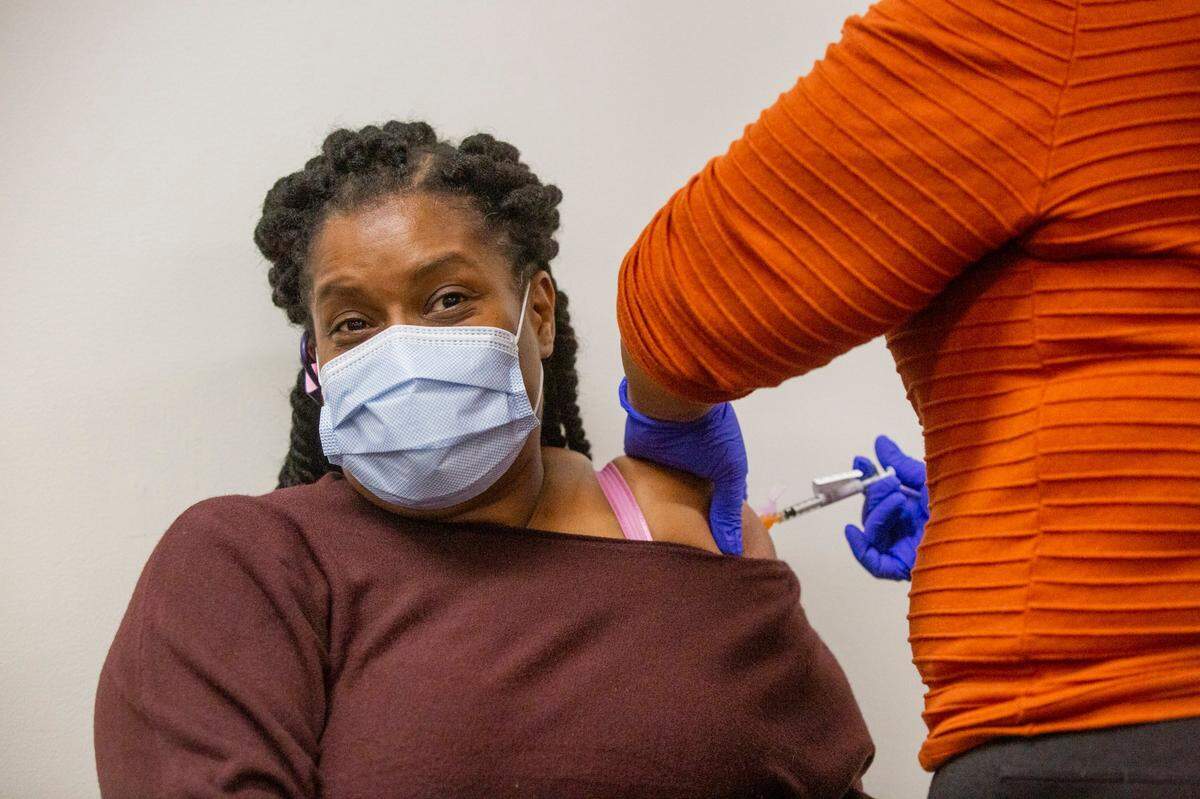
The day that Duke University Hospital received its first shipment of the COVID-19 vaccine last month, Faye Williams sat down, rolled up her left sleeve and made history.
Williams, a nurse at Duke clinics screening people for the virus, was the first frontline worker and the first Black person to receive the vaccine in the Triangle region.
A month and her second vaccine dose later, Williams spoke on a COVID-19 vaccine information panel held last weekend at St. Joseph’s AME Church in Durham’s historically Black neighborhood of Hayti to promote the vaccine to skeptical African Americans.
“I stand before you as exhibit A,” Williams, 65, said at the church. “I felt like I could be a living example and advocate for the vaccine. I believe, and it’s been proven to me, that the vaccine is safe.”
Personal testimonials are just one way that health and government officials are hoping to convince those skeptical about the vaccine to take their shots, especially in the Black community which has been disproportionately impacted by the pandemic and has historic reasons to be wary of government medical attention.
Williams’s introductory remarks were followed by a panel of Black public health and viral experts, who dismissed myths about the vaccine and answered common questions surrounding its side effects and benefits.
She said that minor body aches followed both shots of the vaccine she received, but that over-the-counter medications quickly treated them, and she urged those factors to not discourage anyone.
“Protect yourself from this dreadful disease, protect the ones you love, protect our community,” Williams said.
Vaccine reluctance may persist
The message of the panel at St. Joseph’s AME Church comes as about 19,000 Black or African American people have been vaccinated in North Carolina, according to the state health department.
More than 641,000 people in North Carolina have tested positive for COVID-19 since March and more than 7,745 have died as of Jan. 13.
Black North Carolinians account for 26% of the state’s COVID-19 deaths, though they are about 22% of the total population.
But the African American community has expressed an initial reluctance toward taking the COVID-19 vaccine, at least before results from trials of the vaccines became public.
In a recent survey of 1,200 North Carolinians in nine counties, just 22% of African American respondents indicated they’d be willing to take an early vaccine.
The in-person survey was conducted by North Carolina Central University’s Advanced Center for COVID-19 Related Disparities (ACCORD) before vaccine trial results were published showing strong evidence that the two new Pfizer and Moderna vaccines work.
The NCCU data is in line with national surveys.
A late November survey found 26% of Black Americans willing to take a first-generation vaccine, a figure that was up five points from an October survey. In a September survey, small percentages of Black people felt the coronavirus vaccine would be safe (14%) or adequately tested for safety and effectiveness within their own racial community (28%).
Those attitudes may be changing, thanks in part to people like Williams. A December survey by the Kaiser Family Foundation found 35% of Black adults would definitely or probably not get vaccinated even if it were available for free and deemed safe by scientists. That number was down from 49% in September.
But the figure was still higher than the 27% overall who said they would definitely or probably not get vaccinated in the survey.
In the survey, 62% of Black people were likely to get the vaccine, up from 50% in September. Among white people, 73% said they would likely get the vaccine, up from 65% in September, while 26% said they would definitely or probably not get it, down from 33% in September.
The same Kaiser Family Foundation survey in December found Republicans (42%), those ages 30-49 (36%), and rural residents (35%) also have higher-than-average hesitancy to take the vaccine.
A racist history
Among those Black adults who said they definitely or probably would not get the vaccine, about half said they don’t trust vaccines in general (47%).
“It’s going to take some trust building. They’re not going to be the first,” said Yvonne Lewis Holley, 68, a state representative from Wake County who is Black.
“It’s going to be a full year before people are really feeling comfortable, senior citizens and in my communities. The syphilis stuff and eugenics were real. That was real. So there is a leeriness, plus a lot of research is done and not done on our communities and not whether it affects us differently or not.”
The Tuskegee Study, conducted from 1932 to 1972, studied black men with syphilis, but did not treat them for the illness nor did it inform them of the real purpose of the study.
In North Carolina, from 1929 to 1974, more than 7,500 men and women — many of them Black — were forcibly sterilized under authority of the Eugenics Board of North Carolina as well as local health and welfare officials. The program was designed to “breed out” nonworking Black residents, according to an academic paper from a Duke University professor.
The programs have left scars and distrust in the Black community, including among Black mothers, The Charlotte Observer reported.
Getting the message out
In December, N.C. Central University, along with Duke’s Clinical & Transitional Science Institute, produced a 90-minute theatrical play aimed at Black audiences — called an “ethnodrama” — to raise awareness about the pandemic and the vaccine. It was aired on the web and followed by a live panel discussion.
Several predominantly African American churches planned to air it, said Deepak Kumar, director of NCCU’s biomedical and biotechnology research institute and leader of the ACCORD program.
The state Department of Health and Human Services created a Vaccine Advisory Committee, among whose goals is to “increase public awareness about vaccination activities, especially for prioritized and historically marginalized populations.”
The agency has developed vaccine websites in English and Spanish aimed at answering the most pressing questions about its testing, safety, effectiveness and speed of production.
The agency said it is focused on ensuring that people are hearing information from those they trust.
“One of the guiding principles for North Carolina’s COVID-19 Vaccine Plan is that transparent, accurate, and frequent public communications is essential to building trust,” said Amy Adams Ellis, a DHHS spokesperson. “We are undertaking a comprehensive effort to make sure that North Carolinians can make an informed decision about getting a COVID-19 vaccine.”
And, nationally, Dr. Anthony Fauci is using a specific North Carolinian to help deliver the message. Kizzmekia Corbett, who grew up in Hillsborough and attended UNC-Chapel Hill, is the scientific lead on the coronavirus vaccine at the National Institutes of Health.
At an event last month at the National Urban League, Fauci was asked about hesitancy from African Americans.
“The first thing you might want to say to my African American brothers and sisters is that the vaccine that you’re going to be taking was developed by an African American woman,” Fauci said. “And that is just a fact.”
This story was originally published January 15, 2021 at 8:30 AM with the headline "‘Protect our community.’ How Black leaders are tackling hesitancy over COVID vaccine."