
Number of people dying at home during the pandemic spikes in Mecklenburg County
The call came in around 4 p.m. one day last June.
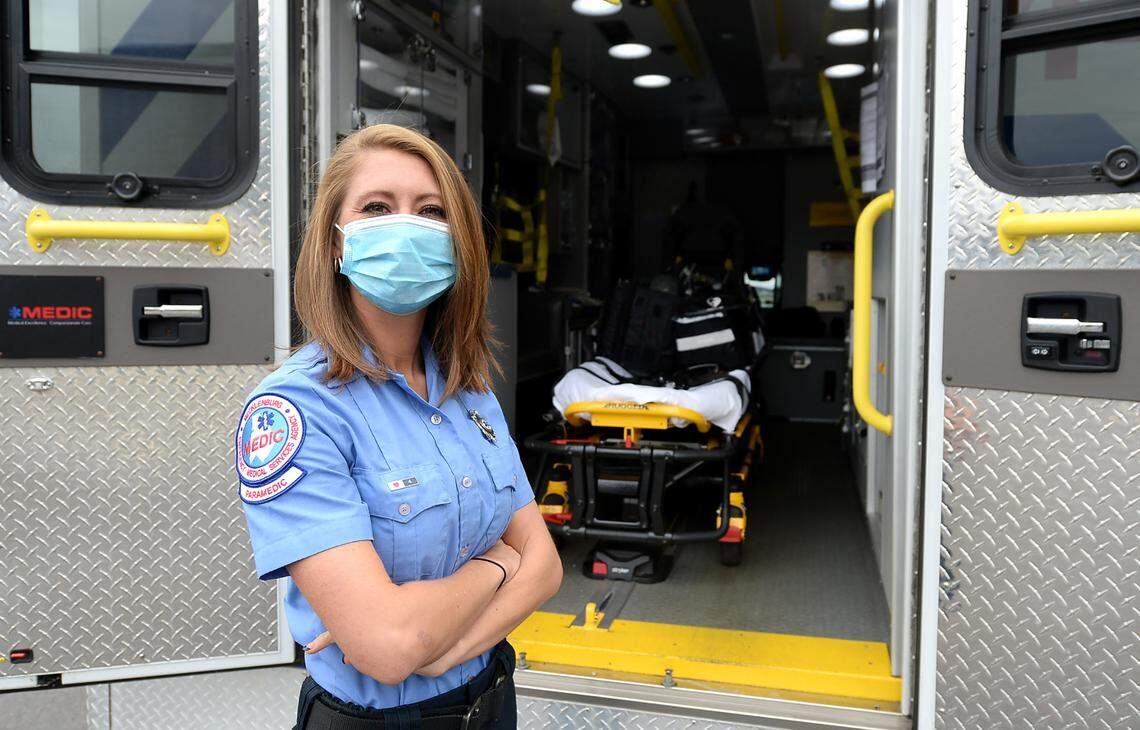
A woman in her late 40s was unconscious in a car outside of her west Charlotte home. Mecklenburg County paramedic Lauren Gosnell and her partner revived the woman and told her she needed to go to the hospital because she had life-threatening low blood pressure.
The woman refused to go. She was afraid of contracting COVID-19 there.
“She would rather stay at home and die,” Gosnell said.
As fears about the pandemic intensify, many patients apparently feel the same way.
From March to August of this year, calls in which Mecklenburg County patients were treated at home but refused to be taken to the hospital for additional care increased to 6,573 — a 25% jump compared with the same period last year, according to data from MEDIC, Mecklenburg’s EMS agency. Data on how many of those people later died was not available.
But the number of patients found dead in their homes after an ambulance was called rose to 545 — a 35% increase over the same six-month period, while calls in which emergency personnel failed to revive a patient rose to 261 — a 51% surge, MEDIC data show.
The pandemic has likely played a major role in these trends, Gosnell and others said.
A lack of child care — because day cares were shuttered — and the misbelief that doctor’s offices remained closed kept some patients from seeing their primary care physicians or renewing live-saving medications, experts said.
And fears of contracting COVID-19 have discouraged some gravely sick people from going to the hospital, they told the Observer.
Gosnell, one of the MEDIC’s roughly 400 emergency workers, responded to three in-home deaths in 2019. This year, she’s already been to six.
“People are waiting till the last minute to call 911 because they’re scared of COVID,” said Gosnell, 27.
Deaths at home jumped 39% from February to March, the largest one-month increase since early 2017, according to MEDIC data. That’s also when the virus began spreading across the state. In the months that followed, those deaths continued to rise, climbing from 121 in March to 146 in July.
Gosnell said she has seen a second spike in recent months, as coronavirus cases in Mecklenburg and other parts of the state surge.
COVID-19 hospitalizations in Mecklenburg increased 70% from early October to early November, data show. About 42,000 county residents have caught the virus and more than 440 have died.
Statewide, COVID-19 has infected some 346,000 and killed more than 5,100.
Ignoring the symptoms
Fred Southwick, an infectious disease specialist in Florida, said people often fear or distrust doctors, particularly during a pandemic. That leads to denial.
“I don’t want to be sick, and if I don’t go, I won’t be sick,” Southwick said, explaining the mindset he sees in some patients. “Obviously, that’s not true.”
So people ignore the alarm bells — chest pains, shortness of breath, high fever.
With COVID-19, the consequences can be fatal.
Max Cooper, an emergency room physician in southeastern Pennsylvania, said the virus can cause blood clots, which can lead to heart attacks and strokes.
Compared to last year, deaths at home that were attributed to heart attacks and strokes in Mecklenburg County are up 30% and 36%, respectively, county data show.
Many of those deaths are likely tied to COVID-19, Cooper surmised.
Conversely, the number of people going to a Mecklenburg hospital for strokes and other types of cardiac events dropped “significantly” during the height of the pandemic, said Raynard Washington, the county’s deputy health director.
The fear of contracting the virus can prove fatal when sick and vulnerable people delay calling for help, he said.
Washington said the county saw a 13% increase in overall deaths in the first half of 2020 compared with the same period last year. About half of the additional deaths were directly because of COVID-19.
Others were likely related to the virus indirectly, either because people could not get to their primary care physicians, renew medications or were too afraid to see a doctor.
“Most people feel there is an underestimation of death due to COVID,” Southwick said. “I think you can say, if a patient or individual is too afraid to go to the hospital and dies ... indirectly it’s because of COVID.”
Deaths at home rise elsewhere
Orange County, where Chapel Hill is located, has seen a similar spike in deaths at home, said Joey Grover, medical director for the county’s emergency services.
From March to August, deaths at home in Orange County increased 31% compared with the same period last year, Grover said. Successful resuscitation dropped, as did the overall number of calls to 911.
“I have never in my lifetime seen so many days of an empty (hospital) emergency department as we did in the initial days of the pandemic,” said Grover, an assistant professor at the UNC Department of Emergency Medicine.
He said that trend also played out nationwide.
“Fear (of contracting COVID-19) absolutely played a major role in it,” Grover said.
Yet, Orange County has yet to have a single COVID-19 patient die at home.
Rather, he said, people aren’t seeking help for conditions that are treatable. And some are dying because of it.
“Just because COVID is happening doesn’t mean baseline heart disease has gone away,” Grover said. “I think there are fewer people seeking care.”
Fear of catching the virus is real
MEDIC Deputy Director Jonathan Studnek said his agency’s paramedics often have to tell leery patients that going to the hospital is safe, that hospital staff sanitize the building, that doctors and nurses wear masks and wash their hands.
“That fear of COVID is very present for folks,” Studnek said. “…Our folks had to put in an effort to get people to get into an ambulance and seek care.”
Gosnell said it is her belief that many people who refuse to go to the hospital are afraid of COVID-19.
In June, she and her partner knew the west Charlotte woman’s condition was life-threatening. First, they told her that hospitals are sanitized regularly and are cleaner than gas stations and grocery stores. That didn’t work.
Then they asked the hospital for permission to take her in against her will. That didn’t work either.
North Carolina law and EMS policy say patients cannot be transported against their will, unless they can’t make that decision for themselves, a MEDIC spokesperson said.
Then Gosnell and her partner waited, and waited.
Two hours later, the woman lost consciousness again and Gosnell and her partner rushed her to the hospital. She was treated for her low blood pressure and later released.
She was among the lucky ones.
“If you have life-threatening symptoms, call 911,” Gosnell said. “If we can treat you on the scene and leave you home, we’ll do that. But call us. Don’t wait till it’s too late.”
This story was originally published November 27, 2020 at 9:34 AM with the headline "Number of people dying at home during the pandemic spikes in Mecklenburg County."
