First-time home buyers need a six-figure income in many states. Is NC one of them?
.JPG "Experts say tariffs on home-building supplies like lumber, steel, aluminum and drywall, much of which is imported from Canada or Mexico, will make homes more expensive.")
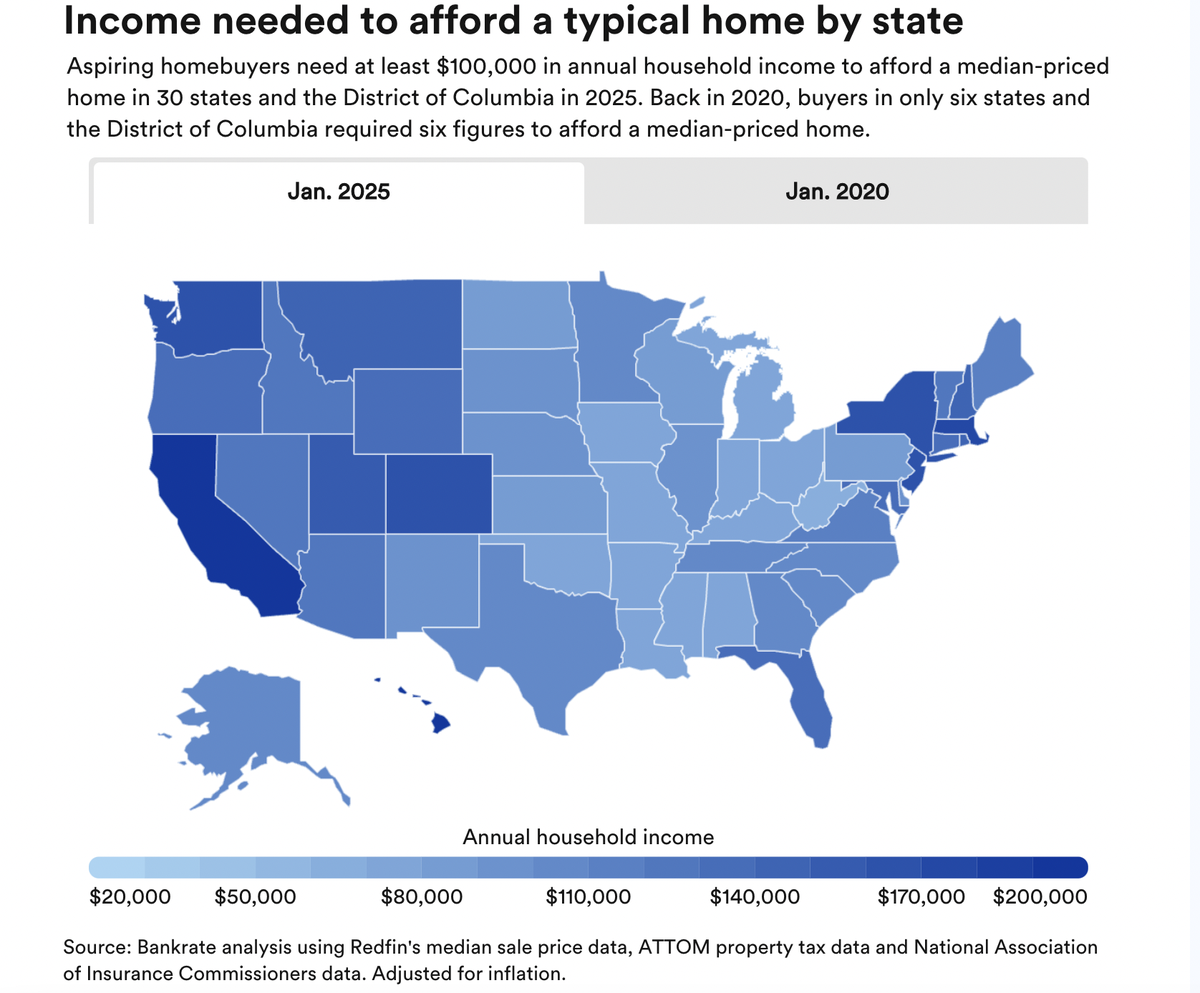
First-time home buyers now need a six-figure income to afford a “typical home” in over 30 states, including North Carolina, according to a new Bankrate study.
That’s a much larger swath than six states and the District of Columbia just five years ago.
And prices have also skyrocketed.
To afford a home based on Redfin’s median national sale price at $418,489 in January, you’d need an annual household income of around $117,000, based on Bankrate’s analysis.
That’s up almost 50% since 2020 when it hovered around $78,000.
“Between elevated mortgage rates and the rise of home prices nationally to a record level, many aspiring homebuyers feel like owning a home is out of reach,” says Mark Hamrick, senior economic analyst for Bankrate.
Using Redfin’s median sale price data, ATTOM property tax data and National Association of Insurance Commissioners’ data, Bankrate analyzed monthly mortgage payments in all 50 states, the District of Columbia and nationwide.
Hamrick couldn’t say when these conditions will ease. He also noted that “prices and availability vary widely across the nation, and even throughout larger communities or metro areas.”
How does North Carolina stack up?
Here’s a closer look:
How NC compares for housing affordability
Since January 2020, the annual household income needed to afford a median-priced home (mid-point where half cost less and half cost more) has increased by more than 50% in 34 states, the study said.
The surge is largely due to higher mortgage rates, rising prices and more competition driven by “pandemic-spurred” migrations. Homeowners from California and Seattle flooded into the Rocky Mountains and other western states, while those in Northeast hubs like Boston and New York relocated to Florida, the Carolinas and Tennessee, the study noted.
Utah saw the biggest jump in needed income, up 89.4% to $151,956 in 2025. In January, the median home sale price was $605,400, compared to an inflation-adjusted median of $433,546 in January 2020, according to a Bankrate analysis of Redfin pricing data.
Montana saw the second-largest increase in needed income, up 84.6% to $142,316.
Wyoming, Maine and Tennessee also saw needed incomes spike since 2020, with Wyoming up 79% to $131,070; Maine up 77.4% to $110,889; and Tennessee up 76.9% to $103,411.
North Carolina saw an increase in needed income over that same period, but not as high — up 66.6% to $102,996.
The income needed increased the least in Texas, up 25.8% to $105,663, Louisiana, up 26% to $76,145, Kansas, up 31.1% to $86,829, North Dakota, up 33.6% to $82,793 and Illinois, up 35.2% to $91,639.
The District of Columbia requires the most income to afford a typical home in the area at $240,009 as of January 2025, followed by Hawaii at $235,638.
West Virginia requires the least at $64,179.
What’s happening in the Triangle
In the Triangle, home prices continue to rise amid a long-running housing shortage and in-migration. But sales remain flat as the 30-year fixed-rate mortgage hovers around 6.65%. Though it has declined to its lowest level since mid-December, it’s still more than double pandemic-era lows.
Raleigh’s market is “somewhat competitive,” according to the latest Redfin data. The median sale price was $433,000 in February. That’s up 14.8% year over year.
However, sales are down 23.2% year over year, and on average, it’s taking homes 45 days to sell compared to 23 days last year.
Durham’s market is “very competitive,” but prices aren’t rising as quickly, Redfin found.
The median sale price was $420,000 in February. That’s up 5% since last year.
Meanwhile, sales are down 6.9% year over year. On average, homes sell after 44 2 days on the market compared to 20 days last year.
Some homeowners remain hesitant to sell, “largely due to concerns about job stability and the broader economic outlook,” said Shanta Jackson, broker at Raleigh-based Jackson Realty Group. She’s also a member of the Raleigh Regional Association of Realtors.
“Those currently buying and selling are often individuals who need to make a move, whether due to life changes or financial circumstances,” she added.
“In many cases, homeowners are choosing to sell as a way to pay off debt, reflecting shifting financial priorities. As a result, home prices are adjusting to align with this new market reality.”
This story was originally published April 1, 2025 at 7:30 AM with the headline "First-time home buyers need a six-figure income in many states. Is NC one of them?."