Brand-new and ‘built on spec’: Why one Durham office building has sat empty since 2022
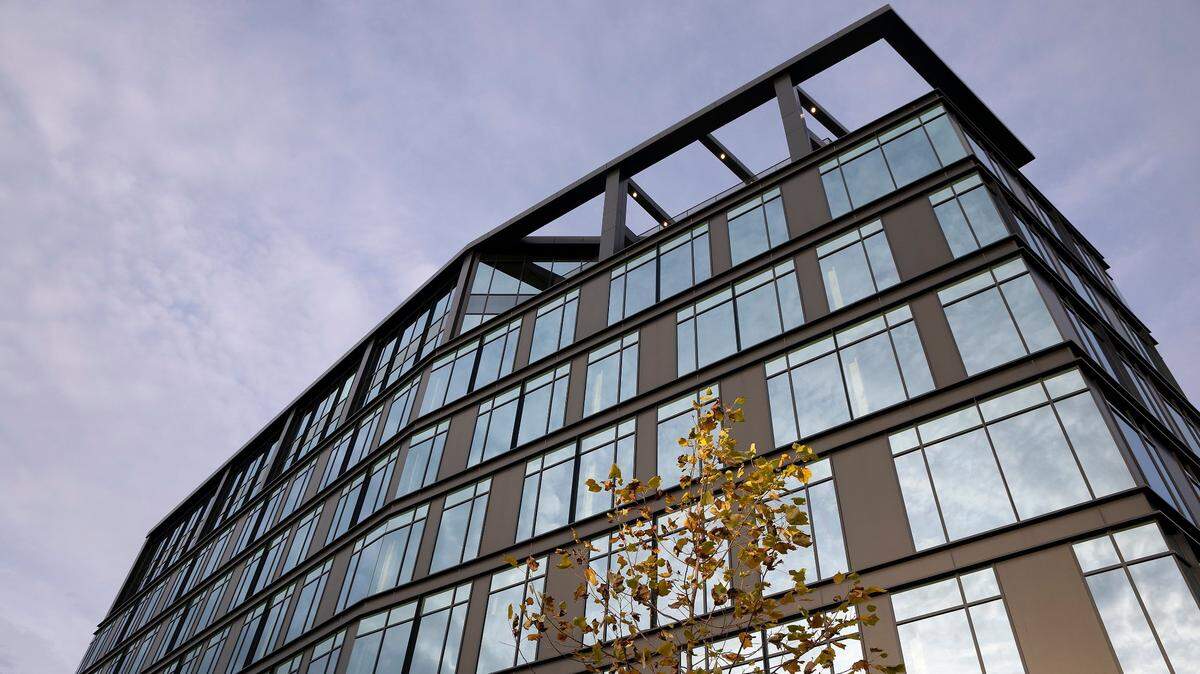
In early 2022, Trinity Capital Advisors, in partnership with SLI Capital, delivered the core and shell of Roxboro at Venable Center, a Class A “built-on-spec” office building in Durham’s revitalized warehouse district.
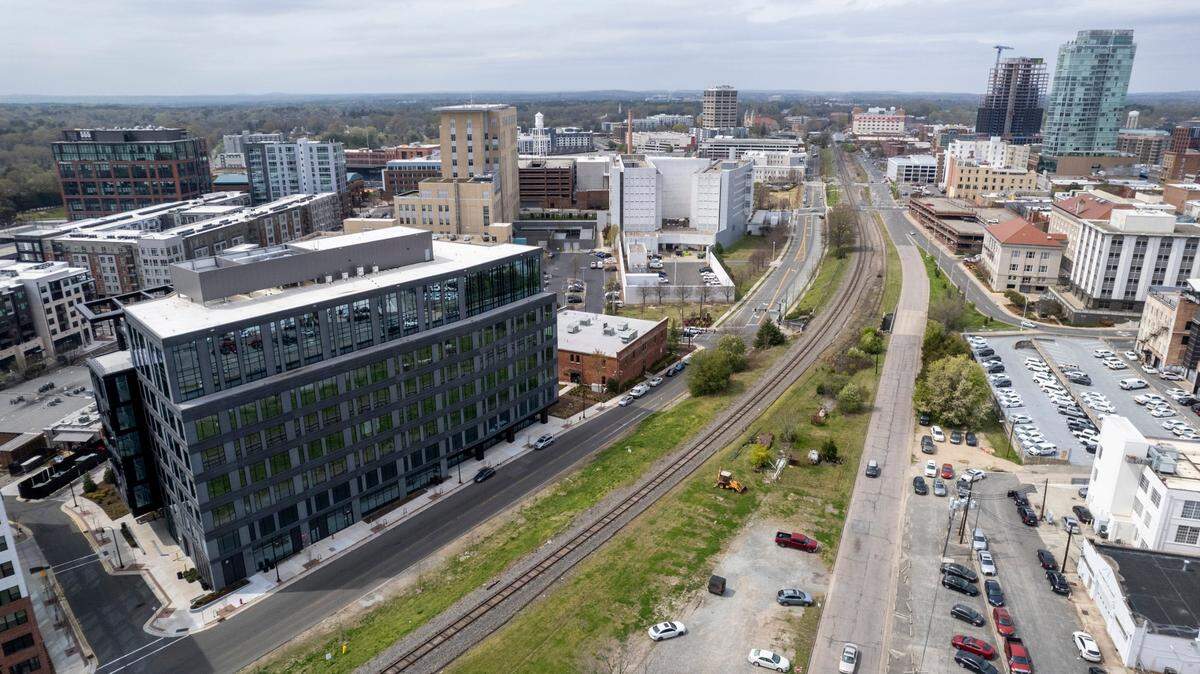
Like a monument sculpted from precast concrete, black graphite and glass, the eight-story, 202,000-square-foot building at 380 East Pettigrew St. stood in stark contrast to its red-brick neighbors — part of an ambitious plan to redevelop this pocket once used for tobacco storage in the early 1900s. Valued at $37 million, the building’s courtyard connects to the larger Venable Center, featuring ground-level retail, 221 upscale apartments, fitness center and 1,000-square-foot sky lounge and pool.
Jeff Sheehan, Trinity Capital Advisors’ managing partner, teased in a 2022 press release that the Roxboro would “energize existing locations and set the tone for what’s to come.”
Three years later, the building is still brand-spanking-new — and empty.
In a post-pandemic office market where deals are slow and vacancies remain at record highs, CBRE, its leasing agency, has struggled to secure a single tenant. Peek through its glassy windows, and no one is actually working inside. All floors remain available on the property’s landing page.
“We’ve hit the bottom [of the market], for sure,” CBRE executive vice president Brad Corsmeier. “There’s no issue with the building or the product or the economics. It’s a great project. It’s simply a demand thing. [We’ve] lost the deal velocity that was once there. In the last two years, downtown Durham has been stagnant.”
Speculative building — constructing offices without pre-signed tenants — is risky business. In the Triangle, it can be especially tricky given the region’s unique cluster of submarkets spread across suburban sprawl, each offering its own set of opportunities — and pitfalls. A well-timed project can yield substantial returns. In the Roxboro’s case, it’s quickly become a high-stakes gamble.
Five years since the pandemic toppled in-person work, the market remains flooded with inventory. Around mid-2024, Raleigh-Durham had some 12.7 million square feet of office space sitting empty, equating to $380.5 million in lost rent per year, Switch On Business calculated. (The online business publication compared occupancy rates against market rates from Cushman & Wakefield’s 2024 MarketBeat first-quarter report.)
For investors like Roxboro’s SLI Capital, headquartered in Raleigh, it’s been a challenge. “Long term, everybody believes it’s a good investment in downtown Durham,” Corsmeier said. “Diversity of talent is a big reason that big tech is [there], and that’s not going to change.”
The highs and lows of building on spec
The Roxboro project marked SLI Capital’s first investment since launching in 2017. It also ushered the arrival of its founder, Bryan Kane, son of Kane Realty CEO John Kane, one of the region’s most prolific developers. His portfolio includes North Hills’ Main District mixed-use expansion and Raleigh’s West End development, among others.
In 2018, Trinity Capital, in partnership with SLI Capital, Kane Realty and Jordan Park, purchased the Venable Center — including an assemblage of three brick buildings and a 1.76-acre of adjacent land at the corner of Roxboro and Pettigrew streets — for more than $27 million.
While Bryan and John Kane had previously collaborated on projects, the investment represented the first large-scale partnership between father and son and his new enterprise, SLI Capital. (John Kane’s Kane Residential manages the Roxboro’s residential portion, Venable Durham apartments, which is 90% leased.) It also offered an exciting prospect to redevelop one of Durham’s long-neglected corners dating back to 1905. Listed on the National Register of Historic Places, it’s the former home to the Venable Tobacco Co. — markings are still visible on parts of the building. It was abandoned for years before operating as an arts incubator in the early 1990s, then converting into office and laboratory space in the mid-2000s.
.jpg "464-e-pettigrew-twi-4697-(ZF-1247-97471-1-050).jpg")
At the time, the Roxboro’s investors felt bullish. Downtown Durham’s vacancy rate hovered around 2.2%. Some 950,000 square feet of office space was already in the pipeline, including projects like the Durham Innovation District and 555 Mangum. The project also promised higher density, just a five-minute walk from American Tobacco Campus and adjacent to one of the many Durham-Orange Light Rail stops then planned for downtown.
“When you look at the buildings being built or coming available in this submarket, virtually all the space has been pre-leased,” Bryan Kane, as managing partner, told The N&O in 2018. “That suggests to me that there is pent-up demand.”
Even as the pandemic hit, the horizon still looked bright. In a tantalizing four-month span in 2021, three of the world’s most valuable companies — Google, Apple and Meta — said they were coming to the Triangle. Durham topped their lists. But in the end, none of it has materialized. While all three companies are here, the surge of interest has all but evaporated. Adding insult to injury: The light rail was axed, for good.
Today, the Durham market has been slower to recover, the younger Kane admits. In part, he blames “key employers” for their reluctance to remove work-from-home policies. “That hasn’t been constructive for the downtown environment as a whole,” he told The N&O. It’s “a substantial departure from the vibrancy Durham had prior to COVID.”
Nationally, office vacancy rates nationally have reached a new record 20.4% in the fourth quarter — the highest since at least 1979, when Moody’s Analytics began tracking.
Central Durham and downtown Raleigh have comparable vacancy rates, at 20.1% and 20.9% respectively. But Central Durham’s direct vacancy is much higher (17.1%) compared to Raleigh’s (13.4%). That makes recovery more challenging, said Elizabeth Gates, a CBRE Raleigh senior analyst.
“Downtown Raleigh has historically had a more diverse tenant base, which will aid the submarket,” she said. Central Durham, meanwhile, is working through Duke University’s pullback amid the tech sector’s downturn.
“West and North Raleigh have also benefited from a large number of small- to mid-sized professional service firms,” she said, drawing interest away from the Bull City.
Yet even with these headwinds, observers say they’re still stumped as to why the Roxboro hasn’t leased more quickly.
“It’s a wonderful project,” said Skip Hill, senior vice president and Raleigh market lead for Highwoods, the real estate firm with a portfolio that includes some of downtown Raleigh’s most prominent buildings, including 150 Fayetteville, PNC Plaza, One City Plaza and Charter Square.
“I can’t put my finger on any one thing that would cause it to be considered less desirable. Maybe it’s just multiple intangibles, or simply unlucky timing.”
For Durham resident and entrepreneur Nick Jordan, the building is “beautiful,” a welcome addition to the city’s skyline. But it’s also a reminder of the metro’s stalled growth and tech scene.
“Obviously, we’ve all been impacted by various conditions over the last five years,” said the founder and CEO of Smashing Boxes, a design and development digital agency at 506 Ramseur St. in Durham. “But imagine if we had 10 of those projects, just sitting there like skeletons.”
On the plus side: Analysts say the overall market has likely bottomed out and is slowly turning a corner. For the first time since 2011, the region’s construction pipeline is also empty. While the “best-in-class” segment — roughly the top 10% of the market — has a higher vacancy rate than overall Class A, it’s outperforming in terms of absorption and rent growth, data shows. By 2026, competition for spaces — like the Roxboro — will heat up due to a lack of new deliveries, analysts say.
“We’re starting to see a lot of green shoots, especially in the life science market,” said Kathy Gigac, managing director of Avison Young’s Raleigh-Durham office. “Pre-COVID, we didn’t have a lot of large blocks of space for large companies to look at. Now, when we’re up against places like against places like Austin, Texas, or Nashville, we can definitely be a player in the way than we weren’t [before]. We have some pretty nice buildings available.”
Looking ahead
Most economists expect the recovery will be protracted and long. And the Roxboro’s investors aren’t sitting idle.
Last fall, Trinity Capital Advisors and SLI Capital invested an additional $8 million to build a full floor of speculative lab suites and broaden their tenant pool. The five suites will range in size from 3,647 to 6,188 square feet and will be available this summer.
Investors are optimistic, Corsmeier said. Overall vacancy rate for biotech space in Central Durham is around 5.4%. That’s well below the market-wide rate of 15.3% and significantly lower than traditional office space.
“There’s really no inventory on the ground for ready-to-go lab suite,” he said. Life science companies can “hit the ground running. Hopefully this time next year, we’re up to closer to maybe a 50%, 65% occupancy, or at least filled. That’s kind of the plan.”
One thing is certain: No one is building office buildings on spec anymore, he said. “The financing is non-existent.”
This story was originally published February 6, 2025 at 5:00 AM with the headline "Brand-new and ‘built on spec’: Why one Durham office building has sat empty since 2022."