On a cloudy morningthis July, a sheriff’s deputy pulled up to Edith Neal’s 1959 ranch home, carrying a summons to her doorstep in east Raleigh’s Woodcrest subdivision.
She’d officially been served.
Raleigh builder Steve Sypher is suing Neal, 61, over her property’s restrictive covenant.
In fact, he’s suing most of the neighborhood.
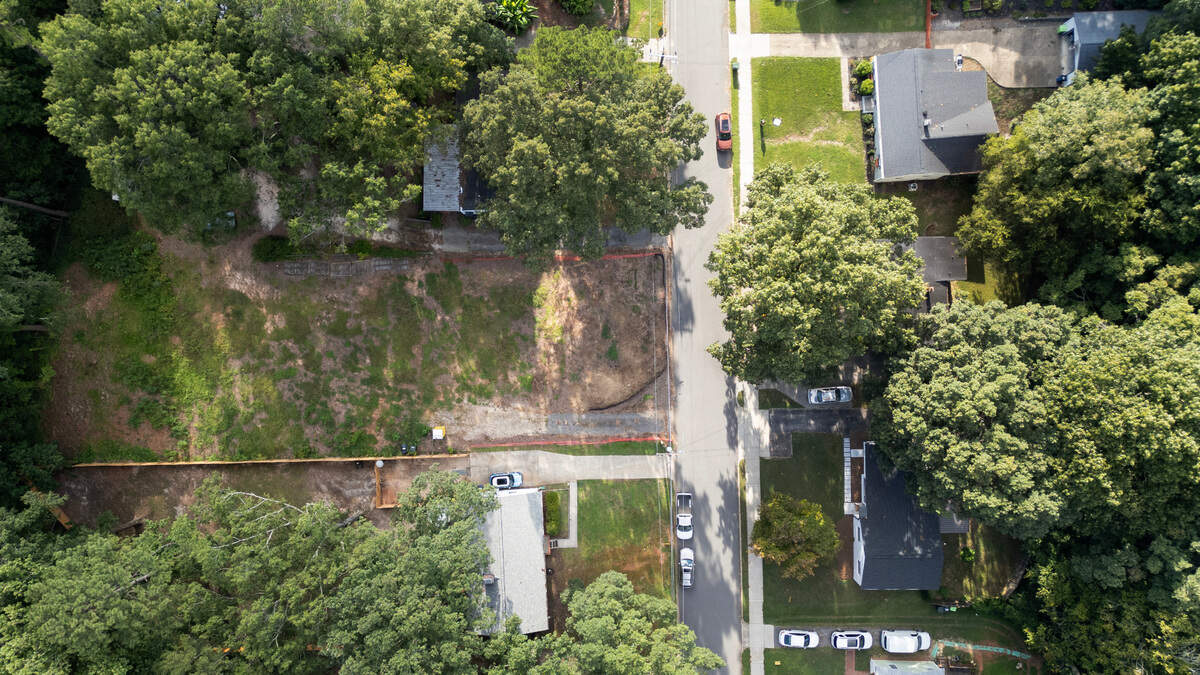
Sypher wants to build 12 four-story townhouses across about nine-tenths of an acre at 524 and 528 Barksdale Drive — next door to Neal.
The city recently gave the green light. But Sypher faces another hurdle: removing the subdivision’s decades-old covenant, tied to his properties as well as his neighbors’, that restricts the land’s use.
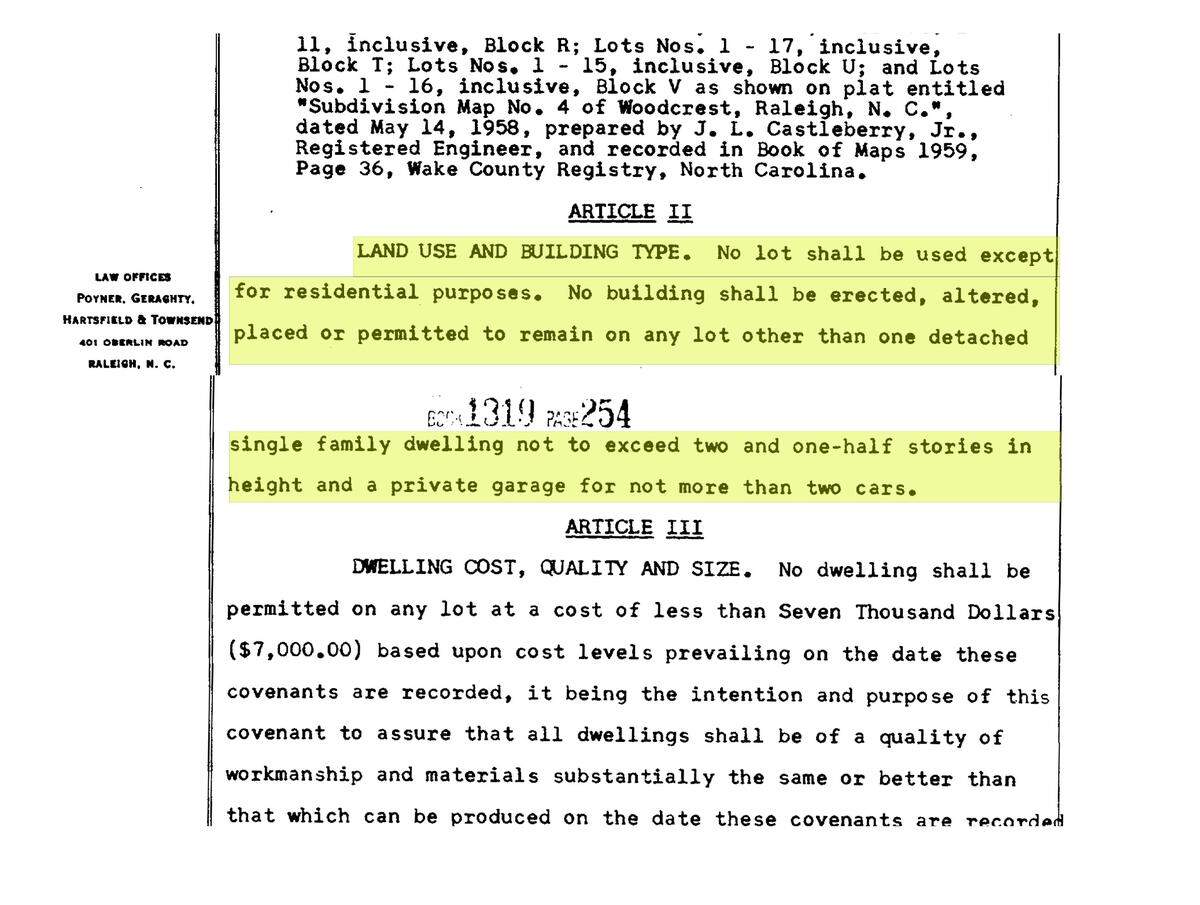
On May 28, 1958, George Building Company, which developed the Woodcrest neighborhood, recorded in Book 1319 on page 253 of the Wake County Registry: Only detached, single-family, two-and-a-half-story homes allowed.
To proceed, Sypher is now suing anyone whose property is subject to Woodcrest’s covenant, roughly 58 households spread across four streets. It’s the latest in a string of lawsuits triggered by the city’s 2021 “missing middle” housing reforms, pitting homeowners against the city and developers and underscoring the complex reality of implementing its policy on the ground.
Neal is one of 87 defendants (some properties have multiple owners) named in the complaint filed by Steve Sypher Designs in Wake County Superior Court on July 1 and amended on Sept. 6.
This largely blue-collar neighborhood includes a mix of young professionals, public servants and retirees, including a 95-year-old former police officer who is an original owner. He lives directly across from the proposed development.
528 Barksdale Drive, center left, in the Woodcrest neighborhood of Raleigh is photographed on Sept 5, 2024. Ethan Hyman ehyman@newsobserver.com
In the lawsuit, he argues that the covenant is no longer binding “due to the passage of time” and the North Carolina Marketable Title Act, which helps clear old claims and defects from property titles, reducing the risks for disputes over property ownership.
After meeting with a group of residents last year, Sypher calls it “a real and existing controversy.” He wants the declaration removed so that it no longer restricts development. He’s asking a judge to decide.
“I’m really not trying to be the bad person in this situation,” Sypher said in a phone call on Tuesday. “I didn’t create the zoning. My concept is not outrageous or over the top. This is what I’m allowed to do.
“I’m trying to do the right thing for our town and our city,” he added. “We need housing desperately. [Some on the street] don’t want 1957 ranch houses with vinyl-siding to change, and it’s just impossible.”
But neighbors are fighting back, including Neal. “It’s mind boggling. I can’t believe somebody would do this to our quiet neighborhood,” said the manufacturing plant worker.
For 30 years, Neal and partner Claudie Bennett have lived on this block, raising three children and now a granddaughter. It’s where they planned to retire, until now. Neal worries about the project’s impact on her property values and the neighborhood.
“The street is already crowded,” she says, pointing to the cars lined up along her curb. “We don’t have anywhere to park as it is.”
This Woodcrest covenant states that only detached, single-family, two-and-a-half-story homes can be built in the subdivision. The George Building Company recorded the covenants in the Wake County Registry on May 28, 1958.
The ‘missing middle’ debate
Starting in 2021, Raleigh began loosening zoning rules to incentivize developers to build what it calls “missing middle” housing — like duplexes, townhouses and accessory dwelling units — in single-family neighborhoods.
Under the text changes to the city’s unified development plan, adopted in 2013, Woodcrest is prime real estate for redevelopment. Just inside the Beltline, it’s about a 10-minute drive northeast of downtown Raleigh and in a frequent transit corridor.
Part of a national trend, city leaders argue that higher-density housing is critical to grappling with the region’s growing affordability crisis. Despite a post-pandemic construction boom, the Triangle is facing a massive housing shortfall. Demand and prices remain high as a steady influx of new and often well-heeled residents move here every year. The Raleigh metro area alone needs at least 17,000 more units, according to a 2023 Zillow study.
Proponents say the policy boosts supply and is a more efficient use of land. They say it also creates more affordable housing options for young families, singles and seniors.
But it’s also sparked backlash and lawsuits.
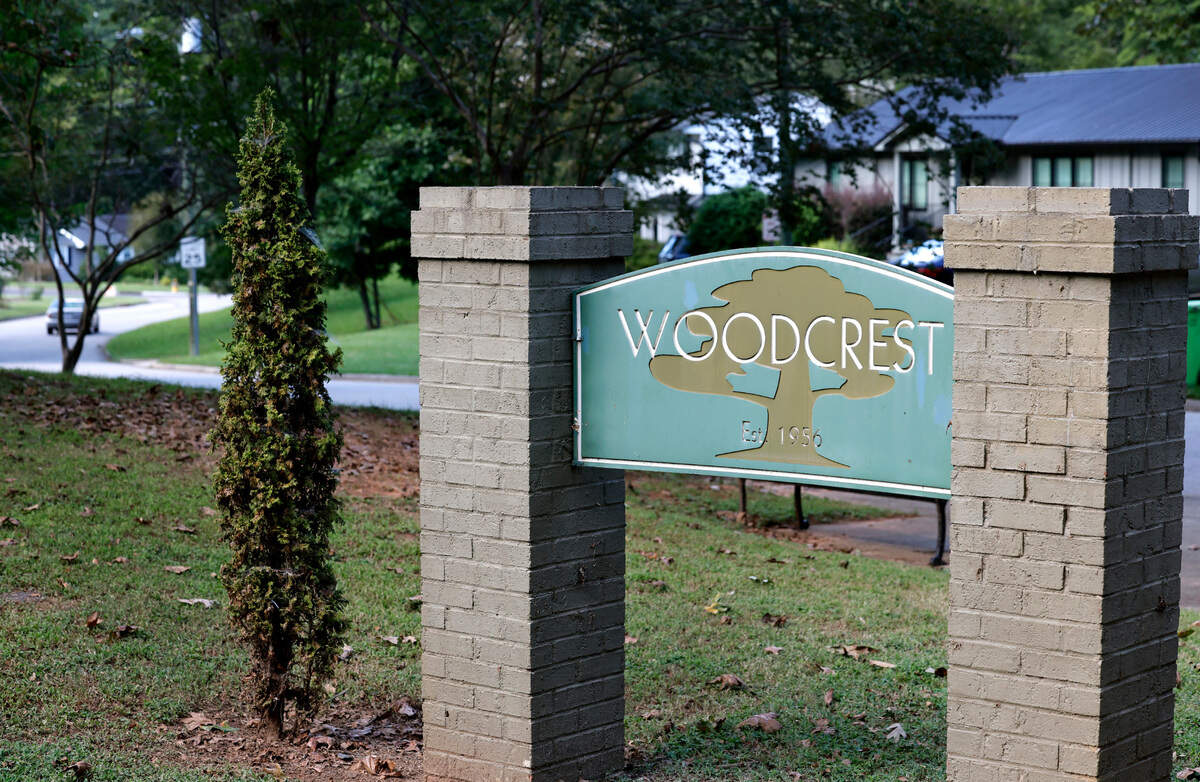
A sign for the Woodcrest neighborhood at Dennis Ave and Timber Drive in Raleigh, photographed Thursday, Sept. 5, 2024. Ethan Hyman ehyman@newsobserver.com
Critics argue it’s illegal and doesn’t adhere to the rezoning process. They say it destroys the character and aesthetic of established neighborhoods and strains existing infrastructure, such as roads, schools and public services. Perhaps more to the point: It doesn’t always guarantee affordable housing, they say.
In March 2023, a group of Hayes Barton residents sued the city and a developer, arguing it didn’t follow proper procedures when it approved plans to raze a 1925 home to build 17 luxury townhomes — at $2 million apiece — in one of the city’s most historic and sought-after neighborhoods. The proposed project is stalled while the case is resolved.
But as residents are quick to point out, Woodcrest isn’t Hayes Barton.
Unlike ZIP code 27608 — where colonial and Tudor-style mansions with manicured lawns line the street and the median sale price hovered around $915,000 in August, according to Redfin — Woodcrest remains a largely working-class neighborhood. Despite the city’s surging growth, the median sale price in this ZIP code (27604) was around $475,000 in August, Redfin found. Raleigh’s overall median sale price was $425,000.
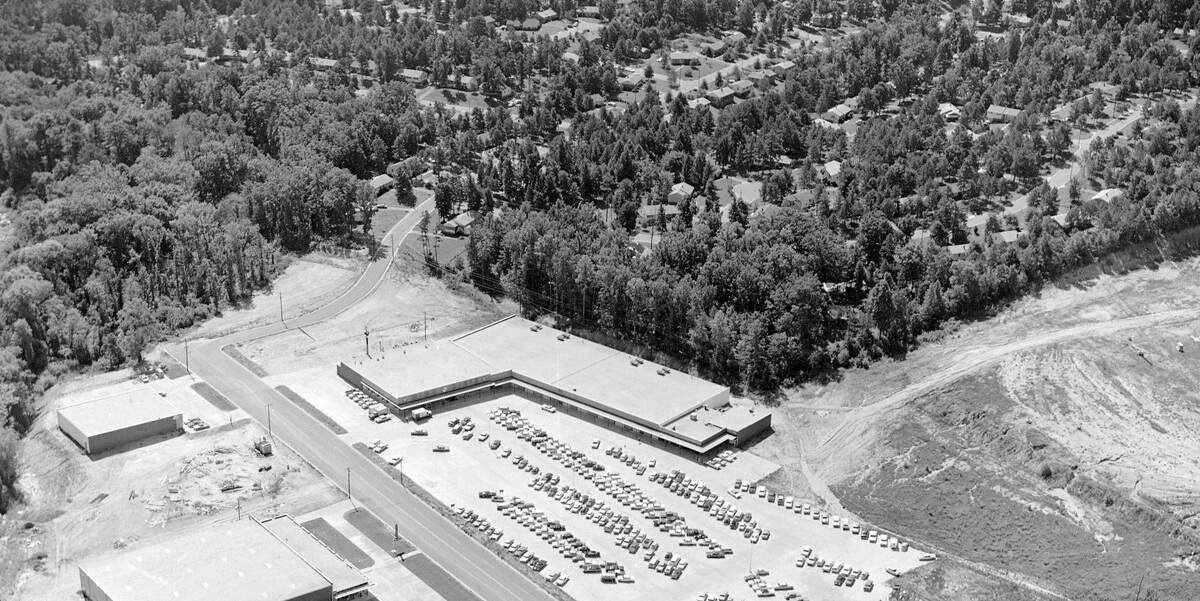
Gateway Plaza on the 2200 block of Capital Blvd, photographed in September 1966. The Woodcrest neighborhood is seen at the top of the frame. File photo
In this latest lawsuit, the roles are also reversed.
The developer is suing homeowners, not vice versa; and longtime residents say they’re getting pushed out and being left to fend for themselves. In this instance, they argue, the city’s policy is hurting the demographic that it seeks to support: the middle class.
“I moved here because it was once one of the few affordable neighborhoods,” said Ann Sun, 47, a designer, who paid $240,000 in 2012 for a three-bedroom ranch home on Barksdale, just a few houses down from Neal.
Many homeowners purchased in this subdivision because of the covenants, Sun added. They believed — and still do — that the covenants are active and enforceable. She’s now spearheading a group to block Sypher’s project. They’ve hired a lawyer and plan to file a response to the complaint in the coming weeks, she said.
It’s expected to go to court in early 2025.
“It’s our responsibility to uphold these covenants,” Sun said. “What’s the point of having a middle-class neighborhood with registered covenants if someone’s just going to come in and still do what they want? For a lot of us, it’s our only investment; we’ve got to protect our property values.”
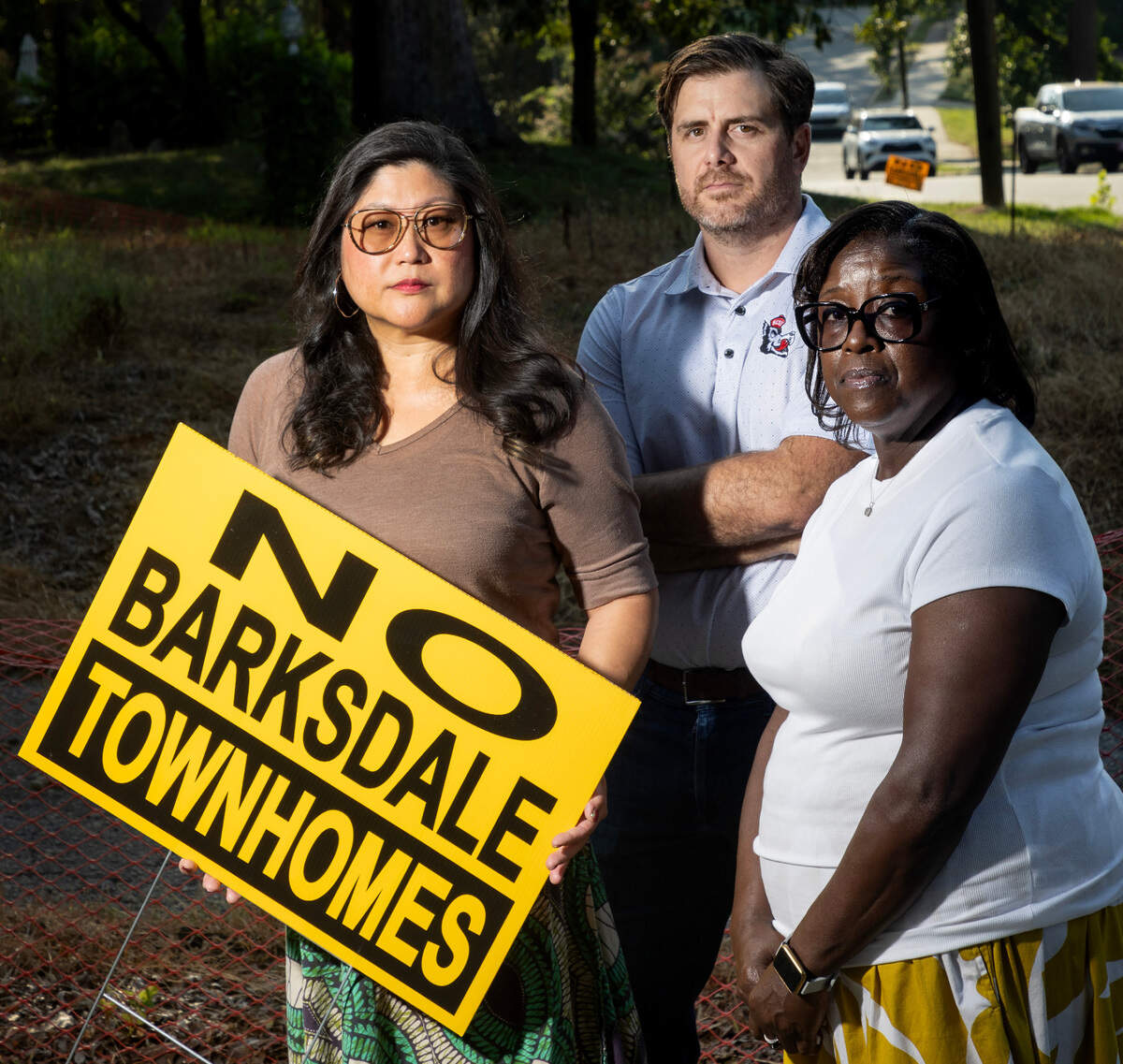
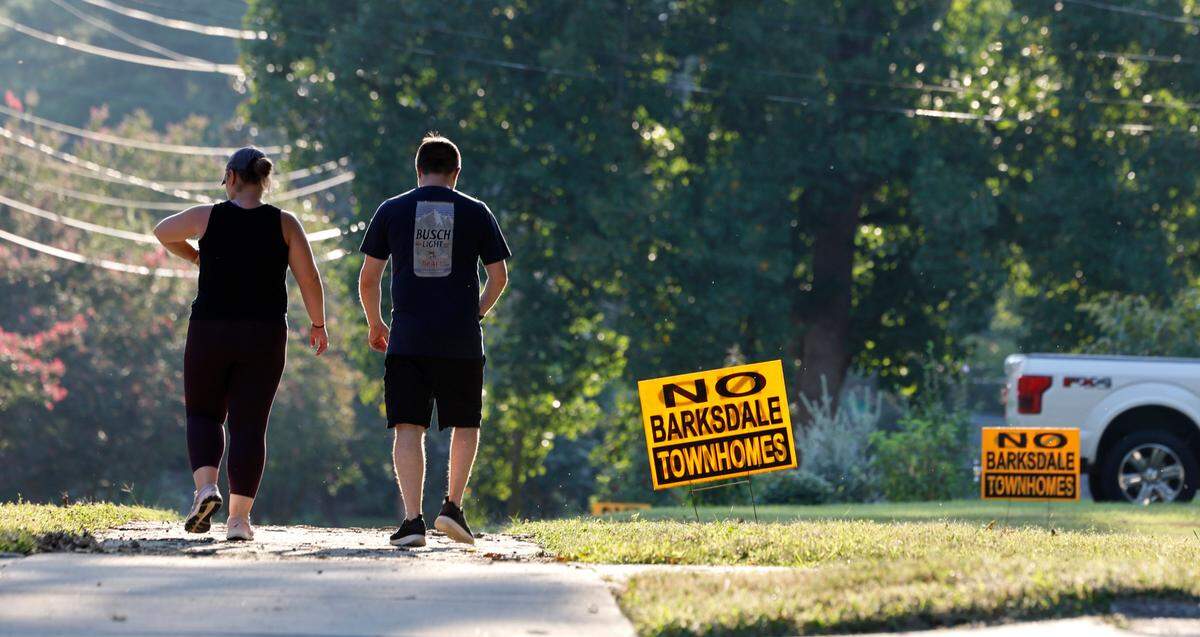
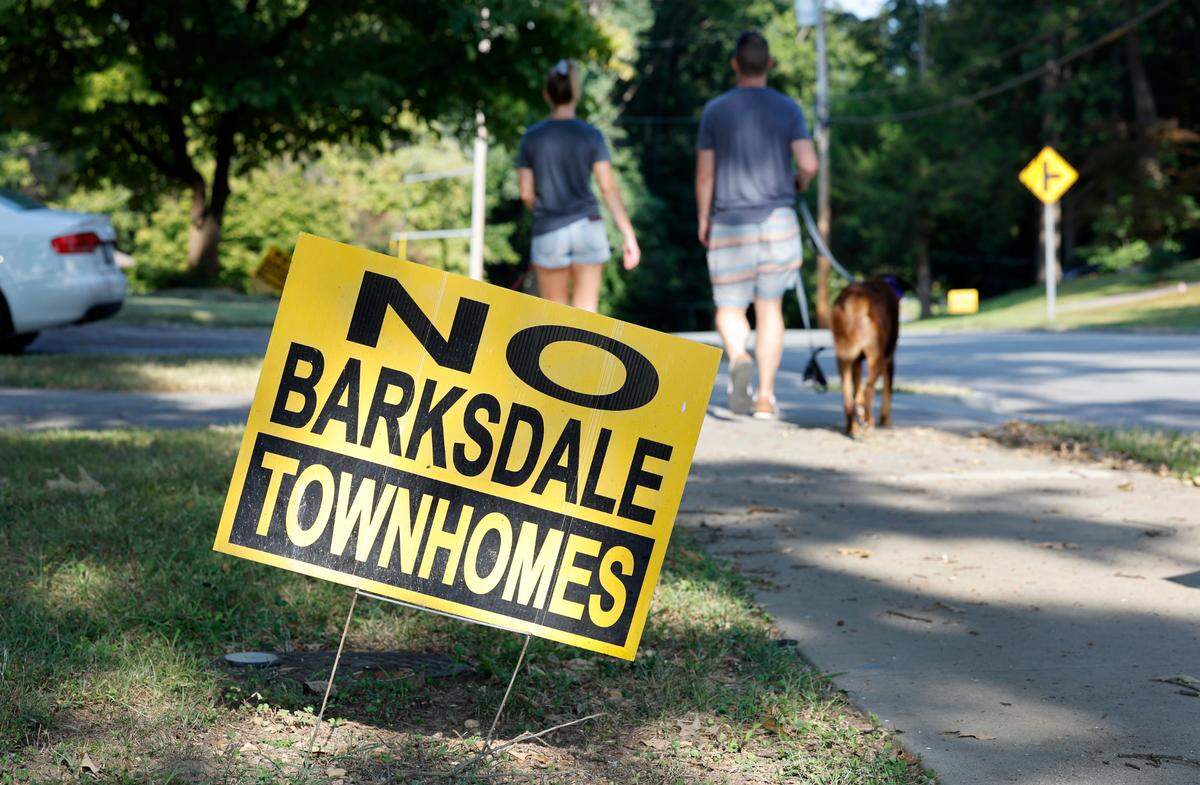
On both sides of this oak-lined street, dozens of signs are now staked to the ground: “No Barksdale townhomes.”
Ann Sun, Daniel McCoy and Edith Neal pose next to 528 Barksdale Drive in the Woodcrest neighborhood of Raleigh Monday, August 26, 2024. The existing home at 528 Barksdale has been torn down and new townhomes are planned at the site. Ethan Hyman ehyman@newsobserver.com
For its part, the city remains on the sidelines.
“The issue regarding the restrictive covenants is a private matter that the city is not involved in,” said Julia Milstead, the city’s public information officer, in an emailed statement.
“The city does not enforce restrictive covenants, and they are not considered during the plan review process.”
Post-World War II subdivision meets ‘missing middle’
Long before the city’s push for higher-density housing spearheaded by outgoing Mayor Mary-Ann Baldwin, the trend was suburban sprawl.
During Raleigh’s post-World War II housing boom, developers were incentivized to build entry-level starter homes in the city’s outskirts. In the 1950s, subdivisions like Woodcrest offered affordable options: a mix of ranch-style homes and bungalows, featuring two- to three-bedrooms, from 1,100 to 1,700 square feet on quarter-acre lots.
Most came with restrictive covenants. A relic from the Jim Crow era, these clauses in property titles became a common tool from the 1920s to the 1960s, preventing racial, ethnic and religious minorities from buying, leasing or occupying homes in certain areas. Most often, they targeted African Americans. After the 1968 Fair Housing Act, this practice is now illegal. However, covenants are still widely used today, though their purposes and applications have evolved.
Even before he bought the two properties on Barksdale Drive, Woodcrest residents say Sypher should have known about the subdivision’s covenant because he used to live there. He’d once been their neighbor for over a decade.
Sypher, 52, is a custom builder who has worked in the area for almost 25 years and remodeled some 60 to 70 houses, by his estimates, in the neighborhood.
In 2006, he paid $130,000 for the 1,732-square-foot ranch home at 2114 Woodview Drive, according to property records. As recently as 2021, Sypher lived on the street and still owns the property, records show. It’s just around the corner from the Barksdale properties.
In September 2021, Sypher paid $440,000 for 528 Barksdale, which has since been demolished. In May 2023, he paid $530,000 for 524 Barksdale. That house is standing but remains empty.
Signs protesting proposed townhomes dot Barksdale Drive in the Woodcrest neighborhood of Raleigh, as seen on Monday, August 26, 2024. Ethan Hyman ehyman@newsobserver.com
On the west side of North Raleigh Boulevard, Woodcrest is considered a “frequent-transit zone,” less than a mile from the city’s first bus rapid transit line, currently under construction. The city would like to see more dense housing options along BRT lines.
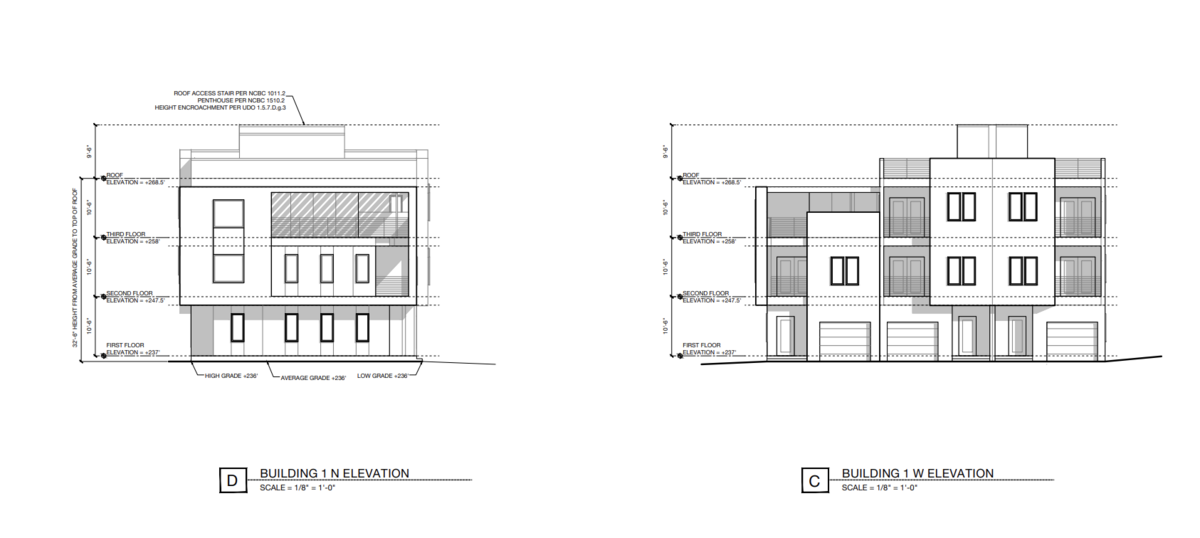
In June, the city approved Sypher’s plans for 12 townhouses across the two lots. Prices are expected to be from $600,000 to $800,000 per home, Sypher said.
In a July 11 letter included with the subpoena to defendants, Sypher’s lawyer, Benjamin L Worley of Raleigh-based Longleaf Law Partners, said the proposed design would offer off-street parking and a design that [Sypher] believes would “match the character of the neighborhood.”
“It’s far less dense than what might otherwise be developed,” he added, pointing to zoning that allows for “up to 20 units per property” and contains no requirement for off-street parking.
That’s not to say the developer wouldn’t consider going bigger. Should the court only approve development on one of Sypher’s two Barksdale properties, he would most likely have to develop the property “at full density allowed by the current zoning.”
“What now would be 12 units across two properties might very well end up with 20 units on one property,” Worley said. If a majority of owners consented to modifying the covenant, however, “then this lawsuit can be dismissed,” he said.
Residents called it an “extortion letter.” And they’re not backing down.
A rendering of the 12 townhouses that Steve Sypher Designs has proposed for 524 and 528 Barksdale Drive in the Woodcrest subdivision of east Raleigh. Steve Sypher Designs
Woodcrest homeowner Daniel McCoy, 38, is watching that case closely as he faces the battle at his own doorstep. He’s among the group of homeowners fighting Sypher’s lawsuit.
“It’s something you think would never happen,” said the risk analyst. “It’s stealing value from adjacent properties and adding to his.”
In 2021, a year before the city’s zoning changes went into effect, McCoy purchased his 1,627-square-foot, three-bedroom brick home on a half-acre, directly across the street from the proposed development on Barksdale Drive.
He and the vast majority of neighbors are not anti-density, he added. For example, roughly 500 feet behind his property, developers have applied to rezone 2321 Crabtree Boulevard for a mixed-use development. He didn’t oppose the project because “it’s appropriate for the location” and not “in the middle of a single-family home neighborhood.”
John Kitto also lives on Barksdale Drive with his wife. Speaking before the City Council in a 2023 recorded meeting, he called Woodcrest a case study in some of the “unintended consequences” of the city’s policy. He wondered if it could be amended “without throwing out the whole thing.”
Andrew Atkins, an attorney with Raleigh law firm Smith Anderson, wouldn’t speculate on how the judge might rule in the case.
In general, he said, covenants that have not been preserved by being re-recorded within the 30-year period will be extinguished under the North Carolina Marketable Title Act.
“In practicality, many have likely already expired and cannot be revived,” Atkins said.
The case law surrounding exceptions is relatively new, he added, despite the law being in existence for over 50 years. “While only a few cases exist,” Atkins said, “the general theme is that the intent of the Marketable Title Act should be broadly construed, while the application of restrictive covenants is to be narrowly construed.”
That will lead to redevelopment, he said.
Signs protesting proposed townhomes dot Barksdale Drive in the Woodcrest neighborhood of Raleigh, as seen on Monday, August 26, 2024. Ethan Hyman ehyman@newsobserver.com
City tweaks ‘missing middle’
Even with multiple lawsuits under way, the city maintains its program is one of the nation’s “most productive.” However, it’s slowly revising the policy to address critics’ concerns.
Since 2021, more than 2,800 dwelling units have been approved or are under review that would not have been allowed before zoning reform, planning director Patrick Young said in June.
A majority of those approved, around 2,400 units, are new townhouses in northeast and southeast Raleigh.
Of those, 203 are considered affordable.
Based on those results, Eileen Taylor, an accounting professor in the Poole College of Management at N.C. State, said officials should find alternative solutions. “In general, the effectiveness of missing middle policies isn’t consistent,” she said. “In Raleigh, missing-middle options don’t make a significant difference.”
The council has discussed possible tweaks. Among them: tree preservation; and the “character impact” of some high-density housing types on existing neighborhoods.
Raleigh Mayor Pro tem Jonathan Melton maintains he wants to find “some middle ground.”
Woodcrest residents say they hope he means it.
NC Reality Check is an N&O series holding those in power accountable and shining a light on public issues that affect the Triangle or North Carolina. Have a suggestion for a future story? Email realitycheck@newsobserver.com
Chantal Allam covers real estate for the The News & Observer and The Herald-Sun. She writes about commercial and residential real estate, covering everything from deals, expansions and relocations to major trends and events. She previously covered the Triangle technology sector and has been a journalist on three continents.