‘Carrot versus stick’: Could developers be enticed to maintain affordable housing?

As North Carolina grapples with a growing affordable housing shortfall, a federal lawmaker is hoping new “carrot” incentives could entice developers to preserve the state’s current stock for longer.
The Keep Housing Affordable Act, recently introduced by U.S. Rep. Wiley Nickel (D-Cary), would extend an optional affordability period for low-income housing tax credit (LIHTC) projects up to 50 years.
Created in 1986, LIHTC provides federal financing for developers to build, buy and renovate housing for low-income renters and buyers.
The proposed bill would give developers access to additional tax credits after 15 years, Nickel said. They could also apply for future credits with existing properties.
If new credits are used, the affordability period resets, offering subsequent 30- or 50-year commitments.
“We’re in the middle of a housing crisis,” said Nickel, in the release. “[This] is a crucial solution.”
Nationwide, more than 500,000 housing units are expected to reach the end of their 30-year “affordable” status by 2030, according to the latest data from the National Low Income Housing Coalition (NLIHC).
In North Carolina, that’s around 15,000 affordable units, or 16% of the North Carolina’s Housing Finance Agency’s low-income housing portfolio. Already, around 9,533 units have lost affordability, NLIHC’s data shows.
Coupled with the state’s surging population and tight housing market, experts warn it could trigger landlords converting these units to market price. That, in turn, would result in the eviction of large swaths of low-income renters across the state, they say.
Nickel said this bill would seek to remedy this problem.
This future “cap-free” access to credits would encourage developers to opt-in “by assuring them of resources.” It would also “boost affordable housing supply and create long-term stability” for low-income families,” he said.
The growing affordability gap
North Carolina is home to some 1.4 million renters. Roughly one‐quarter are “rent burdened,” according to NLIHC’s Out Of Reach report released this month.
In other words, they pay more than 30% of their income in rent as inflation, higher mortgage rates and home prices drive up housing costs.. That squeeze is pushing many middle- to low-income workers to the financial brink across the state.
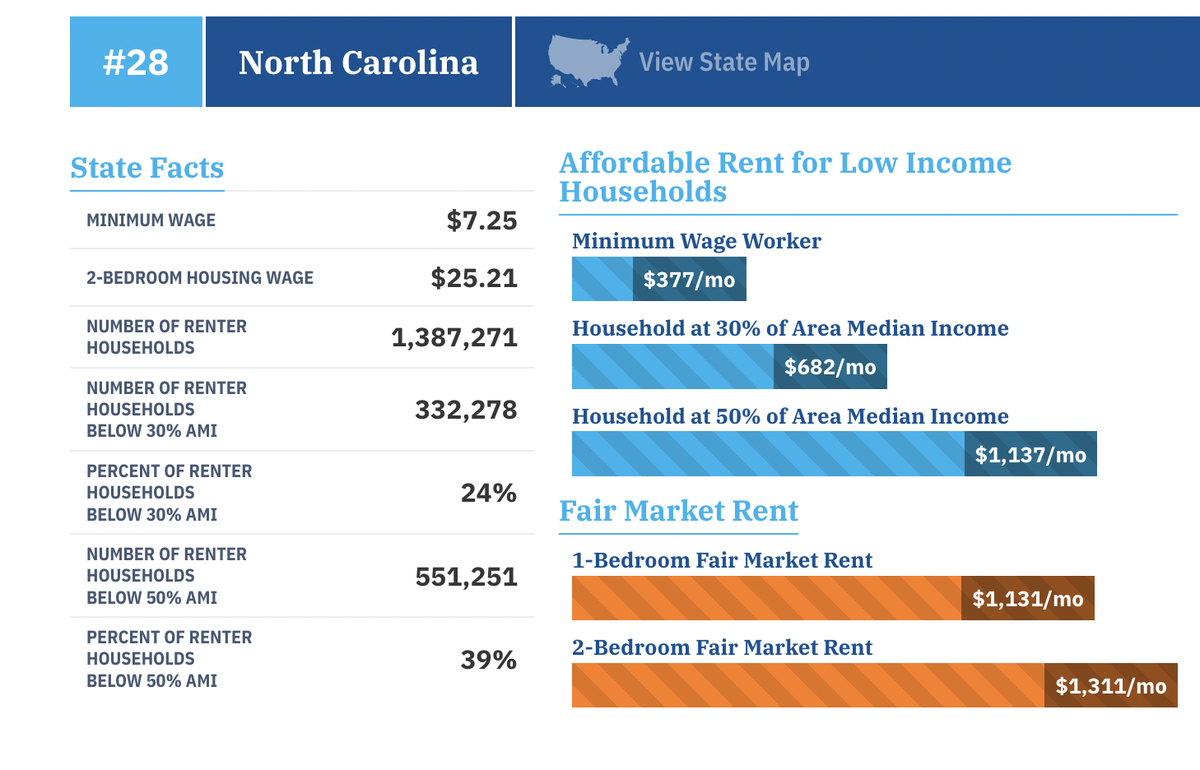
Supply is also desperately short. There only 66 affordable and available rental units per 100 households at or below the 50% area median income (AMI) threshold in North Carolina, the report said.
Statewide, that’s a deficit of 185,186 affordable homes.
What the experts say
Yolanda C. Winstead is president of DHIC Inc., a Triangle affordable housing developer. It’s behind projects like Broadstone Walk, a new 164-unit affordable housing complex along South Hughes Street in Apex.
She welcomed the new legislation. “We need as many tools as possible,” she told The N&O in an email. “If passed, DHIC would look into this incentive on a case-by-case basis.”
But she also remained realistic. “There is no single solution to the housing crisis.”
Given the substantial public investment in LIHTC deals, extending affordability terms “makes sense,” said Kevin Campbell, executive director of Raleigh Area Land Trust (RALT).
RALT serves low- to moderate-income adults and families (60-80% of the area median income) living in Raleigh and Wake County. In partnership with the Raleigh Raised Development and Haven Design | Build, it’s currently building the Cottages of Idlewild, Raleigh’s first affordable “cottage court,” at 907 E. Lane St. in downtown Raleigh.
Campbell said there’s already a “gross shortage” of affordable housing. Preventing units from converting to market-rate sooner would safeguard the state’s current stock, which is particularly important in “hot markets” like Raleigh and Wake, “where the demand is high,” he said.
Samuel Gunter, executive director of the NC Housing Coalition, agreed. He also urged more action.
That includes passing the “the Affordable Housing Credit Improvement Act,” introduced in 2023, that would expand LIHTC’s program by restoring the 12.5%-cap increase that expired in 2021 and boost resources by double digits.
“Our housing affordability problems are not fixed by passing these kinds of bills,” he added. “But if we aren’t building more affordable units and preserving the ones we’ve got, then whatever else we’re doing is paddling upstream.”
This story was originally published July 10, 2024 at 12:18 PM with the headline "‘Carrot versus stick’: Could developers be enticed to maintain affordable housing?."