Rent trap: Triangle housing costs squeeze middle- to low-income workers to the brink

READ MORE
Rent trap
Roughly one‐quarter of North Carolina renters are “rent burdened,” which means they pay more than 30% of their income in rent. That squeeze is crushing many renters’ home-ownership dreams. It’s also creating pressure on the rental market and inflating prices. While rents appear to be stabilizing, experts say, prices skyrocketed by as much as 50% in parts of the Triangle last year.
Expand All
Julie Oram, a nurse who works in Apex, uprooted her family because of rising rents.
Last August, she, her husband, Jeffrey, and their sons ages 14 and 13, moved from Garner to Fayetteville — about a 58-mile drive south.
They’re now paying $1,225 — almost $100 less than in Garner, where they had lived for three years — for a 1,163-square-foot, single-family home. But here’s the catch: She now commutes an hour and 15 minutes each way. Her husband, an Amazon worker, faces a similar drive three times a week.
“I’m stressed every single day,” she said. “I don’t know how much longer I can do this.”
For Oram and many other longtime renters across the Triangle, the “American dream” and its promise of upward mobility is quickly becoming less attainable. Runaway inflation, higher mortgage rates and soaring home prices are keeping many who identify as middle class on the financial brink.
Home prices across the Triangle jumped by 18% between June 2021 and June 2022, when they hit a peak median price of $422,000, as North Carolina remains one of the fastest-growing states. Prices have slowly come down, but the Triangle’s median sale price was still $395,000 — up 6.7% from a year ago, according to data from Triangle MLS released this month.
Meanwhile, the cost of all goods is up by 6.5% in the year through last month, nearly a 40-year high. Given the state’s median household income hovers around $60,000, families are paying hundreds more this year than they did last year for the basic set of goods and services that the Consumer Price Index (CPI) follows. Meanwhile, the labor market is tightening following a rash of tech-industry layoffs. Average hourly earnings are down roughly 3% nationally when adjusted for inflation.
That squeeze is crushing many renters’ home-ownership dreams. It’s also creating pressure on the rental market and inflating prices. While rents appear to be stabilizing, experts say, prices skyrocketed by as much as 50% in parts of the Triangle last year.
The result: a large swath of people pushed into the “rent trap” — unable to save enough for a down payment because they’re paying so much of their income in rent. Many are essential workers who can’t afford to live near the communities they serve.
“We’re in a bad situation as a renter,” said Joyce Paton, an optician who works in Durham. “It’s hard to find a house to buy that’s within reason and doesn’t need major repairs. Then the rents keep going up. How long can this continue?”
At 60, Paton pays $1,770 a month to rent a two-bedroom at Wakefield Glen Apartments in North Raleigh. But after the landlord hiked her rent an additional $340 this year, to more than $2,100 a month, she’s determined to buy a home and find some stability. But low inventory and rising home prices make it hard.
“It’s scary. I might be pushed into whatever I can find, possibly move in with a friend. With gas prices, car maintenance, utilities and everything else, it’s overwhelming.”
In Wake County, the median income of a family now only reaches 60% of the income they would need to afford a median-price house at prevailing mortgage rates, according to the Triangle Multiple Listing Services (TMLS) Housing Affordability Index released this month. In Durham County, it’s slightly higher at 70%, while in Orange County, it’s around 66%. Chatham County, meanwhile, shows the household median income is less than half of what home buyers could afford.
“Currently, the results indicate that no area is ‘affordable’ in any part our 12-county study area,” said Matt Fowler, executive director of TMLS. “We have a dramatic undersupply of properties that real people can buy.”
“Rent burdened”
Roughly 33% of North Carolinians, some 1.5 million households, rent, according to Census Reporter. Since 2010, the median price of a house has increased 31.5%, while rents have risen by 14.6%, according to a recent report from the Cato Institute, “Keeping North Carolina’s Housing Affordable.” The average fair market rent for a two‐bedroom apartment in North Carolina now exceeds $960 per month, or more than $11,500 per year, the report said. A worker would need to earn $18.46 per hour to cover the costs. That’s a median income of about $37,440 annually.
In the Triangle, those figures are much higher. In Raleigh, the median rent for a one-bedroom stands at $1,295 and a two-bedroom at $1,545 — a 7% jump compared to the previous year, according to rental listing site Zumper. In Durham, the median rent for a one-bedroom is $1,309, while a two-bedroom is at $1,515, also at a similar hike, the report said.
As a result, roughly one‐quarter of North Carolina renters are “rent burdened,” which means they pay more than 30% of their income in rent.
While rent burden is more likely to affect low‐income families, high rents are increasingly burdening the middle class as well, said Cato Institute senior fellow Michael Tanner, the report’s author.
“That number is rising in ways that we certainly wouldn’t have seen, say, 10 years ago,” he told the N&O.
In many ways, North Carolina is beginning to resemble California at the end of the last decade or Florida in recent years, he said. In both states, prosperity drove an increasing need for housing that markets failed to meet. “We’re starting to see that tip-over point in North Carolina where more people are coming into the state than you’re building new units to house them.”
That imbalance is pushing many renters out of town or into deteriorating rental conditions. Some of the most vulnerable are ending up in insecure housing or even homeless.
Derrick Thornton, a Realtor with Coldwell Banker Advantage out of Northeast Raleigh, said rents are starting to plateau. Still, when vacancy rates are low, as they are today, tenants have fewer options. Their bargaining power falls substantially, he said.
“The rental market is the Wild, Wild West because you don’t always know what you’re going to get,” he said. “There are more standardized procedures when you’re dealing with a home for sale versus a home for rent. Some landlords use property management companies. Others do everything by themselves. If that’s the case, you can do kind of whatever you want.”
At a minimum, landlords expect renters to earn at least three times the amount of rent and be able to pay first and last month’s rent, plus a security deposit. They can also choose not to renew month-to-month leases or increase rent, forcing long-time renters out. In worse cases, some cash out and sell the property altogether, leaving tenants to scramble on short notice, he said.
That’s how Portia Watson found herself in December packing up her apartment at The Edge at West End in Durham at the last minute over the holidays. The 33-year-old Food Lion worker received notice that her lease wouldn’t be renewed. The building’s new owners, Presidia Asset Management, said she had 30 days to vacate.
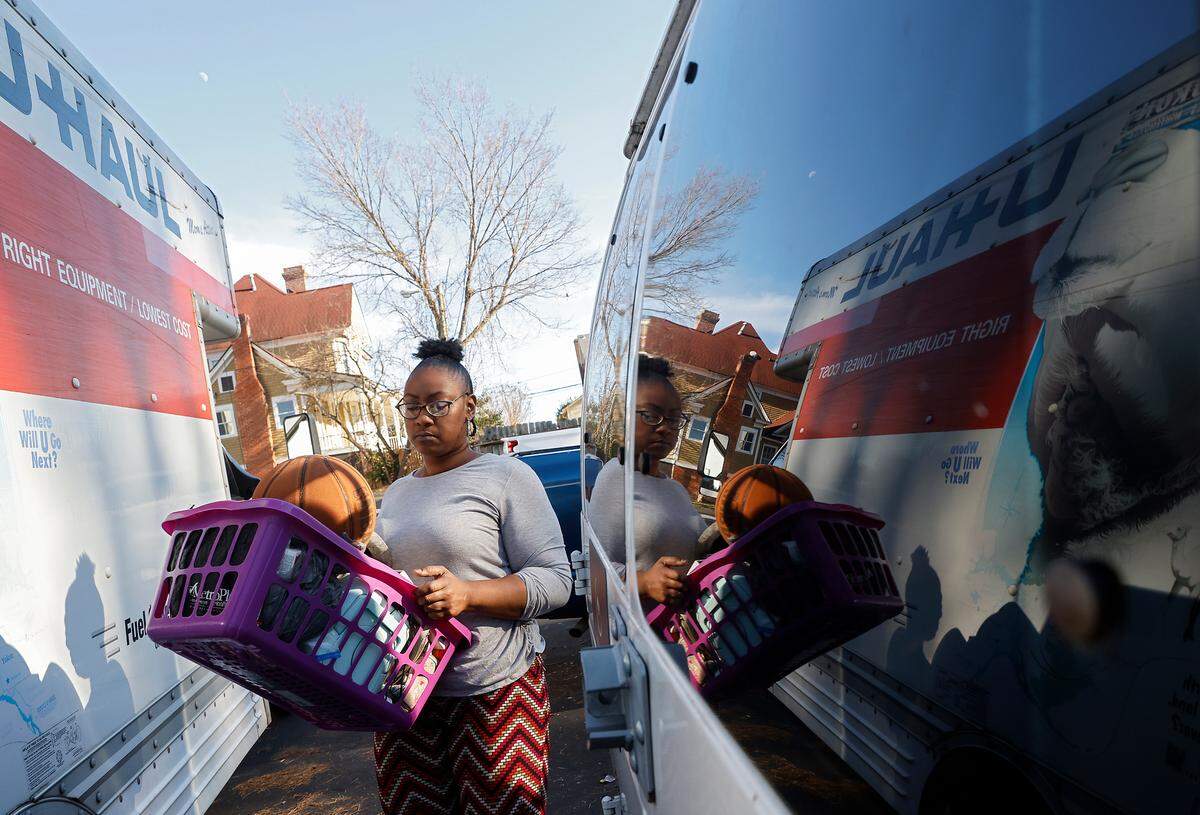
With few rental options, she was forced to quit her job and moved back home with her mother in Burlington in January.
“I’ve been on my own since I was 17. It’s devastating,” she said. “My mom is disabled and has her own bills. But that’s the only option that I have at the moment.”
Here’s a closer look at four Triangle renters and the challenges they face:
‘Beyond stressful’: Renter given 30 days to vacate after helping neighbor
Name: Portia Watson, employee at Food Lion
Accommodation: Two-bedroom apartment in Durham
Rent: $890 per month
Income: $14.50 per hour
Portion of monthly income on housing: 50%
Portia Watson never imagined that she could be threatened with eviction.
That changed last December when her property manager, Presidia Asset Management, issued a notice that her lease wasn’t up for renewal at The Edge at West End in Durham. She had 30 days to vacate. Failure to do so would constitute “a lease violation and trigger eviction proceedings,” the letter said.

“This is beyond stressful. I’ve just been doing a lot of praying,” she told the N&O, shortly before moving out of her apartment at the start of this year. “I’ve been here three years. I’ve never had a problem with any of my property owners.”
Watson, 33, an employee at Food Lion who makes $14.50 an hour, said she had received financial assistance from Central Piedmont Community Action (CPCA) to cover November’s rent. But otherwise, her rent was up to date, confirmed CPCA case manager Angeline Roberts.
Watson believes Presidia’s move to cancel her lease was retribution for taking in her neighbors, a single mother and her son, who themselves were evicted and had nowhere to go.
“I read my lease myself six times. I wasn’t violating my lease agreement,” said Watson. “I’m a good person. I tried to help my friends. This is unfair.”
Gina Hensley, president of Presidia Group, said Watson was on a month-to-month lease and didn’t uphold the terms of the agreement. “She was provided a notice to vacate, as is standard practice,” Hensley told the N&O in an email.
At such short notice, Watson says she had few options: “It’s really hard to find a place. Everything that I’m finding is $1,000 to 2,000 a month. That’s out of my price range.”
She was forced to move back into her mother’s home in Burlington in January. “It’s overwhelming. My mom is disabled and has her own bills. But that’s the only option that I have at the moment,” she said.
Situations like Watson’s are not uncommon, says Sarah D’Amato, program director of the Durham Eviction Diversion Program. Often landlords choose not to renew month-to-month leases or increase rent, forcing long-time renters out.
“It seems some landlords are looking for any reason to evict these days,” she said. “The inventory is low, rents are increasing, and subsidized housing options are limited with long wait lists.”
Over the last year, the number of people facing eviction has leaped across the state. Roughly 3,805 evictions were filed across North Carolina between July and November 2022 compared to 2,155 evictions filed over the same period the year before — a 75% spike, North Carolina Judicial Branch reported.
The surge coincided with the end of federal pandemic legislation and policies aimed at assisting renters and preventing evictions and foreclosures last August. That included actions to authorize and extend national eviction moratoriums between 2020 and 2021.
In Durham, data from NC Data Works showed evictions filed in November jumped to around 457 — a 25% hike from November 2021. And while evictions remain a problem in almost every community, the agency reported that 68% of Durham County’s evictions that month occurred in communities where a majority of residents were people of color.
“Some days, we’ll have as many as 150 cases on the small claims docket for just one day,” D’Amato said. “If the notice is done correctly, there’s not too much that you can do to stop it.”

Back in Burlington, Watson is now looking for both a new rental and job. Moving out of Durham meant she could no longer work at her local Food Lion.
“I loved my job and I wanted to stay in Durham, but I had to resign,” she said. “I don’t have a choice. I’ll probably stay with my mom until I can find something in Alamance County.”
‘I don’t understand the increases’: 60-year-old renter faces housing stress
Name: Joyce Paton, optician
Accommodation: Two-bedroom, two-bathroom apartment in North Raleigh
Rent: $1,770 per month
Percentage of monthly income on housing: 50%
Joyce Paton never imagined that she’d still be a renter at her age. She’d been a homeowner before, then got a divorce and had to sell.
Almost 20 years later, at 60, she’s still renting. “It just turned out like that,” says the optician, who lives by herself in a 1,242-square-foot two-bedroom at Wakefield Glen Apartments in North Raleigh.
It’s been her home for the last 13 years, but she says she may be forced to move out because of skyrocketing rents.
Last June, Paton learned that her building’s property management company, South-Carolina based Greystar Real Estate Partners, was raising her rent by $340, to $2,112 a month. It’s the second bump in as many years.
“If they keep on doing this, there is no way in the world I can stay here,” she told the N&O. “I understand everything goes up [a little] every year. That’s life and the economy. But the way they’re doing it, pushing people out, it’s unfair. I’ve never been late with my rent. I don’t understand the increases.”
Greystar did not return requests for comment.
Prices have shot up by as much as 50% in parts of the Triangle, the N&O reported last year. And while the region’s rental housing market appears to be stabilizing, rents are still up significantly across the board going into 2023.
Despite rising rents, Paton said it’s hard to leave her rental in many ways. She and her neighbors — many of them in their 70s and 80s — have created a tight-knit community. When her 80-year-old neighbor recently had to go to the emergency room, Paton took him. She received similar support when she was battling cancer a few years ago.
“It’s that kind of building because a lot of us don’t have family,” she said. “We all have each other’s back. We help each other out, and we have our own lives.”
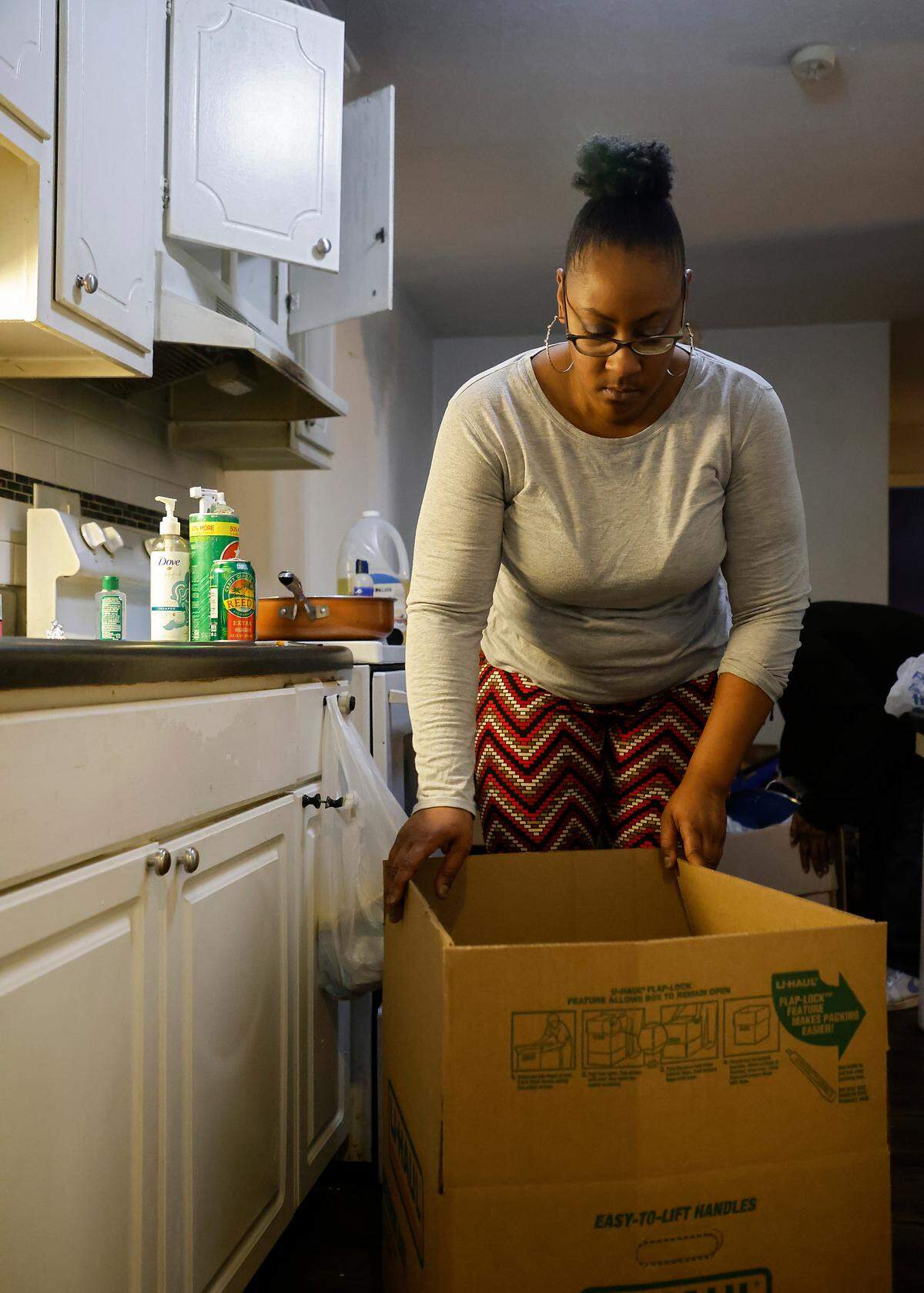
But with rising mortgage rates and house prices, she also knows her window for purchasing a home could be narrowing. That’s pushed her to double down with her Realtor on her home search. She has until September, when her lease ends.
Her price point: $250,000 for a starter home, she said, with monthly mortgage repayments at around $1,000 per month. She’s looking in Angier, in Harnett County, a 55-minute commute northwest to Durham, where she works.
She’s cautiously optimistic but says it’s hard to find something at that price. Last year, she found a house that “she fell in love with” that had 10 bids on it within hours of its listing.
“The next day, it sold for well over $400,000 at the open house. Forget it, I didn’t even bother showing up,” she said.
In the meantime, she’s trying to save as much as possible. “I keep everything at a basic minimum — TV, groceries. I even make my own body butter, so I’m not buying lotion.”
Paton is also weighing other options, including senior citizen apartment complexes. But those also have years-long waiting lists, she said.
It’s the uncertainty of it all that weighs on her most.
“Just not knowing where I’m going to sleep one night is scary,” she said. “Everybody deserves a place to live. It’s not a luxury.”
From Garner to Fayetteville: Moving to make ends meet
Name: Julie Oram, nurse
Accommodation: Three-bedroom, one-bathroom single-family house in Fayetteville
Rent: $1,225
Household income: Around $100,000
Percentage of monthly income on housing: 35%
For the last 15 years, Julie Oram has worked as a nurse at UNC Rex Healthcare’s Rehabilitation and Nursing Center in Apex.
But in August, she and her family, including husband, Jeffrey, and sons ages 14 and 13, moved to Fayetteville from Garner — about a 58-mile drive south — because of rising rents.
Now she commutes an hour and 15 minutes, each way.

“I leave my house at 5 a.m. I’ve got to be at work at 6:45 a.m.,” she said. “It takes me a half tank of gas every time I go to work.”
As the weeks roll on, it’s becoming wearing, she said. Her kids can’t take join sports after school because she’s not there to take them. Rising gas prices are eating into their budget, and their second car is on the brink.
Oram said she may be forced to quit her job to search for something closer to home: “I’m torn. I don’t know how much longer I can do this.”
Oram’s predicament is another example of how the Triangle’s tight rental market is pushing families further out of town and father from their jobs in search of more affordable options.
“Rents are the highest in North Raleigh and Apex, and lower in the outskirts, like Sanford and Youngsville,” said AnnMarie Janni, a Realtor with Allen Tate Realtors who also runs her own Apex-based property management firm, Element Property Management. “The further out you go, the better your rents are, for sure.”
In Garner, Oram paid roughly $1,300 for a three-bedroom, two-bathroom apartment on the third floor with no elevator. If they’d stayed on, the landlord was hiking the rent $350, to $1,650.
“We’re like, ‘Why are we going to pay extra money when you’re not even remodeling our place?’” Oram said. “It was a stupid amount, and we weren’t getting anything extra. It would have been a stretch.”
They toured properties close to Garner. But they couldn’t find anything in their price range and pet friendly. They have three cats.
They also ran into lots of scams, she said. In many instances, fraudsters had lifted an ad from a popular real estate site and created a fake listing using names, photos and even open-house times.
“One guy even gave me the passcode to get into the house. He had all the specifics, and I fell in love with it,” she recalled. “He wanted to send an application to my email. I’m like, ‘Why aren’t we using reputable sites?’ It was a scam.”
After months of coming up short, Oram decided to pull their teenage sons out of the Wake County school system and expand their search to Fayetteville.
Today, they’re paying $1,225 for a 1,163-square-foot, single-family home in Fayetteville. Built in 1948, it has three bedrooms, one bath, a backyard and outdoor shed.
“I hate sharing one bathroom for the whole family, but everything else is great,” Oram said.
Even so, months later, the family budget is still reeling from the expense of covering the deposit, first month’s rent, and moving costs estimated at $5,000.
“The price of everything has gone up so much. I’m stressed every single day,” she said. “My kids barely had Christmas.”
UNC-Chapel Hill med student describes landlord-renter ‘power imbalance’
Name: Nicholas Givens, medical student
Accommodation: Two-bedroom, two-bathroom apartment in Chapel Hill
Rent: $1,700 per month
Household income: $45,000-$80,000
Percentage of monthly income on housing: 35%
Nicholas Givens aspires to own a home one day to raise his young family. But at present, the 34-year-old medical student says it’s not really an option, both financially and professionally.
“Until I’ve secured a residency, it wouldn’t be prudent,” said the third-year student at UNC School of Medicine in Chapel Hill. “There’s no way to be sure where I’ll end up. It’s one reason we feel trapped.”

For the last four years, he and his wife, a nurse at UNC Medical Center, with their 3-year-old daughter, have rented a 1,043-square-foot, two-bedroom at Southern Village Apartments, part of the affluent planned community just outside Chapel Hill’s downtown. They currently pay $1,700 per month, not including utilities.
Givens says it’s easy to get pigeonholed as a renter. “People who rent are seen as transient with less of a stake in their communities. But we’re students, essential workers, downsizing retirees, families, single professionals — all people who can’t enter the housing market for a wide variety of reasons.”
On the plus side: He loves his neighborhood. It’s close to a bus line with a five-minute shuttle into campus, he said. There’s also a public elementary school where he can walk his daughter “when she’s old enough in a couple years.”
But rising rent is making it harder to manage. Each year, his rent has increased by about $50-$80. His family’s annual income is roughly $45,000 to $80,000.
“My wife’s income fluctuates, but roughly one third of her income goes towards rent,” he said.
It’s also becoming more difficult to navigate landlord-tenant dynamics at his complex, which has become strained and “sometimes outright hostile,” he said. Still, he doesn’t feel like he has many alternatives.
“Many don’t realize just how tenuous their housing status is until a dispute arises with their landlord,” he said. “In the end, we have little bargaining power. Based on discussions with other renters in the area, I’m also not very hopeful we’d find a different rental environment anywhere else.”
This story was originally published January 18, 2023 at 6:00 AM with the headline "Rent trap: Triangle housing costs squeeze middle- to low-income workers to the brink."