Fight over fiber internet and Musk satellites is shaping NC’s broadband future
I’m Brian Gordon, tech reporter for The News & Observer, and this is Open Source, a weekly newsletter on business, labor and technology in North Carolina.
More than one thing doomed CommScope’s $60 million, 250-job effort to expand its fiber-optic cable factory north of Charlotte. Debt was an albatross for the North Carolina telecommunications company, which just this week sold off its most profitable division to a competitor and renamed itself. It’s hard to commit to hiring when a new owner will call the shots, CommScope told the N.C. Department of Commerce in a letter last month.
But in that same letter, the company gave another reason why its Catawba County project failed less than three years after it was announced. It cited shifts to a federal policy. It’s a dynamic familiar to other American businesses as the first anniversary of President Donald Trump’s second term approaches: The Biden administration passed a landmark spending program, and the Trump administration — for better or worse — kept everything exactly the sa… Just kidding, it overhauled the program while bashing its predecessor.
CommScope, and much of North Carolina, was affected. Here’s how.
The federal program CommScope highlighted — Broadband Equity Access and Deployment Program, or BEAD — passed in late 2021 under the Infrastructure Investment and Jobs Act of 2021. Through BEAD, the National Telecommunications and Information Administration divvied up $42.5 billion for states to connect more Americans to affordable high-speed internet. With a large rural population, North Carolina was awarded the fifth-most program funding, at $1.53 billion.
“You don’t have to go very far from Raleigh to find holes in high-quality service,” said Mark Johnson, former chief technology officer at MCNC, a Research Triangle Park nonprofit that supports broadband access in the state.
Under President Joe Biden, the NTIA prioritized one type of internet connection over all others. Its bidding process favored fiber-optic cable suppliers, even if they charged more than other options like DSL, cable modems, fixed wireless and low-earth orbit satellites. Some believe this thumb on the scale was worth it. “Fiber has by far the most capacity of the choices,” Johnson said. “Putting fiber in the ground is a long-term investment in infrastructure that will continue to be able to provide service indefinitely.”
North Carolina’s stance on fiber internet dovetailed with the Biden administration’s. “The division has a strong preference towards end-to-end fiber solutions, otherwise known as “Priority Projects,” the N.C. Department of Information Technology wrote in its initial BEAD proposal, which the NTIA approved in September 2024.
Not everyone in North Carolina liked how this program was rolling out, however. “The rules were very cumbersome under the Biden administration,” said Ray Zeisz, senior director of the North Carolina State University Friday Institute for Educational Innovation.
“They wanted you to prefer to use union labor and all kinds of other things,” he said. “Are we trying to get internet to everybody? Are we trying to make sure we maximize the number of jobs? What was the purpose of that bill? From my perspective, I thought we were trying to get all the kids home internet access, so if we had another pandemic, they could do school work.”
.png "image (57).png")
During Biden’s term, no BEAD money was given to directly connect North Carolina homes. Some pointed out such a sweeping initiative needs years to implement. Others blamed onerous federal regulations. Rep. Richard Hudson is in the latter camp, and in March, the North Carolina Republican introduced a bill to erase the program’s labor and environmental rules. His legislation even called for the “E” in the program’s name to be changed from “equity” to “expansion,” to “ensure its focus is on expanding broadband access and deployment, not other issues.”
Hudson also sought to eliminate favoritism for fiber-optic cable. The White House agreed. Instead of waiting to see if the bill would become law, the Trump administration in June adjusted the program to mirror what House Republicans desired. The NTIA ditched language around unions, climate change and promoting women- and minority-owned businesses. The new rules also required the contracting process be “technology neutral.” No longer would fiber-optic cable sit atop a hierarchy. Other options like low-orbit satellites, which not-so-coincidentally are made by former Trump adviser Elon Musk, would be more equally weighed in the bidding. Musk’s SpaceX has launched more satellites into orbit than any other company, through its Starlink subsidiary, and the billionaire had lobbied to deprioritize fiber within BEAD.
States were given 90 days to rewrite their proposals. Those that had already conducted their bidding rounds had to redo them under the new guidelines. This caused funding delays, which CommScope referenced in its letter.
North Carolina hadn’t started its bidding when the rules changed, and officials reframed its initial proposal around tech neutrality. Late last month, the NTIA approved North Carolina’s first BEAD funding, freeing up more than $300 million of the $1.53 billion allotment. With this money, North Carolina intends to service 93,000 locations — around 2% of all coverable sites in the state.
The new rules did deemphasize fiber in North Carolina, though not to a tremendous extent. Under its initial plan, 68% of approved BEAD projects were fiber-optic cable and 30% were low-earth satellites. That adjusted to 63% fiber and 35% low-earth satellites following the Trump administration changes, says Angie Bailey, director of the North Carolina Broadband Infrastructure Office. But that difference can’t help a fiber-optic cable manufacturer like CommScope, especially if the trend repeated across every state.
Starlink is among the providers poised to receive BEAD funding in North Carolina, alongside Spectrum, Amazon, BellSouth, Brightspeed and others. Each will have four years to build once their contracts are signed. And the state is using additional money from another Biden-era bill, the American Rescue Plan, to connect even more households to fast internet, Bailey said.
Opinions differ on whether the federal government should be fiber forward or more agnostic. “There are a ton of places where it will never make financial sense to spend a half a million dollars to run a fiber to one house when you could just give them a satellite dish,” Zeisz said. He recalled the role Musk’s Starlink satellites had in helping Western North Carolina residents make calls in the immediate aftermath of Hurricane Helene.
.JPG "RAL_PENSACOLA-NE-100324-RTW_3 (1).JPG")
While acknowledging the pluses of low-earth satellites, Johnson noted they degrade over time and need to be replaced. Ultimately, he says, fiber-optic internet remains the most “future proof” choice. Many agree.
So, the Trump administration changed the BEAD Program, but at least the rules are settled, right? Come on, now. In December, Trump issued an executive order threatening to withhold remaining BEAD funding from any state that sets “onerous AI laws.” Three months earlier, Gov. Josh Stein had created a group to advise him on state AI policies.
Also in December, the U.S. Government Accountability Office determined that the Trump administration broke the law by not first sending its BEAD changes to Congress. The fallout of this decision remains unclear.
“I think states are tracking that closely,” Bailey said. “But at the same time, I think states are just focused on pushing forward with the work. It’s out of our control.”
J&J promises another NC plant to avoid Trump’s ‘most beautiful word’
In a single press release last week, Johnson & Johnson announced both a new pricing deal with the Trump administration and a new North Carolina factory. It’s perhaps not a coincidence, as these developments have a common aim: to sidestep tariffs.
Johnson & Johnson didn’t share where in the Tar Heel State it would open this facility, but the next day, Gov. Josh Stein gave details in his own press release. Johnson & Johnson committed to build a second multibillion-dollar drug manufacturing site in the Eastern North Carolina city of Wilson, Stein’s office wrote, which promises to create 500 new positions. The New Jersey pharmaceutical giant is already constructing an initial 420-worker plant in Wilson, which J&J says is “ramping up the hiring of advanced manufacturing employees.”
The company didn’t answer questions about when it hopes to launch either Wilson plant. Beyond new construction, J&J has also secured 160,000 square feet inside the massive Fujifilm drug production campus in Holly Springs. North Carolina has supported all three biotech projects with taxpayer dollars; the N.C. General Assembly now plans to appropriate $12 million to broaden a training program at Wilson Community College, which is expected to open next January.
The two Wilson facilities are part of Johnson & Johnson’s $55 billion domestic spending effort. The company is one of many drugmakers to pledge more U.S. production as it seeks to avoid tariffs, which President Donald Trump has previously called “the most beautiful word to me in the dictionary.” And in its press release, J&J shared it would participate in the administration’s forthcoming direct-to-patient drug market, named TrumpRx.gov, under an agreement that gives J&J “exemption from tariffs.”

Clearing my cache
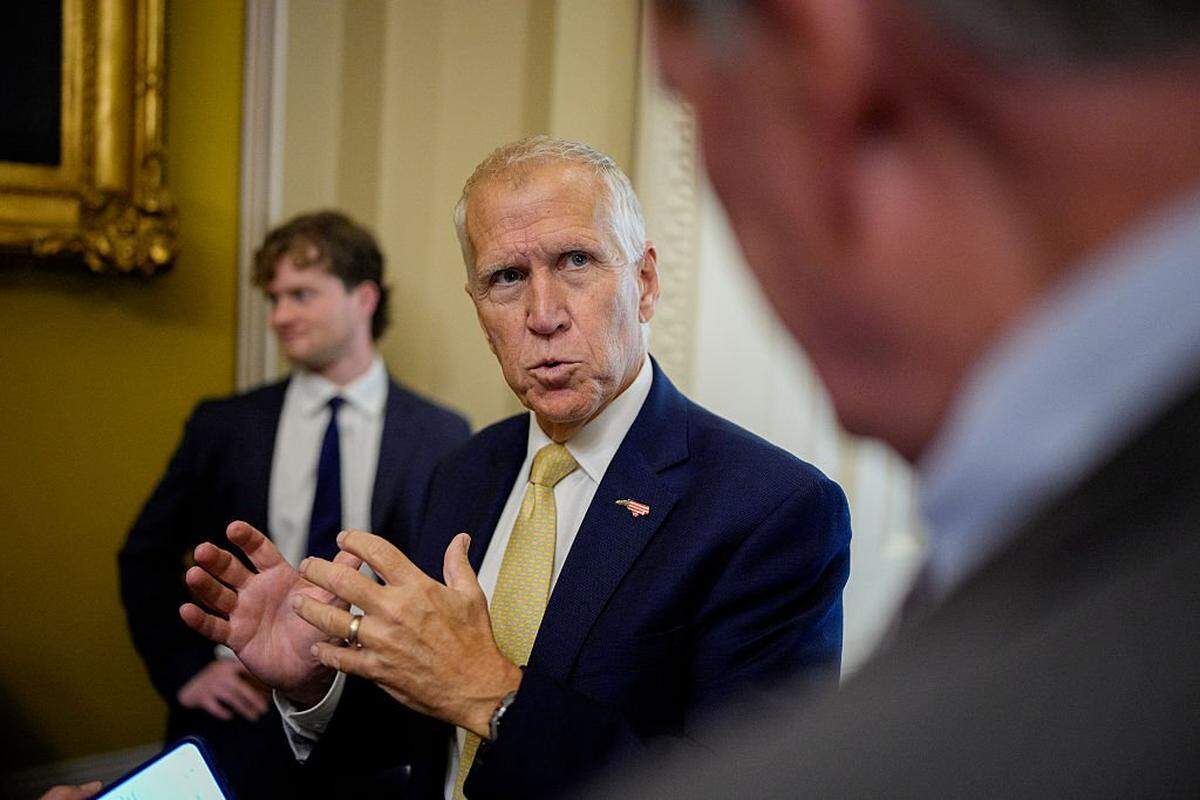
- Out of everyone who has criticized the Trump administration for investigating Federal Reserve Chair Jerome Powell, Sen. Thom Tillis of North Carolina arguably has the most power to stop it. A Republican, he sits on the Senate Banking Committee and has vowed to block President Donald Trump’s forthcoming Fed chair nominee until the Powell probe is “resolved.”
- Another North Carolina Republican to oppose the Powell investigation: former-Rep. Patrick McHenry, who labeled Trump’s actions a knowing attack on our system of checks and balances. “He lights stuff on fire,” McHenry said.
- North Carolina has landed a headquarters from Eastern Tennessee, as the contract research organization LabConnect opens its new corporate office near Research Triangle Park.
- Five years after selling to Bayer for $4 billion, RTP gene therapy company AskBio wants to make its record price tag a bargain.
- Three-digit layoffs: Thermo Fisher Scientific is laying off 421 employees as it closes its Asheville facility. And the food safety firm Fortrex says it will cut 170 workers after Mountaire Farms in Chatham County ended its contract.
- JetZero, which flew onto North Carolina’s radar last year by promising a 14,500-worker factory, raised $175 million in a Series B funding round to advance a prototype of its all-wing commercial airplane. JetZero aims to start constructing its Greensboro site later this year.
- Durham semiconductor supplier Wolfspeed has produced its first 300 mm silicon carbide wafer, a larger size the chipmaker says offers cost efficiencies.
- Meta laid off around 1,500 people in its metaverse division, Reality Labs. Last month, I reported the company had exited its downtown Durham office lease and once posted local Reality Labs job openings.
- Data centers are a flashpoint in North Carolina communities. Stokes County Commissioners this week approved a rezoning request for a developer to build a data center north of Greensboro and Winston-Salem, near the Virginia border. The 3-2 vote followed arguments for the data center (tax revenue) and opposition from local residents.
National Tech Happenings
- Alphabet, Google’s parent company, became the second company to be worth more than $4 trillion, joining Nvidia.
- Merger wars: Paramount Skydance sued Warner Bros Discovery to seek more information about why the latter agreed to sell to Netflix, and not Paramount, for $83 billion. Paramount is also promising a “proxy” fight over control of the WBD board.
- One of the most powerful venture capital firms, Andreessen Horowitz, said it raised just over $15 billion in new funding. This equals 18% of all VC dollars given in the U.S. last year. Investment priorities include AI (of course) and what Andreeseen Horowitz calls “American Dynamism” sectors of defense, aerospace, housing, public safety, manufacturing and industrials.
Thanks for reading!
This story was originally published January 16, 2026 at 7:00 AM with the headline "Fight over fiber internet and Musk satellites is shaping NC’s broadband future."