Open Source: Wolfspeed CEO out | The Woobles are hot | Strange job ads and green cards
I’m Brian Gordon, tech reporter for The News & Observer, and this is Open Source, a weekly newsletter on business, labor and technology in North Carolina.
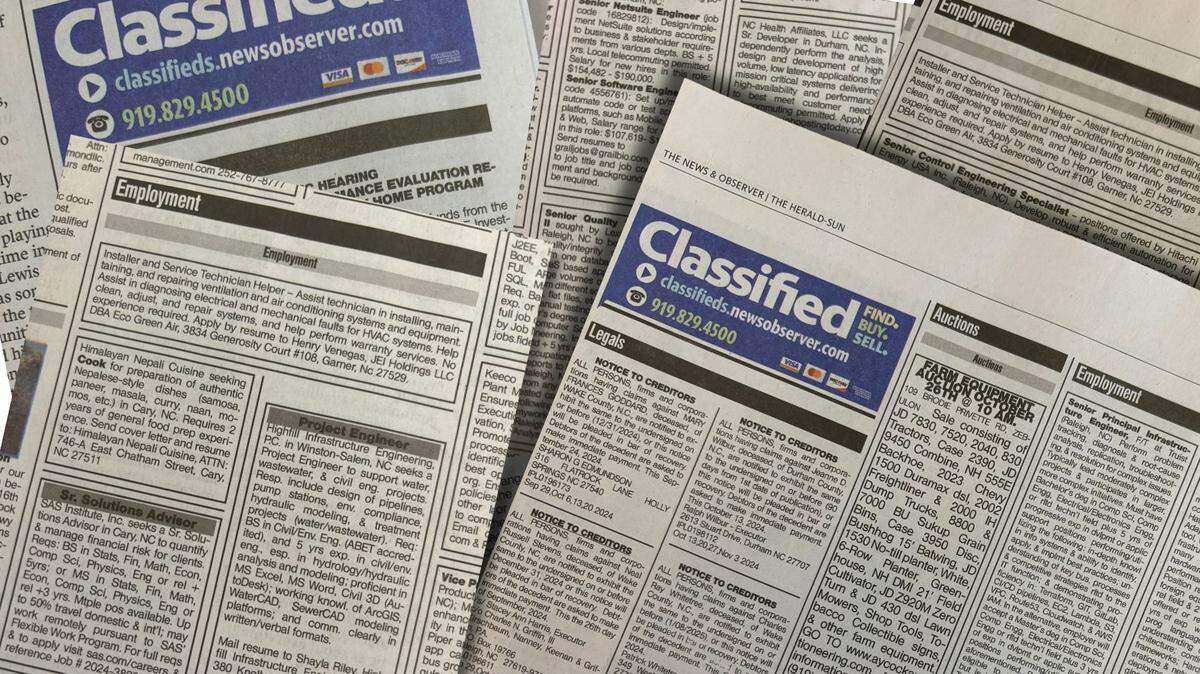
Three weeks ago, a reader emailed me a peculiar classified ad that had recently appeared in our newspaper. It was for a job at a staffing agency in Cary named Skill Buddy. No salary was mentioned, nor a specific worksite. Most distinct of all, this help-wanted advertisement directed applicants to physically mail in their printed resumes.
The reader also highlighted Skill Buddy’s website, which stands apart for its use of broad language written in various fonts against a multi-colored background.
So the question was posed: What’s the deal with this advertisement? I found the answer fascinating.
While the staffing firm wouldn’t confirm, experts say it’s likely Skill Buddy didn’t want applicants. Instead, in fewer than 400 characters, this ad reflected the complexities of America’s immigration system. And each week, job advertisements like it appear in local newspapers across the country — The N&O included.
The story of these strange classified ads touches on questions of citizenship, fairness and exploitation in the U.S. labor market. Overall, it explores a deeper narrative tucked inside our newspapers.
Cooper defends Biden’s legacy
To Democrats it might feel like a cruel irony: President Joe Biden’s chief economic policies, like the CHIPS Act and Inflation Reduction Act, have funneled millions of dollars to support jobs projects in Western, Midwestern and Southern states that just voted to reelect Donald Trump.
North Carolina economic officials say the IRA in particular catalyzed green energy investments in multiple battery manufacturing facilities, which together promise to create thousands of jobs statewide. But a factory doesn’t rise overnight. As The New York Times and others have pointed out, unrealized long-term commitments, while making good headlines, might not have weighed on voters’ minds as significantly as current concerns like grocery store prices.
I asked Gov. Roy Cooper about this dynamic during a press gaggle on Tuesday. He had just spoken at the nonprofit Semiconductor Research Corp. in Durham to celebrate the White House announcing a $285 million award to establish a new research institute near Research Triangle Park.
“The quick political hit was not at the top of this administration’s priority,” Cooper said. “A lot of the benefits aren’t seen in these investments until years later, where families have great paying jobs as a result of these investments now, so I commend them for understanding that they may not get immediate political credit, but these are generational investments that will help families for decades to come in this country.”
New leader, big challenges at Wolfspeed
What the Durham company Wolfspeed has going for it:
- It makes semiconductors, which are essential to so much of the technology around us.
- The semiconductor Wolfspeed produces is called silicon carbide, which performs more efficiently than standard silicon.
- Wolfspeed has a head start in manufacturing larger silicon carbide wafers — 200 millimeters substrates compared to industry standard of 150 mm. This offers greater cost efficiencies.
- The company has increased production at its 200-millimeter device plant in New York State’s Mohawk Valley. It’s also racing to launch its massive 200-millimeter materials factory in North Carolina’s Chatham County. The company should be positioned for success if and when the market for its chips rebounds.
But what has tripped up Wolfspeed over the past two years, leading to a stock nosedive, factory closure, layoffs, and just this week, its CEO Gregg Lowe being fired:
- The company has missed multiple production deadlines as it shifts toward 200mm silicon carbide. Perhaps delays are understandable when ramping up a first-of-its-kind manufacturing site in New York State, but these missed commitments eroded investors’ confidence.
- Lower demand for electric vehicles has hampered Wolfspeed’s short-term growth prospects.
- Liquidity concerns have swirled around the company. Wolfspeed alleviated the most-pressing worries with a $1.5 billion influx of capital this fall, including a $750 million CHIPS Act grant, but its stock price hasn’t been this low — below $7 a share — since 1998.
- Competitors have entered the silicon carbide market. Wolfspeed had a head start, but recent stumbles have led analysts to wonder if it can maintain its industry lead.
These are the challenges and obstacles the next CEO must navigate at the company with several decades of history in the Triangle.
The Woobles are multiplying
Chapel Hill couple Justine Tiu and Adrian Zhang don’t have much to say to Mark Cuban.
“We had a great time meeting their team, but for many different reasons, it’s just sometimes it doesn’t work out,” Zhang said of his 2022 appearance on ABC’s “Shark Tank.” During that episode, the husband-and-wife partners secured a deal from investors Cuban and Lori Greiner for their beginner crochet kit business called The Woobles. This agreement ultimately fell through however, and Cuban, for one, didn’t know why.
Two years later, what Duke undergraduates Tiu and Zhang are keen to talk about is their growing business. The Woobles today has more than 30 employees and a warehouse in South Durham. Having launched in July 2020, its lineup of round, colorful creature kits are now on sale in Walmarts nationwide — plus in smaller retailers and online.
There’s Cornelius the Bee, Tanya the Tiger, Nico the Cat, Fred the Dinosaur, Sebastian the Lion, and Pierre the Penguin. The complete character lineup (which also includes a piece of sushi with eyes) keeps expanding.
“We’ve been launching a lot this year,” Tiu said.
Each kit comes with instructions to guide novice crocheters through the weaving process. Tiu and Zhang say they want customers to achieve fiero, a feeling popularized in video games that occurs when people triumph over challenges.
On the business side, The Woobles also wants to get its kits into more retailers. But without investors, Zhang says he and Tiu aren’t hurried to hit specific growth targets.
“I think the reason why we don’t have investors is that we’re very mission-focused,” he said. “We do this because we really believe in this power of fiero and wanting to spread that feeling to as many people as we can.”
That might be the best answer Mark Cuban gets.
Clearing my cache
- A Raleigh woman and founder of a popular education tech startup was arrested for embezzling funds and lying to investors.
- An Australian firm will buy Charlotte’s Piedmont Lithium, one of two companies looking to mine lithium in North Carolina.
- Layoff alerts: The forklift maker Hyster-Yale plans to eliminate 97 jobs in the Eastern North Carolina city of Greenville while the furniture manufacturer EJ Victor will cut 121 workers in the Western North Carolina city of Morganton. The latter claims that after Hurricane Helene destroyed its building and inventory, its insurance provider has declined to pay. EJ Victor is suing.
- IonQ, a quantum computing company with strong Duke University ties, has nearly quadrupled its stock price in the past two months. IonQ develops one of the two leading types of quantum machines, called ion-trap. This week, it announced an “industry-first demonstration of an end-to-end application workflow” that works with Nvidia products to enhance quantum computing.
Housed in the Chesterfield building in downtown Durham, the Duke Quantum Center partners with the company on research. Duke professor Jungsang Kim (pictured below, center) cofounded IonQ in 2015.
National Tech Happenings
- The Department of Justice has called on Google to sell off its Chrome operations after the government won an antitrust case against the search giant earlier this year. Google said the DOJ is pursuing “a radical agenda.”
- Driverless cars are coming. Driverless cars are already here. Under Google’s parent company Alphabet, the autonomous driving company Waymo provides 150,000 rides per week in California and Arizona. It’s the country’s only paid robotaxi service. “Tourists no longer had their mouths agape as one drove by,” wrote a BBC reporter in San Francisco. “The technology has become a familiar sight.”
- Bitcoin’s ascent since the election continues with investors bullish about cryptocurrency friendly policies under the Trump administration. It’s selling for more than $94,000.
Thanks for reading!
This story was originally published November 22, 2024 at 5:15 AM with the headline "Open Source: Wolfspeed CEO out | The Woobles are hot | Strange job ads and green cards."