After some rough years, city releases new economic strategy for downtown Raleigh
Recent years have been challenging for downtown Raleigh.
The COVID-19 pandemic and the lingering work-from-home trend have reduced the number of daily office workers and weeknight visitors. Meanwhile, unrest after the death of George Floyd in 2020 left several businesses looted or burned, and more recent spikes in crime have eroded the sense of safety.
Now the city and the Downtown Raleigh Alliance booster group have developed a five-year economic strategy to reposition the center city for a rebound that builds on recent successes, particularly in housing. The downtown population has doubled over the last decade, according to the alliance, and more than 1,600 apartments and condos are under construction with another 8,072 planned or proposed.
The economic strategy, released Wednesday afternoon at the Martin Marietta Center for the Performing Arts, includes dozens of ideas and proposals. They focus on four key areas: improving the retail environment with a focus on Fayetteville Street; strengthening the office market; supporting minority and women-owned businesses; and undertaking a series of “catalytic projects,” such as redesigning City Plaza or working with local universities to create a “design hub” downtown.
“I’m thrilled to see these bold ideas that increase vitality in our downtown and stake Raleigh’s place as a world-class destination,” Mayor Mary-Ann Baldwin said in a written statement. “Now comes the important and harder work of bringing this blueprint to life and building the downtown that we all envision.”
The 82-page report was developed over the last year, using input from residents, business leaders and city officials, says Bill King, president and CEO of the downtown alliance.
“This strategy is more than a set of recommendations,” King wrote. “It is a vision for downtown Raleigh’s future, focusing on creating a vibrant, inclusive, and resilient urban center that adapts to our community’s evolving needs.”
The report acknowledges the effect of hybrid work on reducing foot traffic downtown. Other challenges include competition from other downtowns and places such as North Hills, that offer “pedestrian friendly, new urbanist environments with curated tenants and a public realm managed by a single owner.”
The strategies outlined in the report range from targeted and straightforward to vague and aspirational. They include renovation grants and streamlined permitting for new retailers; a better environment for pedestrians and cyclists across and along busy Dawson and McDowell streets; and creating a new “Peace Street gateway” to Halifax Mall, on the north end of the State Government Complex, by tearing down the 15-story Archdale building and replacing it with a “signature, must-see public art piece.”
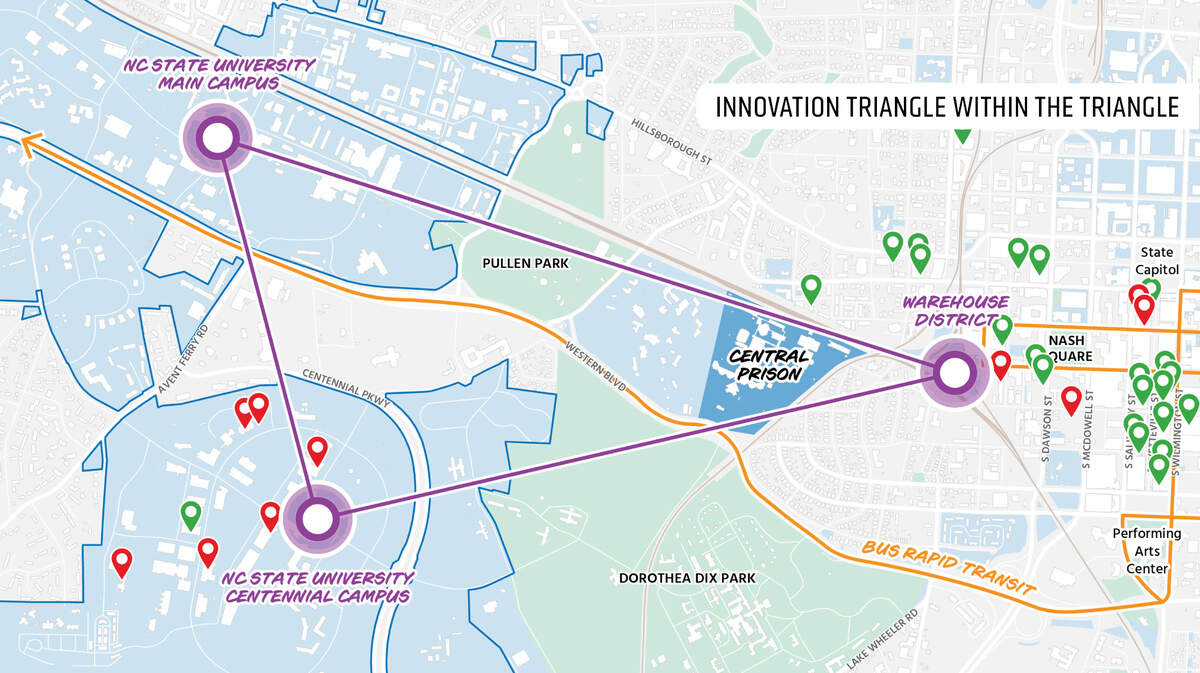
Some of the plan involves connecting downtown to places and institutions outside the core. It includes creating a “bold connection” to Dorothea Dix Park, the 308-acre former state hospital campus separated from downtown by Western Boulevard. Another idea is to create closer ties between downtown and N.C. State University and its Centennial Campus, through joint marketing or other efforts to attract new businesses and workers.
The report ends with more long-term goals, including a downtown professional sports arena or stadium; a central county library; more affordable housing, and potentially moving Central Prison, which sits between downtown and N.C. State’s two campuses.
To read the economic development strategy, go to downtownraleigh.org/ed-strategy.
The State of Downtown is sound, alliance says
The Downtown Raleigh Alliance also released its annual State of Downtown report Wednesday. It concludes that, despite recent challenges, the outlook for downtown is very good.
The office vacancy rate has ticked up since before the pandemic, with the departure of Citrix and Wells Fargo and other companies cutting back. But the downtown alliance says the amount of occupied Class A office space has increased by 430,000 square feet since 2020 and the vacancy rate of 14% is the lowest of any submarket in the Triangle, not counting space available for sublease.
The State of Downtown report portrays a downtown that has recovered from the COVID-19 pandemic in other ways.
▪ Despite the loss of some stores and restaurants, more than 180 storefront businesses have opened downtown since early 2020, for a net gain of 42. About 84% of storefront space downtown is occupied.
▪ Downtown, which includes the Glenwood South district, remains a destination for dining and nightlife. Food and beverage sales are higher than before the pandemic, with 268 bars and restaurants to bring people downtown and another 28 coming soon.
▪ The Raleigh Convention Center, performing arts spaces and special events have helped attract visitors; the number of weekend visitors now matches 2019 levels. There are 1,652 hotel rooms downtown, with another 410 under construction, and the occupancy rate in the year ending in June was 69.8%.
This story was originally published August 28, 2024 at 3:00 PM with the headline "After some rough years, city releases new economic strategy for downtown Raleigh."