White House advisory committee convenes in Cary to discuss regulating AI
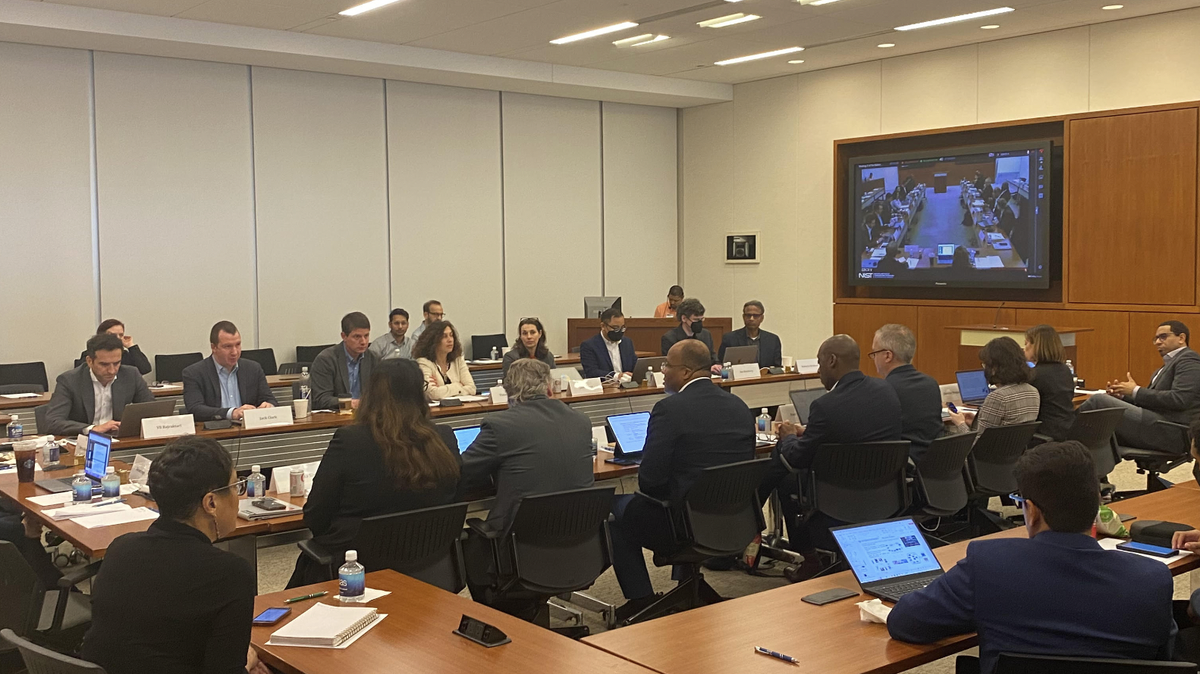
On Friday, AI experts from the world of business, academia and nonprofits gathered on the SAS Institute campus in Cary to discuss how the United States government can best harness the expanding capabilities of artificial intelligence.
This was the third-ever meeting of the National AI Advisory Committee (NAIAC), a 27-person body launched last April to offer the White House strategies for best addressing this powerful technology.
“We have an incredibly important and also relatively broad mandate,” said Victoria Espinel, CEO of the software industry group BSA, at the start of the meeting. “AI can lead to enormous societal benefits if it is used responsibly. It is also clear that it can lead to significant adverse consequences if it is not used responsibly.”
Artificial intelligence is already in use in many parts of daily life, from YouTube video recommendations to sorting through job applicants. In the first hour of Friday’s meeting alone, NAIAC members broached AI in policing, AI competition with China, and the risks AI poises, if not implemented deliberately, to equity.
“In a world where humans are making decisions, it’s pretty easy to point to the individual (who made the decision),” Reggie Townsend, an NAIAC member and director of SAS’ Data Ethics Practice, told The News & Observer after the meeting. “I can hold you accountable if there’s harm as a consequence of your decision. When you turn that over to machines or systems, some of that becomes really opaque.”
Established by the National AI Initiative Act of 2020, the advisory committee has a directive to reach a geographically diverse population. After holding its first two meetings in Washington, D.C., and Palo Alto, California, the group picked North Carolina and SAS, an analytic software provider, for its third site.
“We think it’s important to get the voices of folks from different parts of the nation,” Townsend said.
Amanul Haque, a PhD student studying AI and ethics at North Carolina State University, sat in on the meeting.
“AI as a technology is just so powerful, there’s so much application, that at some point it needs to be regulated,” he told The News & Observer during a break. “Its application is something that pretty much impacts everybody in some area.”
As an example, Haque highlighted how artificial intelligence steers which political content people are shown on social media, which he feels can create echo chambers.
“People may not know it as AI,” he said. “They may just know it as general technology.”
This story was produced with financial support from a coalition of partners led by Innovate Raleigh as part of an independent journalism fellowship program. The N&O maintains full editorial control of the work.
This story was originally published February 11, 2023 at 9:00 AM with the headline "White House advisory committee convenes in Cary to discuss regulating AI."