As R-Line ridership declines, Raleigh seeks feedback on possible changes to downtown bus
Declining ridership and competition from the likes of scooters and rideshare companies Lyft and Uber have prompted the city to consider revamping the R-Line, the free downtown circulator bus.
The city launched the R-Line in February 2009, about six months after the opening of the new convention center. It was meant to help visitors to the city explore downtown and the Glenwood South entertainment district as well as make it easier for people who live or work downtown to get around.
As the service got started, Mayor Charles Meeker said he hoped someone would someday write about people riding the R-Line the same way jazz legend Duke Ellington sang about taking the A Train to Harlem.
That still hasn’t happened. R-Line ridership peaked in the fiscal year ending June 30, 2012, at 296,652 passengers and has declined to less than half that since then. In the fiscal year ending this summer, only 139,677 people rode the R-Line, despite growth in the numbers of workers and residents downtown.
Nathan Spencer of the Raleigh Transit Authority says changes at the R-Line are overdue.
“We haven’t been on the ball with the R-Line,” Spencer said in an interview. “We set it up and walked away and didn’t really think of it.”
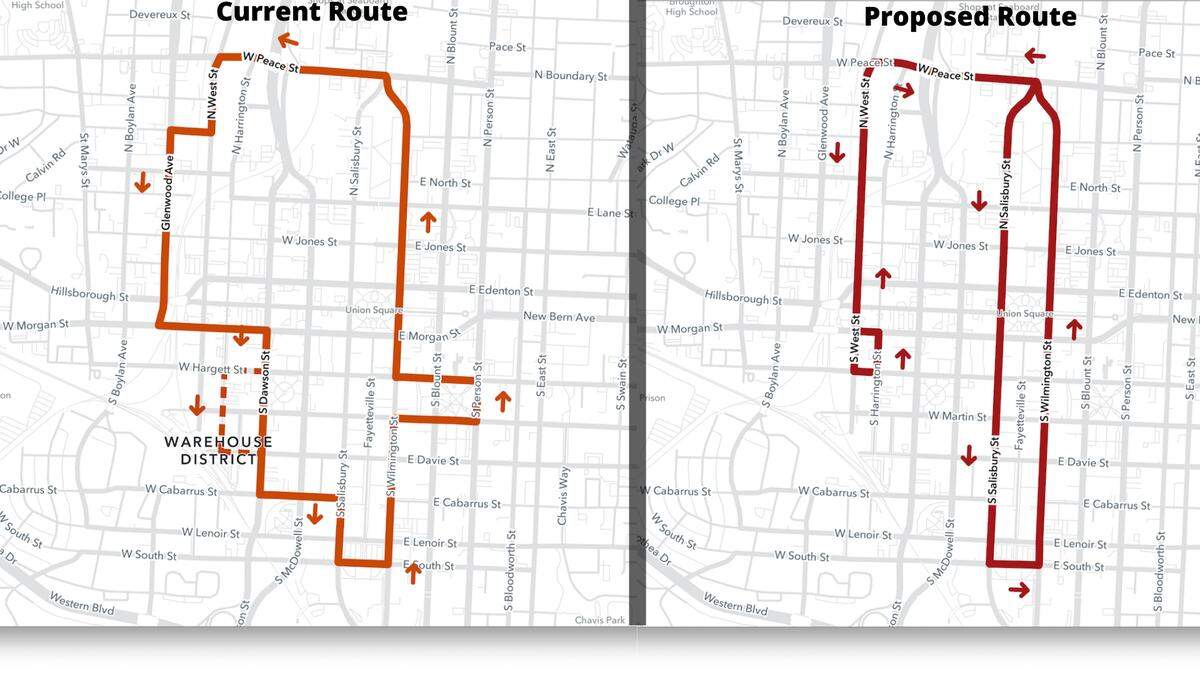
The Transit Authority has proposed streamlining the route, to focus on the busiest areas and to reduce wait times between buses. Someone who just missed the R-Line may have to wait as long as a half hour for the next one to come, Spencer said.
The authority will present the new route and take feedback at two public meetings Wednesday, from 11 a.m. to 1 p.m. and 4 to 6:30 p.m., in Room 303 of the Raleigh Municipal Building on Hargett Street. There’s also an online survey at bit.ly/2r76fJB, and the authority will hold a public hearing before it approves the route.
The current route is a 3.6-mile, counterclockwise loop that includes stops at the convention center, Duke Energy Center for the Performing Arts, GoRaleigh station and along Wilmington and Peace streets and South Glenwood Avenue. On weekend nights, the bus makes extra stops in the Warehouse District.
The proposed, more linear route hits many of the same spots, but avoids Glenwood Avenue, where the bus often gets bogged down in traffic, Spencer said. It also passes by the new Publix grocery store, at the corner of West and Peace streets, twice as the bus goes up and down West Street.
The R-Line is operated by GoRaleigh, but it’s as much an economic development tool as a transit line, said Spencer, who headed the committee that developed the proposed route. The $900,000 annual budget for the R-Line comes from an economic development fund that downtown businesses pay into.
That $900,000 pays for two buses and GoRaleigh drivers to staff them from 7 a.m. to 11 p.m. Monday through Wednesday; 7 a.m. to 2:15 a.m. Thursday through Saturday and 1 to 8 p.m. on Sundays.
The Transit Authority met with downtown business owners and other interest groups to hear what they want from the R-Line. While serving out-of-town visitors is still a goal, Spencer said, people also wanted to meet the needs of the growing number of downtown residents as well as workers who may arrive on a bus and need a reliable way to get the last several blocks to work.
Bill King, who heads the Downtown Raleigh Alliance, said the current R-Line route is inefficient and the organization welcomes a more streamlined approach.
“We do want to make sure, though, before this route is adopted by the city that all citizens affected by this route and its most frequent riders, including for example senior citizens who live in downtown, are aware of the changes and that this route still serves their needs and is accessible for them,” King wrote in an email.
Whatever route the Transit Authority chooses for the R-Line will likely be temporary, Spencer said. With GoRaleigh planning to develop bus rapid transit or BRT lines radiating from downtown, the city will probably want to revisit the R-Line in three to five years to see how it complements the new system, he said.
This story was originally published November 19, 2019 at 6:11 PM with the headline "As R-Line ridership declines, Raleigh seeks feedback on possible changes to downtown bus."