Happy Kwanzaa! How and why it’s celebrated, what to eat and events in the Triangle.
Kwanzaa is an annual week-long celebration that honors Black history and culture.
It celebrates seven values in African culture: unity, self-determination, collective responsibility, cooperative economics, purpose, creativity and faith.
Kwanzaa began in 1966 when it was created by Dr. Maulana Karenga, a Black power activist and professor of Africana studies. The holiday represents family, culture and heritage, and it was modeled after African harvest celebrations.
Kwanzaa became popular in the 1980s and 1990s in tandem with the Black Power movement, per CNN, making up the trio of winter holidays along with Christmas and Hanukkah.
“It’s a holiday designed to meet its participants wherever they are on the Black cultural spectrum. At its core, Kwanzaa is an amalgamation of several solstice and harvest ceremonies traditionally celebrated throughout the African continent,” writes Thérèse Nelson for Eating Well. “The word Kwanzaa derives from the Swahili phrase ‘matunda ya kwanza,’ meaning ‘first fruits.’ It’s a celebration that uses the time of winter harvest to allow its celebrants to reevaluate their lives and reset for the new year.”
When is Kwanzaa?
Kwanzaa begins Dec. 26 and lasts until Jan. 1.
What are the seven values, principles of Kwanzaa?
The holiday centers around the Nguzo Saba (The Seven Principles):
1. Umoja means “unity.” On his Kwanzaa website, Karegna defines this as: “To strive for and maintain unity in the family, community, nation and race.”
2. Kujichagulia means “self-determination:” “To define ourselves, name ourselves, create for ourselves and speak for ourselves.”
3. Ujima means “collective work and responsibility:” “To build and maintain our community together and make our brother’s and sister’s problems our problems and to solve them together.”
4. Ujamaa means “cooperative economics:” “To build and maintain our own stores, shops and other businesses and to profit from them together.” Similar to Ujima, this principle refers to uplifting your community economically.
5. Nia means “purpose:” “To make our collective vocation the building and developing of our community in order to restore our people to their traditional greatness.”
6. Kuumba means “creativity:” “To do always as much as we can, in the way we can, in order to leave our community more beautiful and beneficial than we inherited it.”
7. Imani means “faith:” “To believe with all our heart in our people, our parents, our teachers, our leaders and the righteousness and victory of our struggle.”
How is Kwanzaa celebrated?
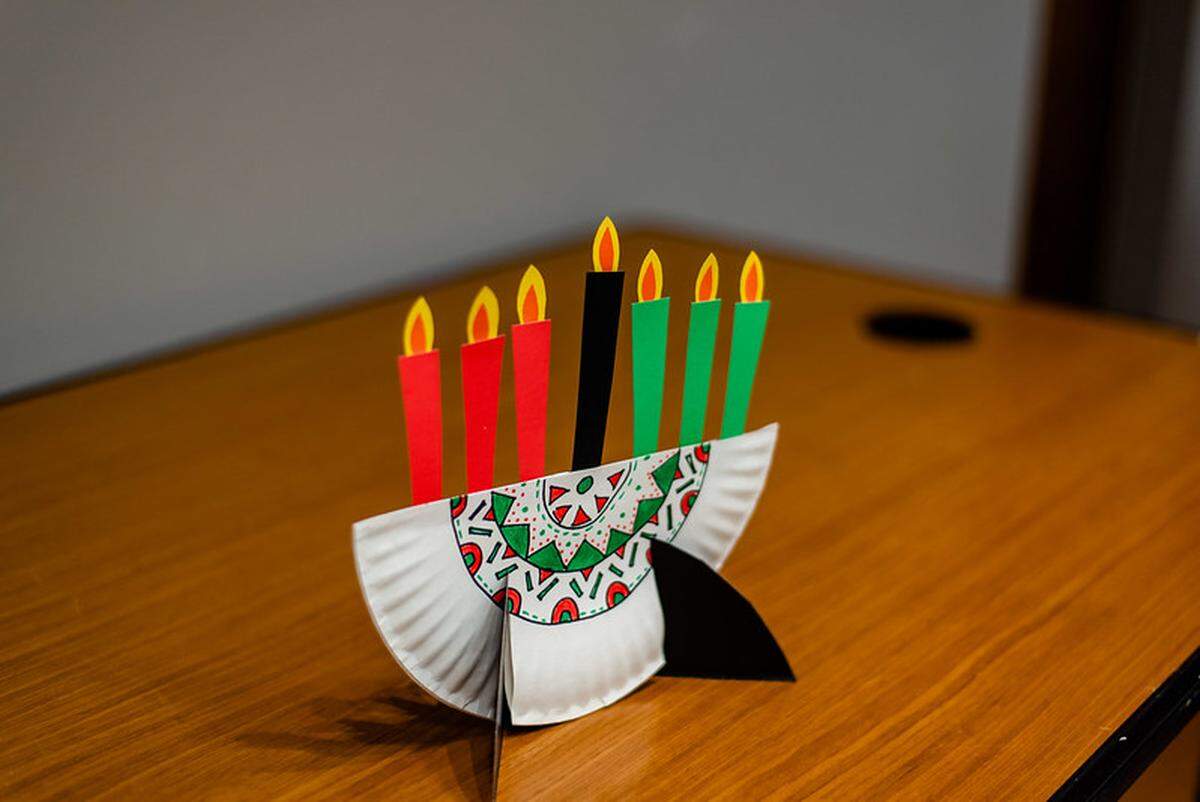
Each of the seven candles on the kinara — the candle holder — signifies the principles.
The kinara has three red candles on the left, three green candles on the right and one black candle in the center. The black candle, which represents unity (umoja) is lit first. Then, lighting alternates between the red and green candles, beginning on the outside of the kinara and moving inward, per TheHolidaySpot. One candle is lit per day of the celebration.
These candle colors symbolize the holiday’s people (black), the noble blood uniting all people of African ancestry (red) and Africa’s rich land (green), per PBS. They can also symbolize struggle (red) and hope that comes from it (green), per ABC11.
The karamu feast on the last night of Kwanzaa (Dec. 31) is a popular gathering to finish out the week-long celebration.
“On that day, folks observing the holiday come together—either in smaller groups as families or in larger ones as communities — to honor the renewal, rededication and resilience that Kwanzaa symbolizes,” wrote Jessica B. Harris for Eating Well. “I savor the ways in which the feast allows for multigenerational transmission of history and culture: how youngsters sit and listen to their elders talk of their pasts and of the common and convoluted history that binds us all.”
Check out her karamu recipes for caramelized ripe plantains with dark rum and herbed chicken thighs.
Raleigh organization forms Kwanzaa working groups
Raleigh’s Fruit of Labor World Cultural Center held a Kwanzaa celebration on Dec. 26, the first day of the week-long holiday. But more is being done each day of Kwanzaa and well into the new year, said Angaza Laughinghouse, co-director of the center.
Working groups were formed at the Sunday celebration.
These groups are working to accomplish goals such as:
- continuing to build an onsite community solidarity garden
- financial health workshops to improve credit and purchase homes
- organizing candidate forums to help elect accountable candidates
- using music and culture to educate and inspire
- conducting workers rights workshops
Those interested in joining one of these groups can contact fruitoflaborwcc@netscape.com and visit their website fruitoflabor.org, Laughinghouse said.
“Kwanzaa isn’t about gathering and celebrating for one day to then disappear,” he said. “We want them engaged and figuring out how to make our communities better, our city better, our country better.”
Where to celebrate Kwanzaa in the Triangle
We’ve compiled a list of Kwanzaa events taking place in and around the Triangle. If you see something we missed that you think we should include, let us know by emailing ask@newsobserver.com.
Important: Please check the websites for each event or venue prior to heading out to verify hours of operation (which can change) and to learn more about rain dates and COVID safety guidelines.
• Kwanzaa at John Chavis Memorial Park – Learn about the seven principles of this holiday, plus the history and traditions of Kwanzaa. Date: Dec. 28 (11 a.m. - 2 p.m.) Location: John Chavis Memorial Park – 505 Martin Luther King Jr Blvd, Raleigh Tickets: Free Info: raleighnc.gov/events/kwanzaa-john-chavis-memorial-park
• Cary’s Annual Kwanzaa Celebration – The annual celebration will be held on Dec. 30 at the Cary Arts Center. The event includes storytelling for kids, drumming, African dance, a traditional Kwanzaa ceremony, art, music and narration at various times. Date: Dec. 30 (12-3 p.m.) Location: The Cary Arts Center – 101 Dry Ave, Cary Tickets: Free Info: townofcary.org/recreation-enjoyment/events/holiday-events/kwanzaa
• Update: This event has been canceled. Kwanzaa Fest – The community celebration, which includes free performances and a vendor market, will be Jan. 1 at the Durham Armory. The venue opens at 11 a.m. and performances start at 1 p.m. Date: Jan. 1 (11 a.m.-4 p.m.) Location: Durham Armory – 220 Foster St, Durham Info: eventbrite.com/e/aade-kwanzaa-fest-tickets-202562809817.
This story was originally published December 27, 2021 at 1:46 PM with the headline "Happy Kwanzaa! How and why it’s celebrated, what to eat and events in the Triangle.."