State employees denounce looming cost hikes as NC health plan tackles $1.4B shortfall
Significant changes loom for active state employees enrolled in the State Health Plan, with the treasurer’s office, which oversees the plan, asserting they are essential to addressing a $1.4 billion shortfall projected through September 2027.
However, the specifics are still being worked out. The State Health Plan Board of Trustees on Friday debated the scope of the changes, with votes on benefit design adjustments — such as deductibles and copays — set for May and votes on premium increases for 2026 scheduled for August.
A deductible is what you pay for health care before insurance kicks in. A copay is a fixed fee for certain services.
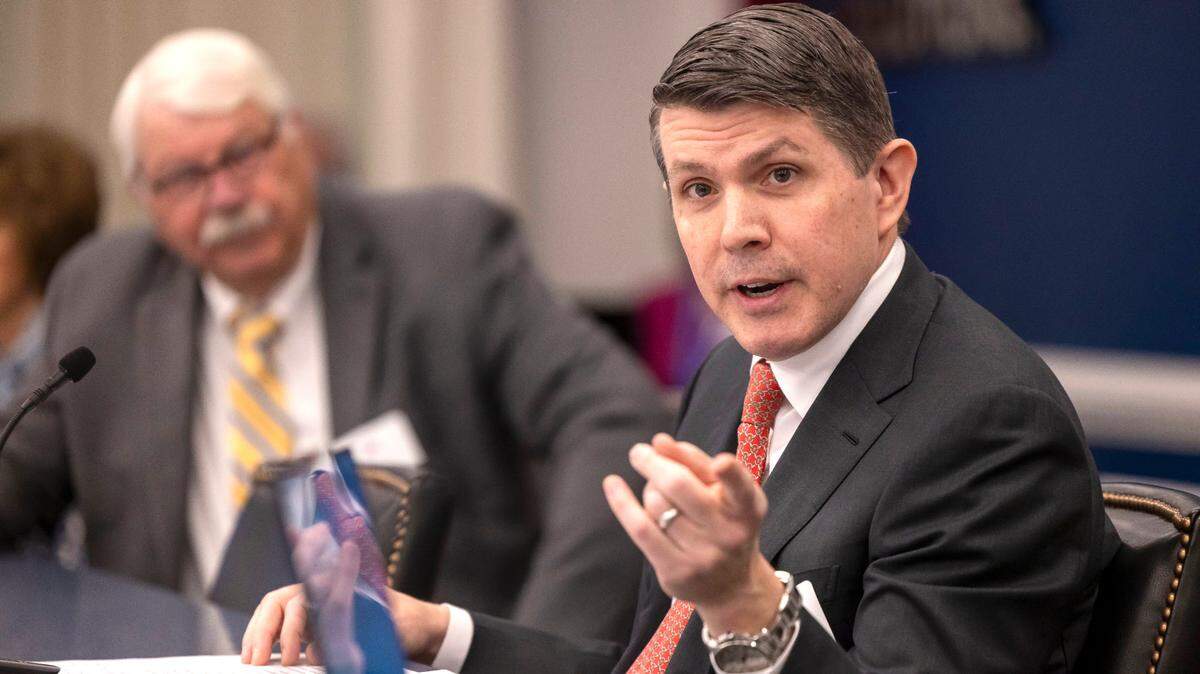
“I recognize that no one wants any increase in out-of-pocket costs. Unfortunately, this is not our reality today. We spent the last seven years holding premiums and out-of-pocket costs flat,” said Treasurer Brad Briner, who took office in January.
“We’re the only large plan in the country who has done that,” Briner said. “Unfortunately, we are now out of reserves. We do not have that option. But we have to do something. Our fiduciary responsibility is to keep this plan solid so that we can continue to offer the benefits for teachers and state employees who serve this state.”
The State Health Plan provides coverage to nearly 750,000 teachers, state employees, retirees and their dependents. Aetna administers the State Health Plan for the state.
Premium increases and benefit changes aren’t the only changes under consideration. The board also discussed revising prior authorization requirements — pre-approvals mandated by insurers before certain treatments — and adjusting the provider network to steer members toward high-quality options.
Opposition to cost increases
Proposals to raise costs for members were met with opposition.
A handful of members of the North Carolina Public Service Workers Union — also known as UE Local 150 — protested outside the treasurer’s office before the meeting.
Multiple speakers also voiced concerns during the board’s public comment period.
Karina Hernandez, a social worker at the state’s Central Regional Hospital in Butner, said that as state employees, “we don’t have many perks, but the health insurance is important. It is enough to attract qualified workers. We can’t afford to change that.”
“Prices are continuing to rise on everything. We can’t afford increases in our health insurance,” she said.
Hernandez shared the story of Su Su, a housekeeper at UNC-Chapel Hill who Hernandez said had wanted to speak at the meeting but was unable to due to her work. Su Su, a refugee from Burma and a mother to two daughters, has colon cancer but is opting out of care due to high health care costs, Hernandez said. “She spends her days cleaning buildings in biomedical research labs but can’t afford the care she deserves,” said Hernandez.
Alexandra Fox, a social worker at Central Regional Hospital and UE Local 150 member, said state-operated health care facilities face “an existential threat.” Fox said there are empty beds and a nursing staff shortage.
“We cannot afford any increases to our premiums, our deductibles or cuts to services. We are the people doing the most direct care, the people cleaning the hospitals, but we can’t afford the care that we give to other people,” she said.
The proposed premium increases would be salary-based and divided into four income-based bands, according to documents from past board meetings. Kevin Tompkins, executive director of human resources at Vance-Granville Community College, asked that the salary bands be expanded beyond four so that price increases would be more spread out.
Justin Guillory with the North Carolina Association of Educators spoke about concerns regarding retaining and hiring good employees. “Why are we asking our underpaid employees to close this gap before we ask more of the state legislature or Aetna,” he questioned.
State lawmakers are supposed to pass a two-year state budget before the start of the new fiscal year on July 1 — but that is often delayed. The budget includes funding to cover the employer contribution rates for the State Health Plan. Both employees and employers pay into the State Health Plan. Budget negotiations involve competing priorities and funding needs. The SHP is asking lawmakers to increase employer contribution rates by 5% each fiscal year, according to a document shared with The N&O by the treasurer’s office.
Suzanne Beasley with the State Employees Association of North Carolina pushed for transparency, questioning why price increases would fall on state employees “without anyone knowing what providers, what the big hospitals are making.”
Former Treasurer Dale Folwell implemented a transparency measure known as the Clear Pricing Project, in which payments to participating providers are based on Medicare rates.
However, the State Health Plan now plans to terminate the project by the end of 2025 and replace it with a rebranded plan focused on behavioral health.
Leadership at the treasurer’s office has said that the Clear Pricing Project led to higher costs for the health plan because the providers that joined were the ones that would earn more by participating. Others opted out because they wouldn’t benefit.
Options for premiums, out of pocket costs
The State Health Plan proposes three options to address shortfalls, all capping premium increases at $20 for the lowest-paid workers (under $40,000). Each adjusts premiums, copays, deductibles and out-of-pocket costs differently for different plans.
In broad strokes, the first option focuses largely on premium increases with less change to out-of-pocket costs, the second balances premium increases with increases to out-of-pocket costs, and the third offers the lowest premium increases but with greater increases in out-of-pocket costs.
Tom Friedman, executive administrator for the State Health Plan, said these were suggestions and opened the floor to board members for ideas.
Kerry Willis, a physician and board member, said he didn’t think those proposals would save much money. Instead, “I think we’re gonna save money in looking at hospital costs and capping those.” He said that could be done by bundling benefits, giving members provider options with different costs.
“If a hip operation is $90,000 at WakeMed or Atrium and $30,000 at UNC, we’re gonna change your out-of-pocket cost for it.” This could mean having it done for free at UNC under the State Health Plan versus paying more at other locations, he said. He also advocated for not raising copays for primary care or having them lowered to zero.
Willis added that he would rather have a slightly higher premium than “hitting folks when they’re sickest or hitting the folks with chronic disease the heaviest.”
Kimberly Jones, a teacher for Chapel Hill Carrboro City Schools and a board member, echoed this, saying not raising the out-of-pocket maximum should be a “priority.”
Brian Miller, a practicing hospitalist and board member, agreed that hospital costs needed to be addressed but said the benefit design changes were necessary because “we have to do something fast” and contracting with hospitals is not a fast process.
Friedman, citing Willis’ comments on costs varying by provider, said the treasurer’s office was also considering tiered pricing — incentivizing members to choose preferred providers, who would be cheaper and of high-quality.
This year, he said, the SHP is looking into implementing a tiered system for orthopedics in the Triangle.
Prior authorizations
The other significant change debated for state employees concerns prior authorizations.
Prior authorizations aim to curb overprescribing of costly procedures and ease insurance burdens, though some argue the restrictions have become excessive, said Friedman. “I don’t think I would disagree with that point of view. I think we have to think through how it fits into kind of a broader set of things,” he said.
Changes proposed on Friday included eliminating authorizations for procedures under $1,000 (or possibly $5,000) and drugs under $500, alongside a plan requiring reviews by qualified physicians.
Willis said “at some point, society decided it was a good idea to let the insurance company control your health care. I’m not sure why that’s a good idea,” he added, “and I’d much rather trust physicians to make that decision.”
Miller expressed concerns with the cuts for medications, saying 70% of the claims under $500 a month requiring a prior authorization were for controlled substances. “I would be very nervous about removing prior authorization for that,” he said.
The authority to modify prior authorization policies rests with the treasurer, who may delegate it to Friedman, while the board can only offer recommendations.
Amy Auth, deputy treasurer for external affairs, told the board in a legislative update that “legislation related to prior authorization is going to be filed soon.” The N&O reported in late January that top Republican lawmakers involved in health care were considering filing a bill to restrict or ban prior authorization at the state level — not solely for the State Health Plan, but for other insurance plans as well.
This story was originally published March 7, 2025 at 5:55 PM with the headline "State employees denounce looming cost hikes as NC health plan tackles $1.4B shortfall."