
Inside the numbers: Duke turning defense into offense leads to better scoring
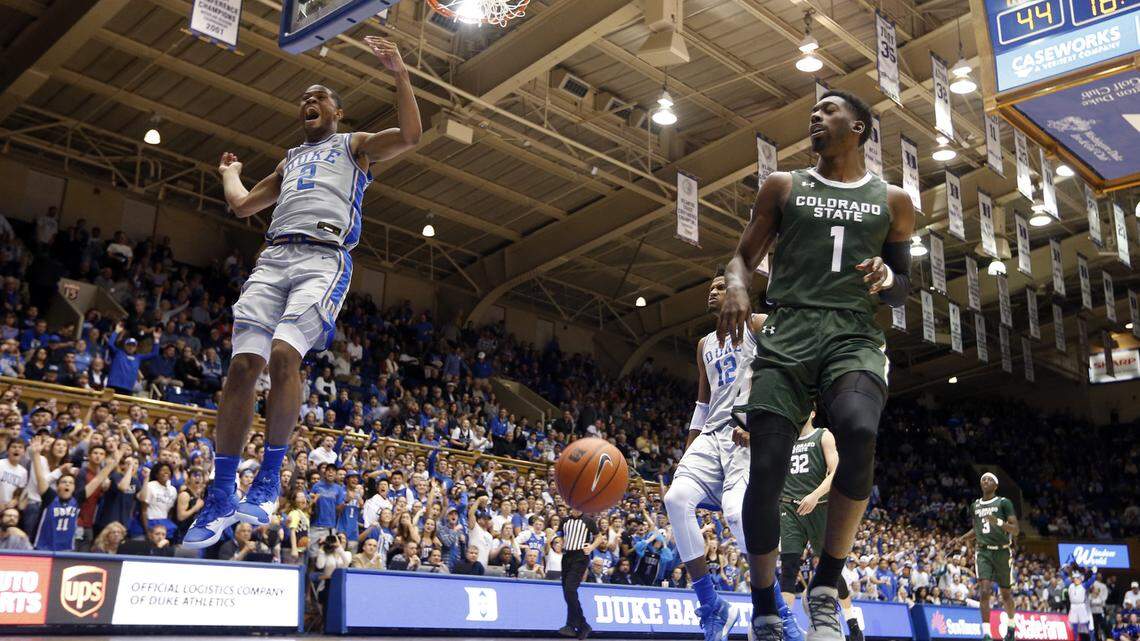
Duke started the season with an impressive win over Kansas last Tuesday night and, the way its schedule lays out, the No. 2-ranked Blue Devils won’t face another team that talented until December.
Duke’s run through what should be a softer portion of its nonconference schedule began with an 89-55 win over Colorado State Friday night at Cameron Indoor Stadium.
The Rams stayed with Duke for the game’s first 18 minutes, trailing 32-26 with 2:18 to play in the first half, before the Blue Devils ran away to the lopsided win.
As Duke prepares to face Central Arkansas on Tuesday night, followed by Georgia State on Friday, here’s an analytical look at where the Blue Devils are on offense and defense so far.
As always, thanks to Synergy Sports Technologies and KenPom.com for their work compiling these analytical statistics.
Shooting
Duke’s jump-shooting remains a work in progress but it didn’t matter against Colorado State. While Duke shot 53.6 percent overall, the Blue Devils made just 4 of 22 3-pointers (18.2 percent). Their shooting percentage on two-point attempts, 70.2 percent, was aided by 12 layups and five dunks.
Colorado State lacked a rim-protecting big man, so Duke rightfully got the ball in the paint, both in half-court and transition, to get high-percentage attempts.
Cassius Stanley continued to be Duke’s most efficient scorer, tallying 19 points while making 8 of 11 shots against Colorado State. He missed his only 3-point attempt. His points per possession efficiency rating for the game was 1.46.
“Cassius has just been fundamentally sound,” Duke coach Mike Krzyzewski said. “What was he tonight? 8 for 11. 5 for 6 against Kansas. Just very efficient. Really efficient.”
Stanley’s points per possession rating of 1.28 leads Duke through two games. Of the players who’ve seen the most playing time for Duke, only Stanley and Vernon Carey (1.16) are averaging more than a point per possession.
Defense
While Colorado State’s 18 turnovers were 10 fewer than Kansas committed, the Blue Devils played a more direct role in causing them.
Duke had 12 steals against the Rams, compared to the 11 they recorded against the Jayhawks. Colorado State turned the ball over on 23.7 percent of its possessions against Duke, while Kansas saw 35 percent of its possessions end with turnovers.
“We got live ball turnovers (against Colorado State),” Krzyzewski said. “Against Kansas, the turnovers were doubles with the bigs. We still scored off turnovers, we still scored off turnovers but not as much. We forced 28, but a lot of them, we take it out of bounds. With this, it turned into offense.”
In both games, Duke showed its pressure makes it hard for teams to score and run an efficient offense.
Colorado State shot 32.7 percent, scoring 0.72 points per possession.
The Rams went scoreless on 22 of their 34 halfcourt offensive sets in the first half and 24 of 34 in the second half.
Nine different Duke players recorded steals, with Tre Jones, Joey Baker and Alex O’Connell leading the way with two each.
Ball movement
Duke’s ability to get the ball inside is reflected in its assist total and percentage against Colorado State.
The Blue Devils had 14 assists, recording one on 37.8 percent of their made field goals.
Tre Jones recorded seven assists to lead Duke.
Ball protection
Duke had 16 turnovers against Colorado State, meaning the Blue Devils only turned it over on 20 percent of their possessions — one of every five.
Stanley and Wendell Moore had four each. That’s a bit concerning for Moore, who has turned it over on 39.8 percent of the possessions he’s been involved with this season. Stanley’s rate is only 19 percent.
Jones had three turnovers against Colorado State but his season turnover rate is just 12 percent.
Controlling the boards
After losing the rebounding battle by 10 to a bigger, stronger Kansas team, Duke had 43 rebounds to Colorado State’s 34.
With Stanley and Matthew Hurt grabbing two offensive rebounds each to lead the team, the Blue Devils earned second-chance opportunities on 25.7 percent of their missed shots against the Rams.
Colorado State, meanwhile, had only eight offensive rebounds and Duke rebounded 81 percent of the Rams’ missed shots.
Stanley led Duke with seven rebounds overall, while O’Connell had six.
This story was originally published November 11, 2019 at 4:00 PM with the headline "Inside the numbers: Duke turning defense into offense leads to better scoring."