
Ken Burns promotes film about bloody, complex truth of US history in Raleigh
In his newest PBS series, Ken Burns trains his slow-zooming gaze on the American Revolution and finds a bloody mess led by a deeply flawed commander, fought in guerrilla style by soldiers as young as 14, leading to an unlikely victory that toppled a monarch.
“It’s the most important event in the history of the world since the birth of Christ,” he said Thursday in Raleigh, promoting his upcoming project. “People were subjects and then they were citizens. It’s big news. Stop the presses.”
In a decade of research, Burns found America’s origin story cloaked in myth and nostalgia, its heroes hidden inside statues and its landmarks limited to a handful of battlefields.
For the filmmaker who pulled viewers into the cannon fire of the Civil War, behind home plate at Yankee Stadium and into the smoky Harlem jazz clubs that spawned Louis Armstrong, the Revolution beckoned like an unclimbed mountain. War reveals the best and worst in people, he said, and he relished the chance to both shape the American figures depicted in paintings and on coins as three-dimensional people.
“I just felt that the ideas were in no way diminished by telling a more complete story,” he said. “If you’re making these people come alive and they’re familiar, and they don’t feel like they’re back in some ancient anachronistic age, are you willing to go the step further and hold the mirror up? Would I have been a patriot or a loyalist? What would I be willing to fight for? What ideal would I be willing to die for?”

‘The American Revolution’ on PBS
Burns’ film “The American Revolution” airs on PBS in November, nearly 10 years after his team started research in the last year of President Obama’s second term. It comes as the country has already seen the 250th anniversary of the “shot heard ‘round the world” at the battles of Lexington and Concord, and while it prepares for the country’s “quarter-millennial” next year.
It airs in six parts over 12 hours, shorter treatment than Burns gave either the Vietnam War or the Roosevelt family, largely because his 18th-century subject matter lacks a single photograph.
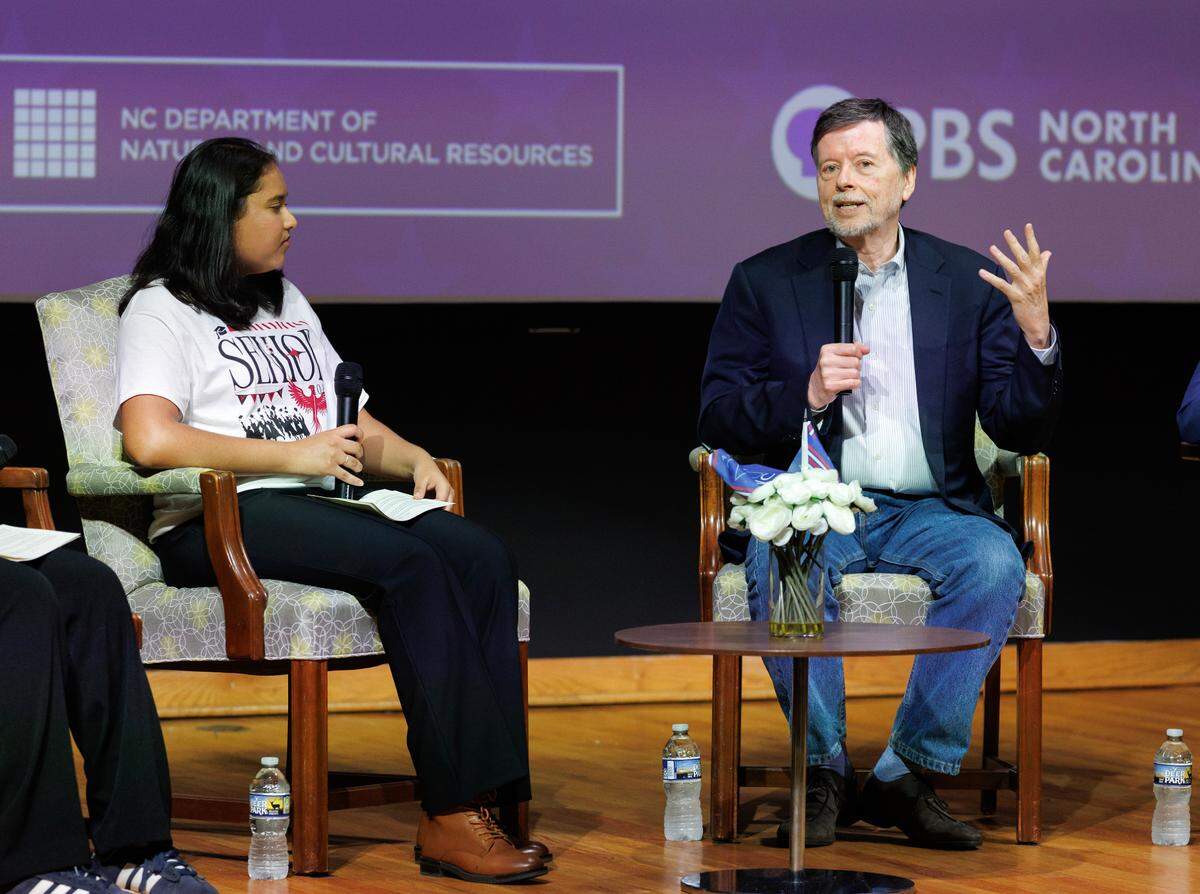
Burns came to Raleigh to meet with NC students, field questions from Triangle media and host a VIP screening at the Martin Marietta Center for the Performing Arts.
As he tours the country in advance of his series airing this fall, stopping in Charleston on Wednesday and Atlanta this weekend, he reminds each state of his own revolutionary role.
The Battle of Guilford Courthouse fought near Greensboro gets large mention in Burns series, largely because the patriots managed to score a deep wound even while losing, whittling down the British whose home base stood thousands of miles away and across an ocean.
But as with the Civil War, Burns seeks themes beyond battlefield maps.
“It’s less the individual stories of a particular state,” he said, “than the willingness of that state to subsume itself to a bigger whole without losing its identity. That’s the great glorious news of the Revolution.”

George Washington humanized
The central figure Burns seeks to flesh out is George Washington, the hero he calls “ a deeply flawed human being.”
“First of all, he owns people,” said Burns. “He is opaque and unknowable. There are very few people who get in.”
But at the same time, “He’s good at executive action. He’s incredibly brave. You would even say he’s rash. He rides out of the battlefield and a soldier has to grab his commander’s horse by the reins. ... He stops a mutiny of his troops after the war is over with just one short speech. ... He gives up power twice. No one does this.”
More than the presidents and generals cast in marble, Burns introduces viewers to a 14-year-old fife player, a Swedish pastor with a church divided between patriot and loyalist and a Vermont soldier forced to shoot his best friend, who chose the other side.
Burns hopes the messy, complicated story of America’s beginnings will resonate in its messy, complicated present, and that the themes that joined 13 disparate colonies will manage to unite its fractured descendants.
This story was originally published May 16, 2025 at 5:00 AM with the headline "Ken Burns promotes film about bloody, complex truth of US history in Raleigh."