
Randall Kenan kept writer James Baldwin’s fire burning
Note: This story originally appeared Sept 5, 2010, in The Chapel Hill News. Randall Kenan died Aug. 28, 2020. For more on his life, read this story.
Randall Kenan is still dabbing sweat from his walk across campus when the clerk looks up for our order.
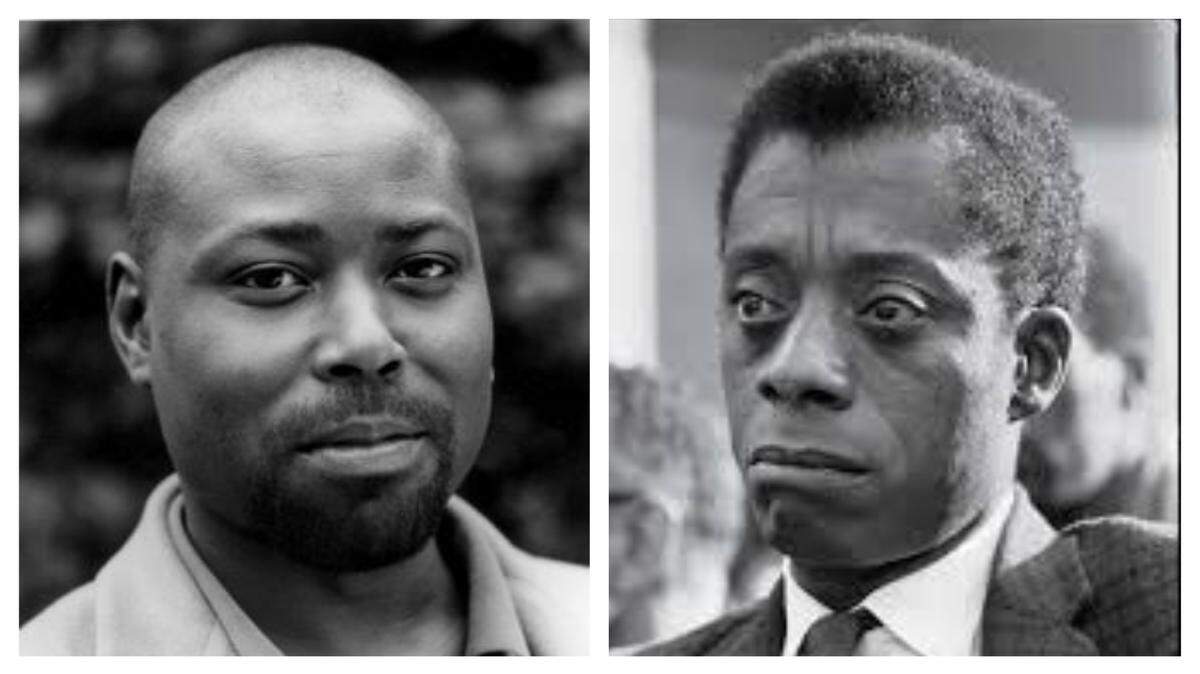
I slide the new book the UNC English professor has edited onto the counter. The 20-year-old clerk scans the big orange letters — “James Baldwin” — above a jazz-cool image of the writer.
Nothing.
“He was an African American writer of the ‘60s and ‘70s,” I say.
Nothing.
“He wrote about civil rights, social justice.”
Nothing
“He edited the book,” I say, gesturing to Kenan standing beside me.
“Oh ... that’s cool.”
Later, as he waits for his chai, Kenan resists a sigh.
He’s gotten used to young people who may not know Baldwin, a writer whose uncompromising social critiques made him a household name when fortysomething Kenan was younger than our barista.
A time when a pop-eyed preacher’s son whose gift for holding a mirror to America’s inequities and admonishing it to do better put him on magazine covers and on stage at civil rights rallies. A time when people still read books.
“The Cross of Redemption, Uncollected Writings by James Baldwin,” (Pantheon, $26.96) brings together essays, letters, book reviews and a short story not previously available in one collection. Kenan, who has written a Baldwin biography and three years ago his own homage to the writer, “The Fire This Time,” was asked to edit the book by Baldwin’s estate.
The following excerpts are from an interview last week.
Q: How did you come to Baldwin, to his writing?
A: When I was a kid he was “the” African-American writer. The only African-American writer who was more famous was Alex Haley, maybe Maya Angelou. ... People in the neighborhood knew who he was. Our minister quoted him from the pulpit; he was that relevant, even in the late ‘70s.
I’m talking the barbershop culture. I mean you’d go to the barbershop, you’d open Jet magazine and there’d be something about Baldwin. You were aware of him on that level.
Q: [The book contains part of a 1961 speech, in which Baldwin says Robert Kennedy has told him one day, maybe in 30 years, Baldwin could be president.] I’m not going to ask you what Baldwin would think of Obama. (Kenan laughs.) But in the speech he flips it. He says why would he want to be president and more importantly, what kind of country would he be presiding over? What would he make of the country today?
A: [Kenan answers the Obama question anyway.] I think he would be giving Obama hard time, like a lot of Black leaders are.
Angela Davis has dedicated herself to the plight of Black men in prison. Marian Wright Edelman has devoted herself to poor Black children. There are still many things he would be fired up about. He would be just as angry in many ways...
The war would have been one thing. So yesterday [when Obama announced the end of U.S. combat in Iraq] would have been good news. A day late and a dollar short, probably.
Q: Can a writer have the influence today that he had then, that a writer might have had 30 years ago?
A: Writers in general were held in higher esteem, or were listened to at least. Organizers wanted him. He was invited to rallies. He was an excellent speaker. It was such a different time...
“The Fire Next Time” was published in its entirety in The New Yorker. He was on the cover of Time magazine. He was on the radio and TV all the time. People wanted to hear what he had to say.
He was one of the voices, like Martin Luther King, like Harry Belafonte, like Vernon Jordan, who had people’s ear.
Q: Why was his race the lens? Why wasn’t his sexuality more of an influence on his writing and the subject of his writing?
A: He was very leery of being co-opted. When you think about the gay rights movement, that didn’t really get off the ground until after Stonewall. That was 1969. He was out as a civil rights leader well before that.
The second novel, “Giovanni’s Room” was about two white [homosexual] men in Europe. He wasn’t running away from it. He was tackling it on another level.
Even before the politics of it coalesced, he was doing his own thing. He probably wouldn’t have used the word gay, but he identified himself as a man-loving man.
Q: What was Baldwin saying about race that we need to hear today?
A: He talks a lot about how to be white in this country, you needed the Black person. That whiteness doesn’t exist without Black people. It comes up again and again in his essays.
Q: That for some people to be on the top others have to be on the bottom?
A: Basically. Other people benefit financially, that it’s a lie in the American soul. And that in order to move beyond that you have to confront that.
Q: [In another excerpt in the new book Baldwin writes, in 1961, that he still believes “we can do something with this country that has not been done before.”] So what was it that he was hoping to get to? What was the country that no one had done before going to be like?
A: It sounds kind of Pollyannaish. But if you look at “Another Country” I think he articulates it there. The sort of Christian egalitarianism He basically was a theologian. He basically did believe in the philosophy of Jesus and the power of Love with a capital L.
The idea is that the concepts that created the United States, the ideas in the Constitution are better than the people who created it. And the thing that animated the civil rights movement was the idea that OK, your ideas are cool, these people are bad, so let’s leap over that to those Jeffersonian ideals. That’s where we’re all trying to get to.
This story was originally published August 30, 2020 at 9:36 AM with the headline "Randall Kenan kept writer James Baldwin’s fire burning."