Problems with electric buses force RDU airport to turn back to diesels
AI-generated summary reviewed by our newsroom.
- RDU board approved up to $4.6 million to refurbish as many as 12 diesel buses.
- Proterra bankruptcy and parts shortages have sidelined many of RDU’s electrics.
- Airport will aim to maintain a mixed fleet, keeping some diesels for reliability.
More than half of the buses that shuttle travelers and employees to and from parking lots at Raleigh-Durham International Airport are electric. They seemed like a good fit for the airport — quieter, smoother, cleaner and ostensibly easier to maintain.
But now the electric buses have become a liability. Mechanical problems and the bankruptcy of Proterra, the company that made most of RDU’s electric buses, have made it difficult to keep them on the road.
That has forced the airport to refurbish some of its aging diesel buses. The RDU Airport Authority board voted Thursday to spend up to $4.6 million to extend the life of as many as a dozen diesels. The board also voiced support for buying new diesels in the future, abandoning a goal of converting the entire fleet to electric or zero-emission vehicles.
“In today’s world, I hate the idea of buying new diesel buses,” said David Kushner, who represents Wake County on the board. “But clearly what we’ve done with the ZEV buses has not worked. So we’ve got to have reliable transportation here.”
RDU was the first to use electric buses in the Triangle, starting in 2019, and has more than any other agency or organization. Electrics account for 18 of the 30 full-size buses that run between RDU’s terminals and its remote parking lots.
But RDU has come to rely more than ever on its 12 diesels, made by Gillig, the newest of which is 10 years old. Most of them have traveled a half million miles or more, usually the end of their expected lifespan, said John Connell, RDU’s chief operating officer.
“Our Gillig fleet has been shouldering the load,” Connell said. “The diesel bus fleet comes in and keeps us going. But they’re showing their age.”
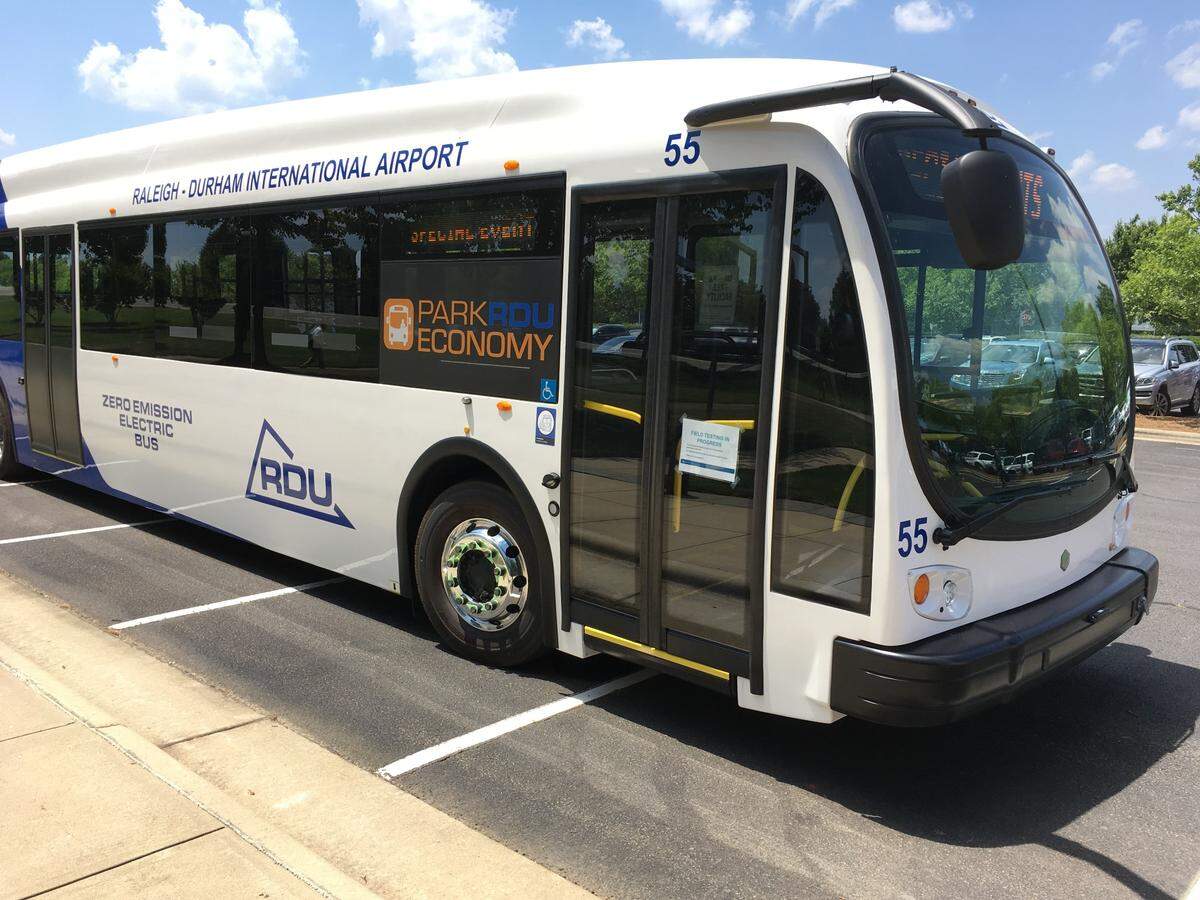
California-based Proterra made 10 of RDU’s electric buses at its plant in South Carolina. The first four arrived in 2019. In 2024, the airport got a bargain price on six more when a transit agency in Miami, Florida, couldn’t pay for them. That same year, the airport ordered eight electrics from New Flyer, and signaled its plans to phase out diesels altogether.
But now RDU’s Proterra buses are operating less than 50% of the time because of various mechanical problems, Connell said. Proterra declared bankruptcy in 2023, and the company that took over its bus business, PhoenixEV, is not providing support, he said.
“Even when our team is able to source a part, beg, borrow and barter — I won’t say steal, we’re not there yet — many times we still have to have the [manufacturer] involved because they’ve got to update software that we don’t have control over,” he said. “So it’s really a struggle.”
Effects of Proterra bankruptcy have rippled nationwide
The failure of Proterra and its buses has vexed airports and transit agencies nationwide. Last spring, Charlotte Douglas International Airport put four of its five Proterra buses up for auction because it couldn’t keep them on the road. Newark Liberty International Airport in New Jersey retired 36 Proterras, the largest fleet on the East Coast, in 2023 for the same reason.
Locally, both of GoTriangle’s Proterra buses are parked because of “a shortage of available parts,” according to a spokesman. Four of GoRaleigh’s five Proterra buses are also out of service, said David Walker, the city’s transportation manager.
“Receiving parts in general has been a significant challenge since the bankruptcy filing,” Walker wrote in an email.
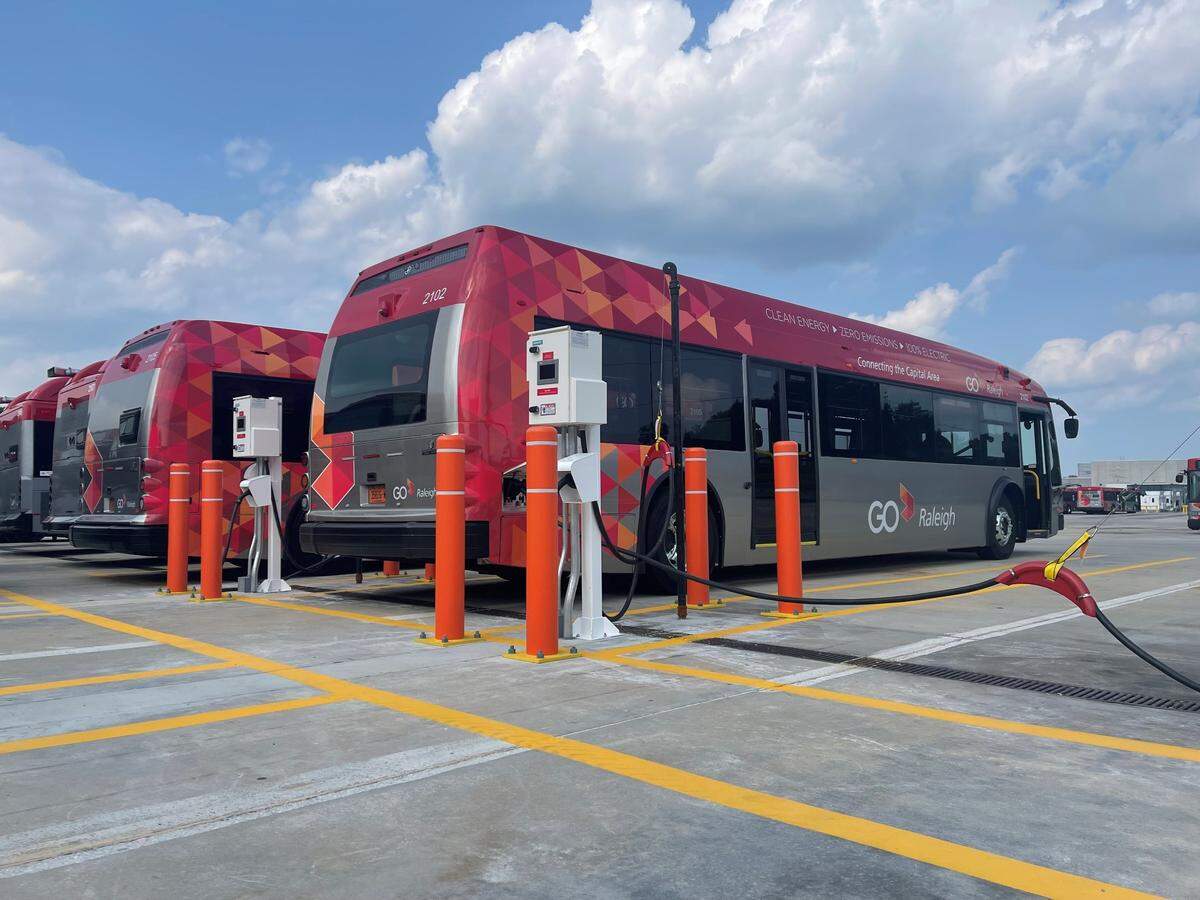
Both GoRaleigh and GoTriangle have dozens of buses that run on diesel or compressed natural gas, so losing the Proterras has not hurt operations. In contrast, Proterra buses represent a third of RDU’s fleet.
“I want to make sure we can deliver somebody in 10 minutes or less,” said Michael Landguth, RDU’s president and CEO. “We have to have a fleet we can rely on. And we can’t rely on the fleet we’ve got today.”
RDU won’t keep all 12 of its old diesels
Refurbishing the diesel buses entails replacing the engine, transmission, drive-train and seats, said fleet manager Brian Mclean. The work will extend the useful life of each bus a minimum of five years, Mclean said.
RDU’s contract with Midwest Bus Corp. calls for overhauling a couple buses at a time over the coming five years, though it’s likely the airport will opt out of refurbishing some of them. Connell and Mclean will return to the board in a few months to propose buying new diesels, rather than refurbish the oldest ones.
RDU is not giving up on electric buses altogether. The airport’s eight New Flyer buses have been running fine so far, Connell said, though they are still less than a year old. He said the Airport Authority will consider buying new EVs in the future.
“I think as time goes on, they’ll be more reliable, and we can maybe work through some of these issues,” he said.
But Connell says RDU will aim to have a “mixed fleet,” of half electric and half diesel buses. The electrics help the airport meet its sustainability goals and are more pleasant for passengers, both inside and out, while for now the diesels are more reliable.
This story was originally published January 15, 2026 at 4:19 PM with the headline "Problems with electric buses force RDU airport to turn back to diesels."