
UNC unveils spring COVID-19 testing. Colleges hope to prevent surge as students return.
Thousands of college students, most now home for the holidays, will be going back to campuses for the spring semester with protocols to help limit the spread of coronavirus, just as they did this fall.
But one big change will be mandatory COVID-19 testing.
At the UNC System Board of Governors meeting last week, President Peter Hans said institutions will do re-entry testing for the spring semester or require students to show a negative COVID-19 test in order to return to campus.
On Monday, UNC-Chapel Hill sent out details of its program.
Hans also sent a letter to chancellors on Nov. 2 suggesting strategies for the end of the fall semester and spring, including re-entry and surveillance testing. Those efforts are intended to keep students and employees safe and keep universities running this spring without serious spikes in cases and disruptions, which happened in the fall.
What colleges require COVID-19 testing?
Over the summer, mass asymptomatic COVID-19 testing was not recommended by the Centers for Disease Control, and some health experts and medical professionals at local universities advised against it. But that’s changed with new research and the experiences of other universities, such as Duke University.
Duke’s COVID-19 testing program will continue this spring, which the university expects to help keep campus open as it did in the fall.
None of the universities in the UNC System required students or employees to be tested for COVID-19 before coming to campus in the fall. While many offered ongoing surveillance testing throughout the semester, it was mostly voluntary.
UNC-Chapel Hill, N.C. State University and East Carolina University each had to send students home, close dorms and move classes online because of spikes in coronavirus cases in August. Now, each is requiring students to get tested for COVID-19 at the start of the spring semester with hopes they won’t have to pivot again.
“This is a fluid process, we’re all learning and changing as we need to,” ECU Vice Chancellor of Student Affairs Virginia Hardy said. “And it takes everybody.”
Hardy said universities can do the mass re-entry and surveillance testing, but it’s up to every student and employee to make this work and see a successful spring semester.
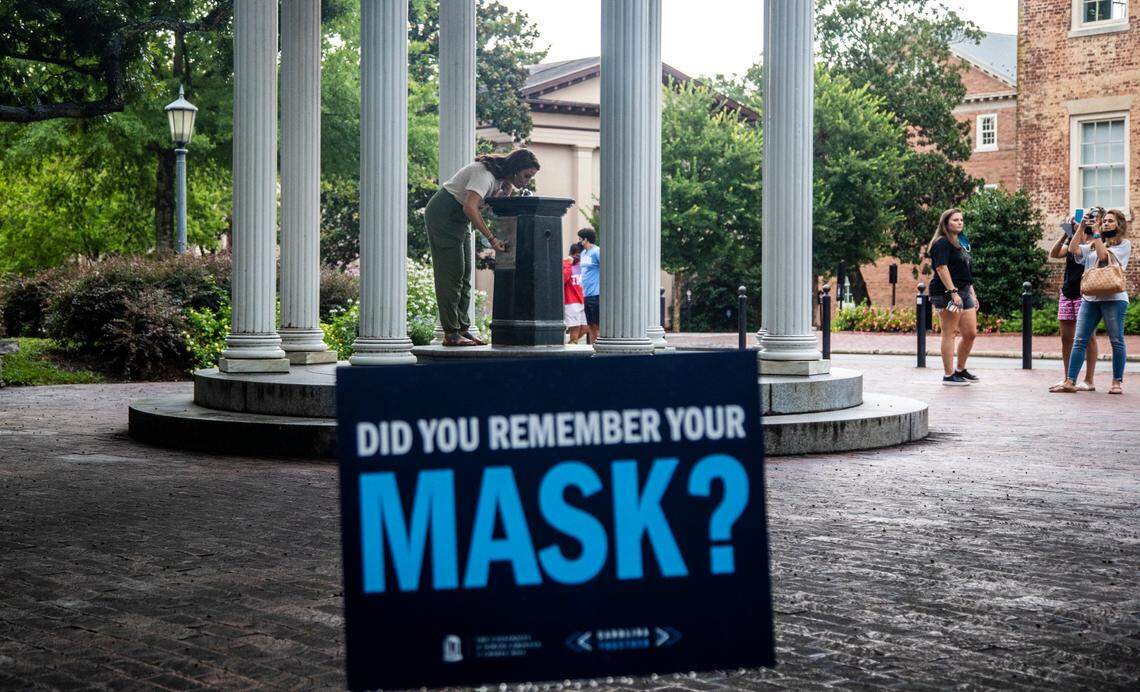
UNC-Chapel Hill
Most UNC-CH students, faculty and staff will be tested for COVID-19 upon returning to campus in January and must participate in regular coronavirus testing throughout the spring semester.
The university plans to have three testing sites that can accommodate more than a dozen students at a time. The sites will be located across campus, near bus routes and will have parking for students to easily access. UNC health professionals say the self-administered tests will take about two minutes to complete, and students should expect results within 48 hours.
UNC Chancellor Kevin Guskiewicz said the university expanded its testing plans for spring based on how the virus spread in Chapel Hill this fall and by looking at what had worked and what hasn’t at other institutions. He also said they know a lot more about testing than they did over the summer.
All undergraduate students living on campus and in Chapel Hill or Carrboro must take a COVID-19 test at home prior to arrival, the university announced Monday. Those students will also do re-entry and regular asymptomatic evaluation testing twice a week throughout the spring semester.
Campus housing will be open for students at a reduced capacity, with about 3,500 students living in single dorm rooms and Granville Towers this spring.
The regular testing for students living in dorms is critical next semester because the “magnitude and velocity of the spread” was greatest in campus residence halls during the fall, Guskiewicz said. UNC didn’t see spread in classrooms, dining halls, student stores or the student union, he said.
“Based on the opinions of infectious disease and public health experts we believe the serial testing throughout the semester will be important to help prevent the spread of the virus,” Guskiewicz said.
Graduate and professional students and post-doctoral fellows are not required to get a COVID-19 test before the spring semester, but can participate in voluntary asymptomatic testing each week.
Graduate students coming to campus to teach, learn or work in a lab will be required to get a COVID-19 test once a week. However, there are exceptions for graduate students in programs where daily symptom checks are required, including the health professions programs. Those living in the area but not accessing campus can get tested weekly.
Faculty and staff working on campus will also be asked to monitor their symptoms before coming to work each day but are not required to get tested this spring. Employees coming to campus can get tested once a week.
The university is still working on the numbers for what it will cost, but UNC is setting up its own laboratory on campus, which will lower the overall cost of the testing program. UNC plans to pay for it with some money from the CARES Act COVID-19 relief fund that it didn’t use in the fall and some reserves within campus health and a few other areas, Guskiewicz said.
NC State University
N.C. State University is testing all students, faculty and staff when they return to campus and is encouraging everyone to get tested before coming back to Raleigh in January.
Students living on campus who don’t have a negative test result will get tested for free on campus during move-in. Students off campus can go to testing sites that will be near the larger apartment complexes and centers. Those test results will have a 24-48 hour turnaround time, but that may go up to 72 hours as demand increases.
Dr. Julie Casani, director of Student Health Services at N.C. State, said the university is doing re-entry testing this spring after seeing the unexpected rapid rise in the number of COVID-19 cases at the start of the fall semester.
“When we saw what were essentially a set of superspreader events in early August stemming from a small number of entry cases, we were stunned,” Casani said in an email to the N&O. “We don’t want to repeat that.”
Casani expects to see more COVID-19 cases after people have gathered indoors over the holidays.
She said re-entry testing will hopefully identify those cases early and students will either delay coming if they are positive or it they identify them on campus, N.C. State can isolate them quickly. The university also plans to amplify its ongoing surveillance testing of students, faculty and staff throughout the semester, particularly among students living in dorms.
Casani didn’t know the exact expected cost, but said it is a significant investment by the university.
“The reality of this pandemic is that it isn’t going away January 19th when we start classes,” Casani said. “Our campus community is large, and we interact not only internally but also externally with the greater Raleigh and Wake County communities so we are impacted by their transmission rates and we impact theirs.”
She said these plans are set to help keep the campus healthy and see the spring semester through without having to pivot again.
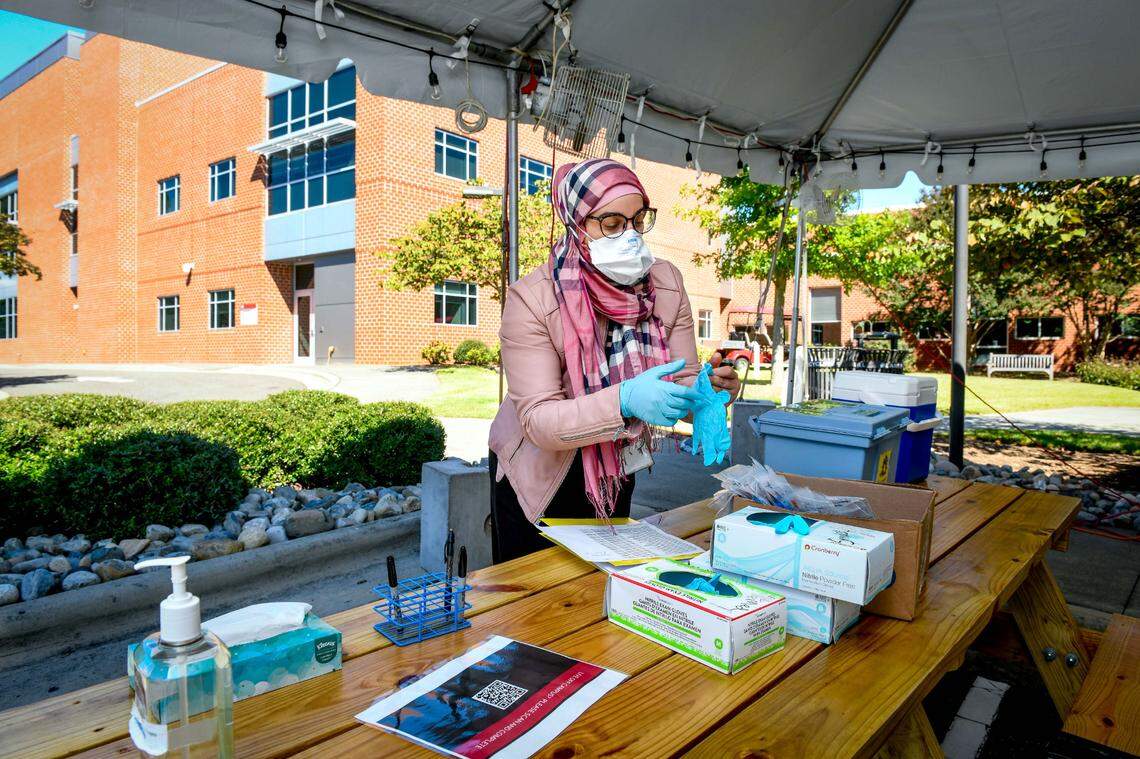
East Carolina University
ECU is requiring re-entry COVID-19 testing for students living on campus next spring. Residential students will need to get a negative test result within seven days of move-in and students living off campus should do the same. Residence halls will open at a reduced capacity, allowing about 1,800 students in single rooms only.
Last fall, ECU had safety measures in place, but didn’t require testing for all students who were back in Greenville. The school mostly tested students with symptoms. When cases spiked in August, the university was forced to move classes online and told students to move out of dorms.
“We all didn’t know what was happening and how to do this in the fall,” Hardy said. “We live and learn and use what we learn to help us tweak our plan and improve our plan.”
Re-entry testing will not be required for students living off-campus or for faculty or staff, but it will be available.
“We are encouraging and educating people even more so about the importance of doing that testing prior to campus or when they get to Greenville,” Hardy said.
ECU will do a round of surveillance testing two weeks into the semester, in anticipation of a possible surge, and then each week throughout the semester for students living on campus. Weekly surveillance testing will also be available for all students, faculty and staff throughout the semester.
The university is working with ECU’s Brody School of Medicine to offer free saliva testing for the asymptomatic surveillance testing, which will make it more accessible and convenient to attract more students. Those tests will get results back in about 24 hours.
“If we have a spike in the asymptotic population, it helps us see ‘hey you have a surge coming,’” said Dr. LaNika Wright, director of ECU Student Health Services.
Seeing those numbers tells the university to do more education and testing in those specific areas, Wright said. Then they can get a better idea of prevalence and what control measure or preventive measure they need to put in place to limit the spread.
With these plans, ECU expects to keep students on campus, living in dorms and taking in-person classes for the entire spring semester.
Appalachian State University
All Appalachian State students returning to residence halls for the spring semester are required to get tested for COVID-19 before coming to campus.
This fall, App State did some testing during move-in week, primarily for students who lived in residence halls, but it was not required for entry. For the spring, residential students must present a negative COVID-19 test.
The university will continue mandatory surveillance testing of athletes, residential students and other students. App State will also still offer weekday testing through Student Health Services and host free testing events for students, faculty and staff throughout the spring semester.
App State is also participating in a wastewater study to help the university identify areas for targeted testing.
University spokesperson Megan Hayes, said it is important to extend testing to students living off campus because that is where the majority of positive cases were found in the fall.
The university is considering mandatory re-entry testing for all students returning to Boone, but it’s challenging logistically, Hayes said in an email to the N&O.
That includes “knowing who is currently living in Boone, ensuring all students have been tested whether or not they are in face-to-face classroom learning environments and ensuring tests have been conducted within a short timeframe of the first day of classes,” she said.
N.C. Central University
Students will get two COVID-19 tests when they return to NC Central’s campus in Durham after winter break.
The Binax rapid antigen tests will gives students results within 15 minutes and the PCR confirmation test will give a laboratory confirmation within 24 to 36 hours. Both tests use short nasal swabs.
Students who test positive with the Binax test will immediately be moved to isolation. All other students will self-quarantine until they get the results from the second test.
N.C. Central will also do surveillance testing starting Jan. 25 at the Walker Complex. Students living in residence halls, student-athletes, students taking face-to-face classes and high-risk individuals will be on rotation throughout the semester for periodic testing, according to the university.
UNC Charlotte
All students living, learning or working on UNC Charlotte’s campus this spring will be required to get tested for COVID-19 before the start of the semester.
Faculty and staff who are working on campus with “frequent/close contact with students or the public during the spring semester” must also get tested, according to the university.
Students and employees can be tested on campus for free Jan. 15-19. They can also go to a health provider off-campus within 72 hours before coming back to campus.
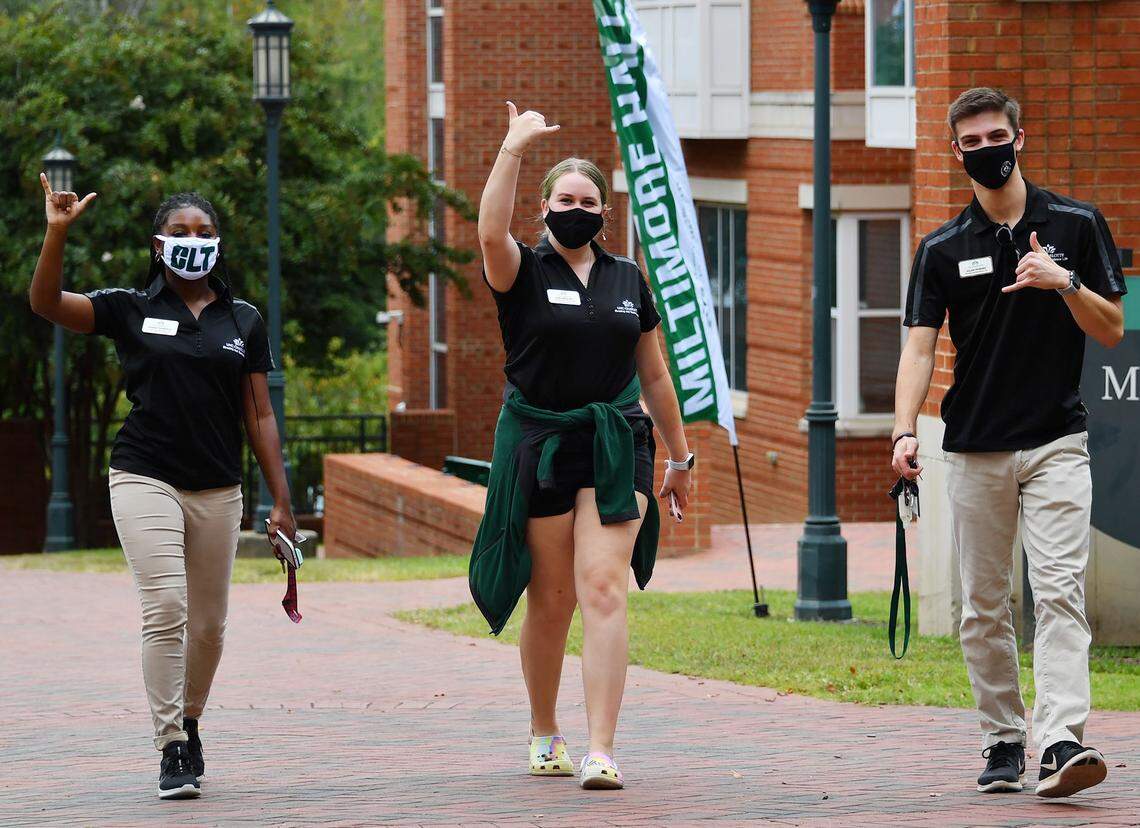
UNC Wilmington
Residential students at UNC Wilmington must provide “an indication of a negative COVID-19 test” three days before returning to campus this spring. The university is asking students who test positive at home not to return to campus until they are released from isolation.
If students don’t get tested at home, they will be tested on campus during move-in.
UNCW also plans to do weekly surveillance testing of students and employees living and working on campus during the spring semester through the Student Health Center.
UNC Greensboro
UNC Greensboro will require residential students to be tested as they return to campus for the spring semester.
North Carolina A&T
NC A&T students living in campus housing will have to send the university results of a negative COVID-19 test before moving back to Greensboro.
University spokesperson Todd Simmons said the university has organized a system for students to get a COVID-19 test in the mail at home from a diagnostics lab, which they will complete between Jan 4 and Jan. 14. Students must return the test to the diagnostics lab and won’t be able to move in until its submitted.
If students test positive, they won’t be able to move in until they’ve finished their isolation period. And if students don’t complete the test and send it in, then their housing contract won’t be honored.
A&T will also continue mass asymptomatic testing of students for free on campus throughout the spring semester.
Elizabeth City State University
Students living on campus at Elizabeth City State University for the spring semester will be required to either present a negative test result taken no more than three days prior to arriving on campus or receive a rapid test upon arriving on campus.
If students test positive for COVID-19, they will be immediately quarantined.
ECSU will also test “high-activity” students weekly, including athletes and ROTC students.
Fayetteville State University
Fayetteville State University will require students to have an entry test for the Spring 2021 semester. Students can get tested through Student Health Services the day they arrive on campus or they can get a COVID-19 test up to 72 hours before their arrival to give the school.
Winston-Salem State University
The university has not announced official details, but all residential and commuter Winston-Salem State students that come to campus will be required to have a COVID-19 test prior to returning to campus, according to university spokesperson Haley Gingles.
Western Carolina University
Students living on campus at Western Carolina will be required to show they tested negative for COVID-19. They will need to provide documentation of a test result taken 3 to 5 days before their scheduled move-in date.
The university encourages, but does not require students living off campus and employees to get tested for COVID-19 before returning to campus this spring.
WCU Health Services will also offer free surveillance testing to students by appointment at the start of spring 2021 classes and throughout the semester.
UNC Pembroke
All residential students and student employees will be required to provide documentation of a negative COVID-19 test taken three to five days prior to returning to UNC Pembroke’s campus. If students living on campus arrive to their dorm or residence hall without test results, they will need to take a rapid antigen COVID-19 test at student health services.
A randomized sample of students who live off campus and are enrolled in in-person classes or work on campus must also submit negative test results.
UNCP will also offer free surveillance testing once a month during the spring semester.
UNC Asheville
At UNC Asheville, residential students must provide documented medical proof of a negative COVID-19 test taken within 72 hours of their scheduled residence hall check-in appointment. If students have not been tested or do not have the results, they will not be allowed access to the residence halls until they provide proof of a negative COVID-19 test result.
UNC School of the Arts
UNCSA faculty, staff and students will all be required to submit a negative COVID-19 test before the spring semester begins on Feb. 8, 2021.
This story will be updated as universities release new information abut COVID-19 testing.
This story was originally published November 23, 2020 at 7:00 AM with the headline "UNC unveils spring COVID-19 testing. Colleges hope to prevent surge as students return.."
